



As coronavirus case rates in much of continental Europe are rising, the UK has been recording a fall in the number of positive tests.
Although the decrease took some by surprise, modellers forecast that instead of soaring as winter approached, case numbers in the UK could decline.
The situation remains finely balanced, however, with some suggestions that numbers may be creeping up again.
UK Prime Minister Boris Johnson said this week he could not rule out a Christmas lockdown if infection rates did continue to climb.
Nonetheless, the recent figures have given cause for optimism only weeks after the English Health Secretary, Sajid Javid, gave a warning that positive tests could more than double to 100,000 a day.
But why does the UK appear to be bucking the upwards trend of many of its neighbours?
The National explains.
What has been happening to UK case numbers?
By mid-to-late October, the UK had seen five successive weeks of increases in the number of positive Covid-19 cases. This fuelled concerns that the country was going to experience a tough winter in which hospitals would be put under extreme pressure, especially given the risk that influenza cases could spiral, too.
In the week beginning on October 18, there were 330,465 confirmed cases, the country's highest figure since January and third-highest since the start of the pandemic.
However, the trend since has been for case numbers to fall by more than 10 per cent each week, although in the last seven days case numbers have crept back up by six per cent to 262,419.
Trends in deaths tend to follow several weeks behind cases. In the latest seven-day period there were 1,093 deaths, 6.9 per cent down on the previous seven-day period.
Hospital admissions have fallen too.
Has the recent fall in cases come as a surprise?
-
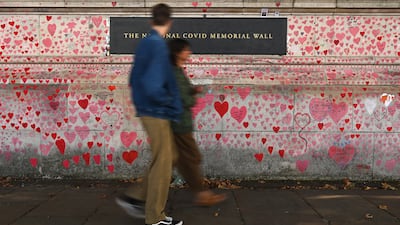
Pedestrians pass the National Covid-19 Memorial Wall, opposite the Palace of Westminster, in London. EPA -
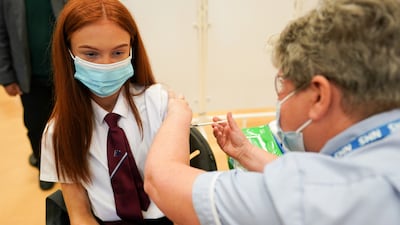
Lauren McLean, 15, receives a Covid-19 vaccine at the Excelsior Academy in Newcastle upon Tyne, in north-east England, as the country begins vaccinating children aged 12 to 15. Getty Images -
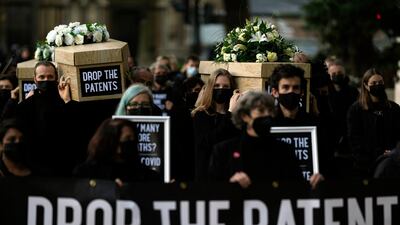
Campaigners carry fake coffins in London to highlight the number of Covid-19 deaths globally. AP -

Most passengers on an underground train on London's Bakerloo Line wear masks as a precaution against Covid-19. AP -
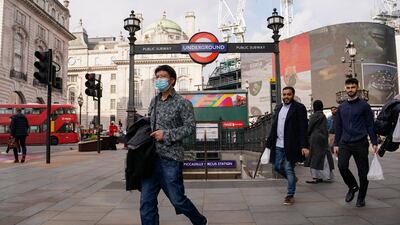
A man wears a face mask as he walks in Piccadilly Circus, in London. The UK has the highest rate of infections in Europe, with new cases averaging 43,000 a day over the past week. AP Photo -
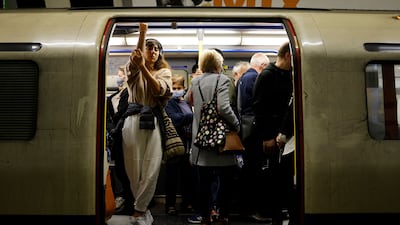
Commuters wait for an underground train to leave from a tube stop in central London. Data up to Sunday showed more than 300,000 confirmed cases reported over the last seven days, a 15 percent increase in cases on the previous week. AFP -
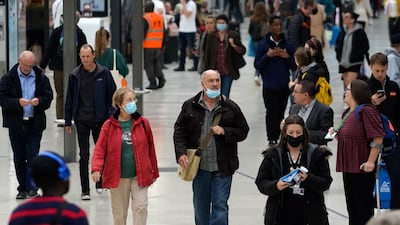
Commuters, some wearing face coverings, walk through Waterloo train station in central London. -

Chelsea fans show vaccine-related paperwork to a Covid-19 steward before entering the club's Stamford Bridge stadium in west London. Reuters -

People attend a candlelit procession and vigil in the northern city Manchester to remember all those who have died due to the pandemic. Getty Images -

Chelsea Pensioner John Byrne talks to Deputy Chief Nurse Vanessa Sloane before receiving a Covid-19 vaccination at the Royal Hospital Chelsea, a retirement home for former soldiers, in London. PA -

A member of staff prepares a Covid-19 vaccine at a pop-up vaccination centre at Westfield Stratford City shopping centre in east London. PA -

Artist Luke Jerram walks through his installation 'In Memoriam', in Bristol, west England. It was created to remember the losses experienced during the Covid-19 pandemic, and is made up of more than 100 flags made from NHS hospital bed sheets. PA -
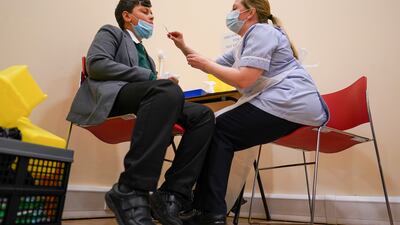
Felix Dima, 13, receives his flu inoculation ahead of receiving a Covid-19 vaccine at the Excelsior Academy in Newcastle upon Tyne. Getty Images


David Taylor, professor emeritus of pharmaceutical and public health policy at University College London, said the UK had some of the world’s best disease modellers in the world – and they had forecast a decline. He highlighted in particular work by Imperial College London and UCL.
A UCL forecast published on November 3, for example, suggested that the number of deaths per day would remain at about 150 then decline slowly.
“[These] models for some months have been indicating that if we maintain levels of vaccination and use the booster, and at the same time there are relatively high numbers of cases in children and young adults, causing immunity with little harm, the outlook for the UK over the winter is good,” Prof Taylor said.
“Although our record is in some ways chequered, on this occasion … it may be that we’re going to see quite a good level of control, although we shouldn’t in any way get complacent.”
What is causing the fall?
In the UK case numbers and death rates over the summer tended to be higher than those of similarly sized countries in Europe.
Young people in particular experienced significant increases in case numbers but more recently, there have been large falls in younger age groups.
Because more young people have now had Covid-19, levels of natural immunity have increased, which means that it is now harder for the virus to spread in people of this age group.
Also, vaccinated people in the UK may have more durable immunity to Covid-19 because first and second doses were spaced further apart then they were on the continent.
The UK has also given 12.6 million people a third “booster” coronavirus vaccine dose, which will help to protect some of the most vulnerable.
What is likely to happen now?
Ian Jones, a professor of virology at the University of Reading in the UK, said case numbers would change in waves. But he said these waves would be more modest than previous ones and a return to a lockdown – which some European nations are now experiencing – was unlikely.
“I think it’s the beginning of the end of the pandemic,” he said. “I think we’re at the end … we’ve just reached it before the continent.
“There are just less susceptible people around now … I don’t want to use the term 'herd immunity', because it’s a difficult concept.
“But you reach the point where the virus is finding it harder to infect people. Even though it can infect vaccinated people, it doesn’t find it easy.”
The UK, he said, was following Israel, which was one of the fastest to distribute vaccinations and has given boosters to four million of its population of 9.4 million. Rates are now low in Israel, with about 20 deaths per week.

