

Saudi Arabia's “blue holes” will soon attract curious scuba divers from all over the globe, scientists in the kingdom are predicting.
The Red Sea has more than 20 of the naturally occurring phenomena, formed when water floods a previously cavernous region, discovered in 2022.
Scientists in the kingdom are now studying three of the holes.
The geology of the Red Sea's blue holes are “unique”, Carlos Duarte, professor of marine science at Saudi Arabia's King Abdullah University of Science and Technology, told The National.
“In terms of its biology, geology and overall diving experience, I will predict they will rise to the top of the bucket list of every scuba diver in the world once these become known globally.”
In August, the kingdom's National Centre for Wildlife released a video calling the research a significant breakthrough in oceanic and marine exploration.
Each blue hole can contain very different biodiversity and can vary in shape, size and depth, said Dr Shannon Klein, research scientist at Kaust.
Some of the holes reach a depth of 400 metres, while the depth of others is not yet known.
Numerous other blue holes remain undiscovered, said a team of researchers after studying the areas of the Red Sea where the phenomena exist.
Some of the Red Sea's blue holes “have not been explored since 1888", Ms Klein said in the Saudi city of Thuwal.
The blue holes are “almost like a natural laboratory for us to study”, containing “things that have not really been seen for well over 100 years”, she said.
They are becoming a popular tourist destination and are providing opportunities for studies and research in marine biodiversity.
What are blue holes?
Blue holes are a unique ecosystem and geological formation rich in biodiversity and a haven for a wide variety of marine creatures such as sea turtles, fish, marine mammals and invertebrates, Mr Duarte told The National.
The holes are known in carbonate formations “across the world – in Belize, China and even a modest one in UAE”, he said.
-
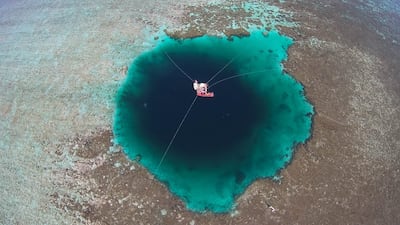
The worlds deepest blue hole is Dragon Hole in the South China Sea. Photo: Wikimedia -

Dean's Blue Hole, Long Island, Bahamas. Photo: Wikimedia -
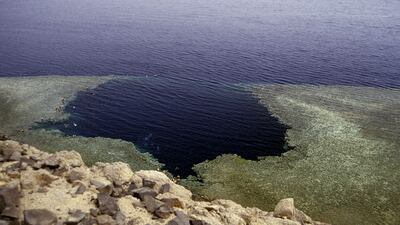
Blue Hole is off the Sinai Peninsula on Egypt’s Red Sea coast. Photo: Wikimedia -
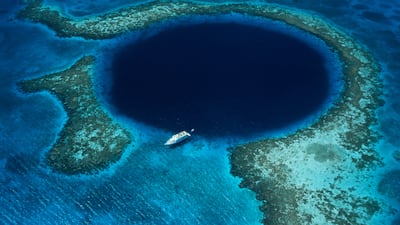
Great Blue Hole lies about 40 miles off the coast of Belize. Getty


They are formed by the dissolution of the underlying carbonate, leading to the formation of the deep hole surrounded by a shallow reef, which gives the impression of a deep blue colour.
With limited oxygen, only creatures that can adapt to the environment can survive.
What is unique about them?
In 2022, Saudi Arabia's National Centre for Wildlife partnered with the non-profit ocean exploration organisation OceanX and Kaust for a four-month comprehensive study of the area.
“The Red Sea is one of the least explored bodies of water, yet it is rich with scientific data and information of great global significance,” said Vincent Pieribone, vice chairman of OceanX at the time.
In 2022, more than 20 blue holes were discovered along the southern Saudi coasts of the Red Sea.
Mohammad Ali Qurban, chief executive of the National Centre for Wildlife, said last week that the blue holes are rich in biodiversity, hosting new, healthy coral reefs. The bottoms of the holes can have a completely different set of biodiversity, he said.
Mr Duarte said the investigated area is a labyrinth of coral that is “very difficult to navigate”, extending more than 500km along the shore and about 150km offshore. It is the third-largest continuous coral reef ecosystem in the ocean, he said, behind those in Australia and Belize.
“We found, in internal waters of the labyrinth, a vast expand of open water, surrounded by very shallow reefs, therefore impossible to penetrate by vessels,” he said.

“A complex [series] of blue holes consisting of blue rings, cylindrical structures of 1km in diameter, rising up to 400 metres from the sea floor, with deep 50 to 80-metre lagoons inside and a formation of sunken lagoons representing much deeper, 400 to 600-metre sink holes with extraordinary features.
“We explored just four of these structures and there are many more awaiting to be explored. It is inspiring to see that still in the 21st century major discoveries await us in the ocean, not just far away, but also at the doorsteps of our own waters.”
Future Red Sea projects
In 2022, the Red Sea Development Company revealed plans for a state-of-the-art Marine Life Institute to showcase the country's rich biodiversity and conservation.
It will bridge “educational exhibitions with adventure-filled excursions”, the Saudi Press Agency reported.

John Pagano, chief executive of TRSDC, said the institute will have 10 zones featuring augmented reality experiences, night diving and spaces for the scientific community to work on projects.
The kingdom's Heritage Commission launched a research project in 2022 to explore underwater sites in the Red Sea.
The Survey of Underwater Cultural Heritage Project is to explore more than 25 underwater sites along in areas including Umluj, Ras Sheikh Humaid, Duba, Al Wajh and others to recover artefacts and collect samples for analysis and documentation.
As part of Saudi Green Initiative, the kingdom has committed to protecting 30 per cent of its terrestrial and marine area by 2030.

