



Faisal Malikah's love for non-venomous snakes has evolved from having just one when he was five to ultimately crossbreeding dozens to produce “live art” in unique colours and patterns.
In the garden of his palace in Saudi Arabia's Red Sea city of Jeddah, the 35-year-old Saudi businessman has a sign on the wall in green block letters that reads: “The Snake Room”.
“There are people who collect precious stones or classical cars or paintings; as for me, I like to collect live art,” the father of three told AFP, referring to his collection of more than 100 reticulated pythons – the world's longest snake – from South-East Asia.
“They are popular in the fashion industry, where their skin is used to make bags, shoes and belts, but one out of every 1,000 snakes hunted is one with a rare colour," he said.
“The hunters sell the unique-coloured snakes to collectors like myself … and I crossbreed to produce rare genetic mutations with patterns and colours unseen before,” he said, pointing at a gold and grey-dotted white snake wrapped around his left arm.
Mr Malikah said he had no interest in selling to fashion brands, criticised by animal rights groups for their unethical use of animal skins.
“I value life, so I love [the snakes] alive and not as bags or shoes,” the breeder said.
In the air-conditioned room, the creatures slither around in large glass-encased boxes, with holes just big enough for them to flick their tongues out.
-
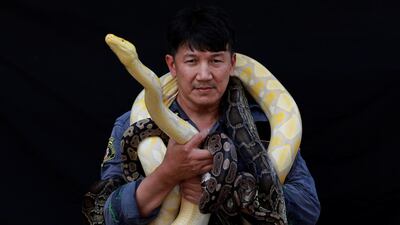
Firefighter Pinyo Pukpinyo, known as 'snake wrangler', poses for a photograph with pythons of which some were caught by him, in Bangkok, Thailand. All photos by Reuters -
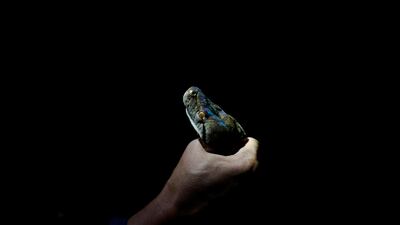
Pukpinyo holds a python he caught at home. -
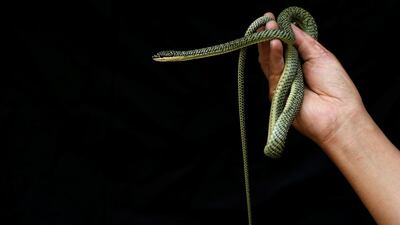
Pukpinyo shows an ornate gliding snake which he caught. -
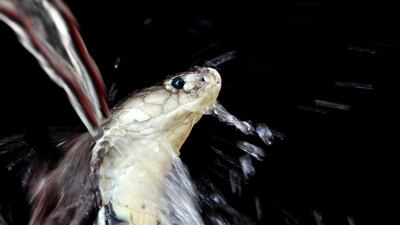
Pukpinyo washes a snake at a fire station. -

Pukpinyo shows a Bungarus fasciatus snake. -
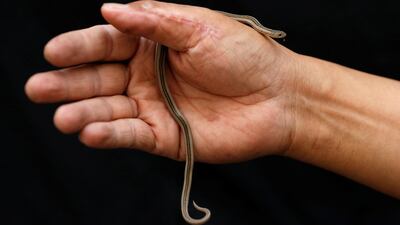
Pukpinyo shows a kukri snake. -

A white-lipped pit viper snake is seen at a fire station. -
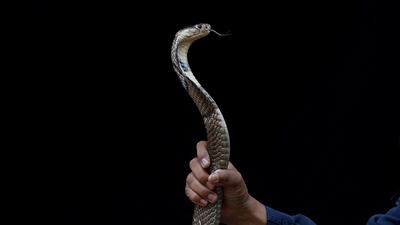
Pukpinyo shows a cobra snake. -

Snake catching equipment is displayed at a fire station. -

Pukpinyo shows a copperhead rat snake.


Sawdust lines the floor of the boxes, absorbing odours from the snakes' droppings.
Crossbreeding the pythons takes time and patience, said Mr Malikah.
It takes “three or four generations … and about 10 to 12 years” to produce a tri-coloured snake, he said.
In the wild, pythons are constrictors – meaning they coil their bodies around their prey and squeeze until it dies, swallowing it whole. They are not venomous.
At the palace, Mr Malikah feeds them chicken or rabbit once a week.
'Some worth $100,000'
Working alongside Mr Malikah is his friend, 32-year-old Ibrahim Al Sharif.
Mr Al Sharif said Mr Malikah, the chief executive of a finance company, had spared no expense, bringing in specialists from the US to learn more about crossbreeding and mutations.
“Malikah has spent lots of time, effort and money on this hobby,” he said.
In one of the enclosures is a six-metre (20-foot) white python with golden markings. The eight-year-old snake weighs 100 kilograms (220 pounds) and moves with great effort.
“The snakes I have are unlike any in the world or very rare, some worth $100,000,” said Mr Malikah.
But he said most of his snakes were worth between $200 and $20,000 each.
For Mr Malikah, living among the widely feared creatures is a dream come true.
“Since I was a boy, I would go to libraries looking for books about snakes and reptiles,” he said.
“You can say that I have always lived in an atmosphere of a biology class."
While collecting snakes may have been an unusual hobby for a child, Mr Malikah said his family never had a problem with it.
“These are mysterious creatures, and it is natural for people to be afraid of them … but I love them, especially that they are my creations.”

