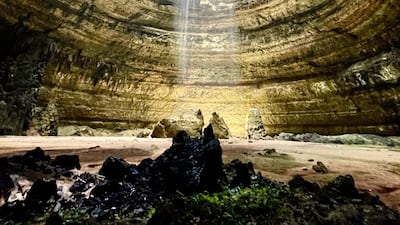
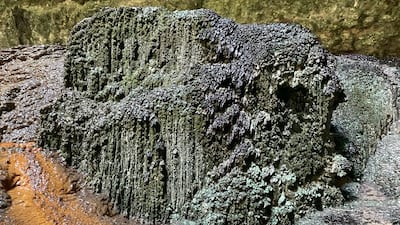
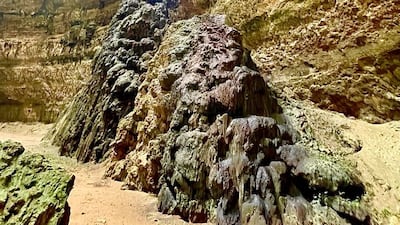
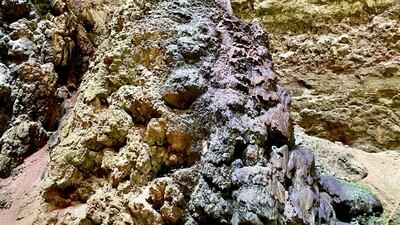
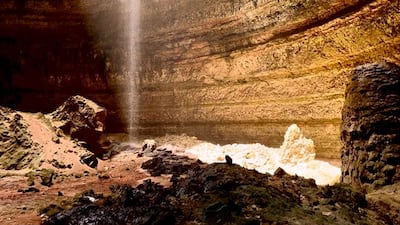
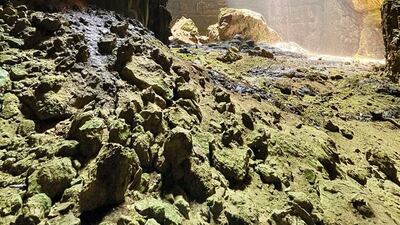
With nerves of steel, Mohammad Al Kindi descended through a 30-metre hole in the desert into the foreboding underground cave near Yemen's border with Oman.
Mohammad and a team of Omani cavers recently found out what exactly lay at the bottom of this geological structure known locally as the Well of Barhout or the Well of Hell in Al Mahra region, a mysterious place that has long been the subject of much mythology and folklore.
“Some say it is where apostates and non-believers are tortured after death," the geologist and owner of the Earth Sciences Consultancy Centre tells The National. "Others believe that their heads would be severed once they’re down there.
I was the last one to climb in and the last one to leave. I spent about six hours down there
Mohammad Al Kindi,
cave explorer and geologist
What they found may have been spellbinding, but he says neither he nor his seven teammates felt the effects of any curse.
“They say that Makkah’s Zamzam water is the holiest and purest on earth and that the water from the Well of Hell is the most evil,” he says. “All we saw was pure freshwater down there. We even drank an entire bottle and nothing happened to us!"
Mohammad says he’s always had a passion for natural formations and cave exploration.
“I live in a mountainous area. I have been visiting caves since I was a child,” he says.
But his quest into the belly of the mythical chasm was unlike any other of his adventures. “I was the last one to climb in and the last one to leave. I spent about six hours down there,” he says.
Using surveying equipment and gas detectors, Mohammad and the team found the sinkhole was indeed possessed – by normal levels of oxygen and poison-free air – and he says there was a high number of snakes.
"They procreate when there are no predators to eat them,” he explains. “That's normal."
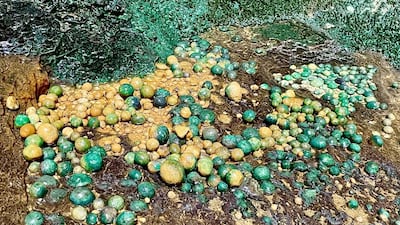
The most magical elements he saw were the cave pearls that shone through underground waterfalls.
“Cave pearls are concentric calcium carbonate deposits that form around nuclei under falling water. These rings are smoothed by the movement of water falling for thousands of years until they form beautiful pearl shapes,” he said.
With the sinkhole steeped in local folklore, many brave Yemenis and some scientific expeditions claim to have entered and returned, but Mohammad says he saw no indications of any human encroachment at the bottom.
“There were no footprints or other signs of disturbances,” he says. “None of the prior missions there have been documented so it’s unclear whether anyone had actually gone down there, although it’s difficult to be 100 per cent certain.”
Mohammad hopes that with his visit to the bottom of the Well of Hell, his findings can dispel some of the myths surrounding the cave and other similar sites.
"I believe that the Well of Hell, known as Barhout, is a legendary cave assigned to many caves in Yemen. Now that we have gone to Khasfat Foujit, the cave should not be called by any other name than the area it is in."
To make sure there is no demonic phenomenon at other similar sites, Mohammad now plans to visit the Hadramout region in Yemen to investigate whether a similar sinkhole could hold the secrets of the underworld.
“I have no doubt that the one in Hadramout will also be normal, and even small. But with the right conditions, we will go and find out," he says.
more from Janine di Giovanni
THE BIO
Favourite author - Paulo Coelho
Favourite holiday destination - Cuba
New York Times or Jordan Times? NYT is a school and JT was my practice field
Role model - My Grandfather
Dream interviewee - Che Guevara
THE BIO
Ms Davison came to Dubai from Kerala after her marriage in 1996 when she was 21-years-old
Since 2001, Ms Davison has worked at many affordable schools such as Our Own English High School in Sharjah, and The Apple International School and Amled School in Dubai
Favourite Book: The Alchemist
Favourite quote: Failing to prepare is preparing to fail
Favourite place to Travel to: Vienna
Favourite cuisine: Italian food
Favourite Movie : Scent of a Woman
Ten tax points to be aware of in 2026
1. Domestic VAT refund amendments: request your refund within five years
If a business does not apply for the refund on time, they lose their credit.
2. E-invoicing in the UAE
Businesses should continue preparing for the implementation of e-invoicing in the UAE, with 2026 a preparation and transition period ahead of phased mandatory adoption.
3. More tax audits
Tax authorities are increasingly using data already available across multiple filings to identify audit risks.
4. More beneficial VAT and excise tax penalty regime
Tax disputes are expected to become more frequent and more structured, with clearer administrative objection and appeal processes. The UAE has adopted a new penalty regime for VAT and excise disputes, which now mirrors the penalty regime for corporate tax.
5. Greater emphasis on statutory audit
There is a greater need for the accuracy of financial statements. The International Financial Reporting Standards standards need to be strictly adhered to and, as a result, the quality of the audits will need to increase.
6. Further transfer pricing enforcement
Transfer pricing enforcement, which refers to the practice of establishing prices for internal transactions between related entities, is expected to broaden in scope. The UAE will shortly open the possibility to negotiate advance pricing agreements, or essentially rulings for transfer pricing purposes.
7. Limited time periods for audits
Recent amendments also introduce a default five-year limitation period for tax audits and assessments, subject to specific statutory exceptions. While the standard audit and assessment period is five years, this may be extended to up to 15 years in cases involving fraud or tax evasion.
8. Pillar 2 implementation
Many multinational groups will begin to feel the practical effect of the Domestic Minimum Top-Up Tax (DMTT), the UAE's implementation of the OECD’s global minimum tax under Pillar 2. While the rules apply for financial years starting on or after January 1, 2025, it is 2026 that marks the transition to an operational phase.
9. Reduced compliance obligations for imported goods and services
Businesses that apply the reverse-charge mechanism for VAT purposes in the UAE may benefit from reduced compliance obligations.
10. Substance and CbC reporting focus
Tax authorities are expected to continue strengthening the enforcement of economic substance and Country-by-Country (CbC) reporting frameworks. In the UAE, these regimes are increasingly being used as risk-assessment tools, providing tax authorities with a comprehensive view of multinational groups’ global footprints and enabling them to assess whether profits are aligned with real economic activity.
Contributed by Thomas Vanhee and Hend Rashwan, Aurifer
Mohammed bin Zayed Majlis
Sri Lanka-India Test series schedule
1st Test July 26-30 in Galle
2nd Test August 3-7 in Colombo
3rd Test August 12-16 in Pallekele
Fines for littering
In Dubai:
Dh200 for littering or spitting in the Dubai Metro
Dh500 for throwing cigarette butts or chewing gum on the floor, or littering from a vehicle.
Dh1,000 for littering on a beach, spitting in public places, throwing a cigarette butt from a vehicle
In Sharjah and other emirates
Dh500 for littering - including cigarette butts and chewing gum - in public places and beaches in Sharjah
Dh2,000 for littering in Sharjah deserts
Dh500 for littering from a vehicle in Ras Al Khaimah
Dh1,000 for littering from a car in Abu Dhabi
Dh1,000 to Dh100,000 for dumping waste in residential or public areas in Al Ain
Dh10,000 for littering at Ajman's beaches
MATCH SCHEDULE
Uefa Champions League semi-final, first leg
Tuesday, April 24 (10.45pm)
Liverpool v Roma
Wednesday, April 25
Bayern Munich v Real Madrid (10.45pm)
Europa League semi-final, first leg
Thursday, April 26
Arsenal v Atletico Madrid (11.05pm)
Marseille v Salzburg (11.05pm)
Mercer, the investment consulting arm of US services company Marsh & McLennan, expects its wealth division to at least double its assets under management (AUM) in the Middle East as wealth in the region continues to grow despite economic headwinds, a company official said.
Mercer Wealth, which globally has $160 billion in AUM, plans to boost its AUM in the region to $2-$3bn in the next 2-3 years from the present $1bn, said Yasir AbuShaban, a Dubai-based principal with Mercer Wealth.
“Within the next two to three years, we are looking at reaching $2 to $3 billion as a conservative estimate and we do see an opportunity to do so,” said Mr AbuShaban.
Mercer does not directly make investments, but allocates clients’ money they have discretion to, to professional asset managers. They also provide advice to clients.
“We have buying power. We can negotiate on their (client’s) behalf with asset managers to provide them lower fees than they otherwise would have to get on their own,” he added.
Mercer Wealth’s clients include sovereign wealth funds, family offices, and insurance companies among others.
From its office in Dubai, Mercer also looks after Africa, India and Turkey, where they also see opportunity for growth.
Wealth creation in Middle East and Africa (MEA) grew 8.5 per cent to $8.1 trillion last year from $7.5tn in 2015, higher than last year’s global average of 6 per cent and the second-highest growth in a region after Asia-Pacific which grew 9.9 per cent, according to consultancy Boston Consulting Group (BCG). In the region, where wealth grew just 1.9 per cent in 2015 compared with 2014, a pickup in oil prices has helped in wealth generation.
BCG is forecasting MEA wealth will rise to $12tn by 2021, growing at an annual average of 8 per cent.
Drivers of wealth generation in the region will be split evenly between new wealth creation and growth of performance of existing assets, according to BCG.
Another general trend in the region is clients’ looking for a comprehensive approach to investing, according to Mr AbuShaban.
“Institutional investors or some of the families are seeing a slowdown in the available capital they have to invest and in that sense they are looking at optimizing the way they manage their portfolios and making sure they are not investing haphazardly and different parts of their investment are working together,” said Mr AbuShaban.
Some clients also have a higher appetite for risk, given the low interest-rate environment that does not provide enough yield for some institutional investors. These clients are keen to invest in illiquid assets, such as private equity and infrastructure.
“What we have seen is a desire for higher returns in what has been a low-return environment specifically in various fixed income or bonds,” he said.
“In this environment, we have seen a de facto increase in the risk that clients are taking in things like illiquid investments, private equity investments, infrastructure and private debt, those kind of investments were higher illiquidity results in incrementally higher returns.”
The Abu Dhabi Investment Authority, one of the largest sovereign wealth funds, said in its 2016 report that has gradually increased its exposure in direct private equity and private credit transactions, mainly in Asian markets and especially in China and India. The authority’s private equity department focused on structured equities owing to “their defensive characteristics.”
'C'mon C'mon'
Director:Mike Mills
Stars:Joaquin Phoenix, Gaby Hoffmann, Woody Norman
Rating: 4/5
Moon Music
Artist: Coldplay
Label: Parlophone/Atlantic
Number of tracks: 10
Rating: 3/5
Our family matters legal consultant
Name: Hassan Mohsen Elhais
Position: legal consultant with Al Rowaad Advocates and Legal Consultants.
Company profile
Date started: 2015
Founder: John Tsioris and Ioanna Angelidaki
Based: Dubai
Sector: Online grocery delivery
Staff: 200
Funding: Undisclosed, but investors include the Jabbar Internet Group and Venture Friends
Living in...
This article is part of a guide on where to live in the UAE. Our reporters will profile some of the country’s most desirable districts, provide an estimate of rental prices and introduce you to some of the residents who call each area home.
What is Folia?
Prince Khaled bin Alwaleed bin Talal's new plant-based menu will launch at Four Seasons hotels in Dubai this November. A desire to cater to people looking for clean, healthy meals beyond green salad is what inspired Prince Khaled and American celebrity chef Matthew Kenney to create Folia. The word means "from the leaves" in Latin, and the exclusive menu offers fine plant-based cuisine across Four Seasons properties in Los Angeles, Bahrain and, soon, Dubai.
Kenney specialises in vegan cuisine and is the founder of Plant Food Wine and 20 other restaurants worldwide. "I’ve always appreciated Matthew’s work," says the Saudi royal. "He has a singular culinary talent and his approach to plant-based dining is prescient and unrivalled. I was a fan of his long before we established our professional relationship."
Folia first launched at The Four Seasons Hotel Los Angeles at Beverly Hills in July 2018. It is available at the poolside Cabana Restaurant and for in-room dining across the property, as well as in its private event space. The food is vibrant and colourful, full of fresh dishes such as the hearts of palm ceviche with California fruit, vegetables and edible flowers; green hearb tacos filled with roasted squash and king oyster barbacoa; and a savoury coconut cream pie with macadamia crust.
In March 2019, the Folia menu reached Gulf shores, as it was introduced at the Four Seasons Hotel Bahrain Bay, where it is served at the Bay View Lounge. Next, on Tuesday, November 1 – also known as World Vegan Day – it will come to the UAE, to the Four Seasons Resort Dubai at Jumeirah Beach and the Four Seasons DIFC, both properties Prince Khaled has spent "considerable time at and love".
There are also plans to take Folia to several more locations throughout the Middle East and Europe.
While health-conscious diners will be attracted to the concept, Prince Khaled is careful to stress Folia is "not meant for a specific subset of customers. It is meant for everyone who wants a culinary experience without the negative impact that eating out so often comes with."