


Residents in the Gulf region should be more careful with how they use water, experts have urged, at a time when the region faces growing challenges in conserving supplies due to climate change and population growth.
A new analysis of the Gulf Co-operation Council’s water resources says the public has so far not responded adequately to public media campaigns to cut water use.
The study, Water resources availability, sustainability and challenges in the GCC countries: an overview – published in the science journal Heliyon – says there are areas in the region that have had as much as 80 per cent of underground water reserves exhausted, while some reserves are becoming saline because excessive extraction of freshwater is causing intrusion by seawater.
The research says that "extensive awareness campaigns" must be adopted to encourage behavioural change and to reduce wastage of drinking water.
"Although several GCC ministries and water authorities have initiated such awareness activities, including advertisements, media campaigns, water days, and in some cases the distribution of efficient water fixtures, the outcomes are still not satisfactory," the authors wrote.
Drinking water should not be used for irrigating back gardens, for example, as lower-quality supplies could be used instead.
Improved educational campaigns in schools and universities, along with incentives to promote water conservation, may also be needed, according to the researchers.
The study also highlights that GCC governments are investing heavily in renewable desalination, following decades in which carbon-intensive plants have been relied upon.
The Middle East is one of the most highly stressed water regions in the world, with high population growth, low rainfall and high temperatures increasing evaporation, which places great demand on water resources.
Higher water use
Water supplies are subsidised in the region and tariffs should be amended to manage demand, say the authors of the study, two of whom are at UAE University in Al Ain.
The GCC’s average annual water use per person of 200 cubic metres is high by international standards, 1.6 times the figure of the UK, for example, although agriculture is a key user alongside domestic, industrial and other demands.
Dr Nasser Karami, a water resources and climate change researcher who runs Mena Era, a Norwegian-based institute that aids vulnerable societies facing threats from climate change and environmental degradation, said in some parts of the region rainfall had declined by as much as 20 per cent, which puts further pressure on supplies.
The Mena region already has "very fragile ecosystems" and small changes could have significant impacts on landscapes, including the water resources within them, he said.
However, Dr Karami, who was not connected with the new study, said poorer nations would struggle to cope with the effects of climate change on the amount of available water.
"Some countries, for example the UAE and Bahrain, they have enough money to adapt to these conditions," he said. "It won’t be so easy in Somalia, Sudan, Iraq or Syria."
World Water Day around the world – in pictures
-
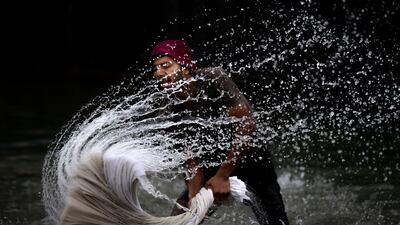
A man washes clothes on the banks of the river Brahmaputra on World Water Day (March 22) in Guwahati, India. AP Photo -

The cracked earth of the Sau reservoir north of Barcelona, Spain. AP Photo -
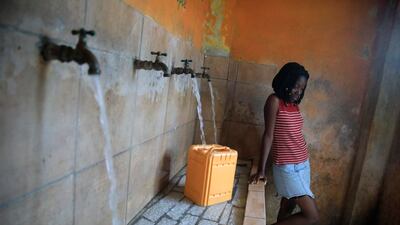
With no running water at home, a woman fills a container at a water fill station in Port-au-Prince, Haiti. AP Photo -

Carmelo Del Valle, displaced from his home by the rising waters of the Paraguay River, fills buckets to haul to his temporary shelter in Asuncion, Paraguay. AP Photo -

Women carry water on the outskirts of Sanaa, Yemen. More than 17 million of Yemen's 30-million population lack access to safe water, the UN says. EPA -
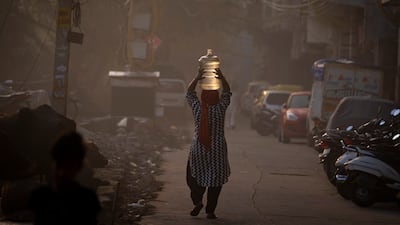
A woman returns home after collecting drinking water from a tanker on World Water Day in New Delhi, India. Wednesday is the 30th anniversary of World Water Day. AP Photo -
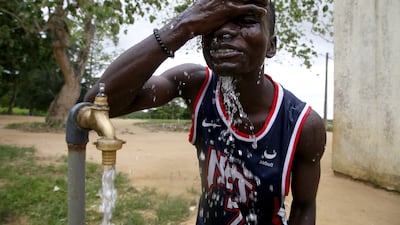
A man in Abidjan, Ivory Coast, a day before World Water Day. Ivorian Prime Minister Patrick Achi announced an investment of about $5 billion to achieve universal access to drinking water by 2030. EPA -
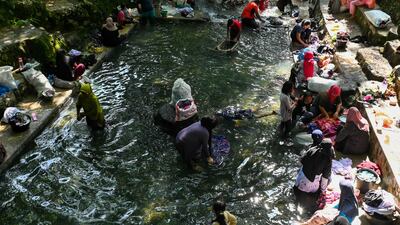
People wash clothes in a public pool of spring water in Japakeh, Indonesia, on World Water Day. AFP -

A photograph taken on March 16, 2023 shows the dried-up lake Serre-Poncon, near Embrun in the French Alps. AFP -

A woman washing up outside her house in a slum on the eve of World Water Day in Mumbai, India. AP Photo -
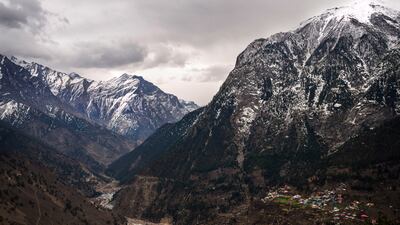
The Satluj river in the valley below the snowy peaks in Kinnaur district of the Himalayan state of Himachal Pradesh, India. AP Photo -

Wind pumps in Kinderdijk, Netherlands. The pumps prevent the region from being flooded, since a third of the Netherlands lies below sea level. AP Photo -

Franklin Caceres checks a water pump used to collect water from a well in the Petare neighborhood of Caracas, Venezuela. Caceres supplies water to more than 400 people. AP Photo -

A man puts empty water containers back on a lorry belonging to a private distributor in Caracas, Venezuela. AFP


In parts of Saudi Arabia, 80 per cent of deep underground aquifer water reserves have been exhausted, the study in Heliyon states, in part because of huge extraction for agriculture, which consumes more than 80 per cent of the GCC’s total available water resources.
The researchers say previous studies had found groundwater reserves in the UAE were "depleting rapidly due to over-exploitation and lack of recharge".
As more water is extracted from underground reserves, seawater intrusion has become "a major challenge in the GCC countries", the authors say, a problem likely to intensify as sea levels rise because of climate change.
While the new study praises some for their efficient use of wastewater – notably Dubai, where 90 per cent is treated and reused – the authors say that in the GCC as a whole, treated wastewater is "squandered" and not reused for every day purposes such as flushing toilets, in air-conditioning systems, in fountains and for extinguishing fires.
"Major efforts are needed to raise awareness among the public about the acceptance and safety of the use of treated wastewater," the researchers said.
"Farming communities may also need to be encouraged to utilise sewage sludge instead of artificial manure, as it does not have harmful impacts on crops."
Dubai Municipality has set a target of recycling 100 per cent of the emirate's wastewater by 2030 as part of its sustainability strategy.
Renewable desalination
As with its neighbours, a deficit in natural water reserves has led the Emirates to invest heavily in desalination plants.
About 42 per cent of the UAE’s water demands are provided for by desalination, while in Saudi Arabia it is 50 per cent (the country accounts for 10 per cent of global desalination capacity) and in Qatar, it is as much as 87 per cent.

Many desalination plants have been carbon-intensive and have caused, the study notes, air pollution and other environmental harms.
"Significant amounts of heavy metals are observed in the vicinity of fossil fuel-operated desalination plants," the study said.
"The high salinity and temperature of the discharged brine lower the dissolved oxygen concentration in seawater, which can adversely influence neighbouring ecosystems."
However, the analysis notes that there are increasing investments in renewable desalination technology, including in Dubai and Abu Dhabi.
Authorities in the Emirates are planning for the long term, having previously announced the UAE Water Security Strategy 2036 to ensure the country has adequate water supplies for both normal and emergency conditions. The programme includes an aim to cut total water demand by 21 per cent.
In Dubai, new reverse osmosis desalination facilities are coming onstream, such as at Jebel Ali Power Plant and Desalination Complex and the Hassyan Power Complex.
The UAE is also focusing on aquifer storage and recovery, where desalinated water is used to replenish aquifers, the underground rocks that store water.
Prof Jos Lelieveld, who researches climate change in the Middle East and Mediterranean at the Max Planck Institute for Chemistry in Germany and The Cyprus Institute, said with rainfall "already very small in most of the Middle East", many countries were likely to be able to cope with changes in precipitation patterns brought about by climate change.
"In the region, they have to rely on hydrological [resources] or desalination. That’s not going to change much," he said, adding that population increases could cause "a major stress" on water supplies.

