

The US Navy sailed its first drone boat through the strategic Strait of Hormuz on Wednesday, a crucial waterway for global energy supplies where American sailors often face tense encounters with Iranian forces.
The trip by the L3 Harris Arabian Fox Mast-13, a 13m speedboat carrying sensors and cameras, drew the attention of Iran's Revolutionary Guard, but took place without incident, said Navy spokesman Cmdr Timothy Hawkins. Two US Coast Guard cutters, the Charles Moulthrope and the John Scheuerman, accompanied the drone.
The drone and accompanying ships passed safely through the strait, a busy waterway between Iran and Oman which at its narrowest is just 33km wide. A fifth of all oil traded passes through the strait, which connects the Persian Gulf with the Gulf of Oman.
“The Iranians observed the unmanned surface vessel transiting the strait in accordance with international law,” Cmdr Hawkins told the Associated Press. He said an Iranian drone and at least one Houdong-class fast-attack vessel operated by Iran's paramilitary Revolutionary Guard observed the Mast-13 drone.
The US Navy's Bahrain-based Fifth Fleet patrols Middle East waters, particularly the Arabian Gulf and the Strait of Hormuz, to keep open the waterways for international trade, as well as protect American interests and allies. Iran, however, views the navy's presence as an affront, comparing the strategy as the equivalent of Iranian forces running patrols in the Gulf of Mexico.
Iranian state media did not acknowledge the drone voyage and Iran's mission to the United Nations did not immediately respond to a request for comment.
The Fifth Fleet launched a special drone task force last year, aiming to have a fleet of about 100 unmanned drones, sailing and submersible, operating in the region with America’s allies.
-
The US Navy's Saildrone Explorer unmanned surface vessel in the waters of the Arabian Gulf on January 27, 2022. All photos: US Army and Navy -
The US Navy says the craft, which can collect information and map the sea floor on 12 month missions without requiring fuel or new batteries, could be used to enhance 'maritime domain awareness' -
Vice Adm Brad Cooper, left, commander of US Naval Forces Central Command, shakes hands with Capt Michael Brasseur, the first commodore of Task Force 59, the first unit to integrate unmanned systems in the region. -
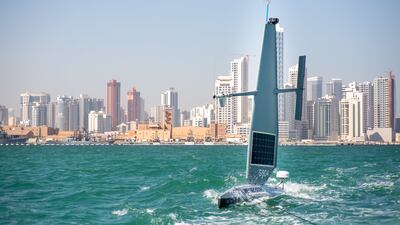
The Saildrone Explorer vessels were originally designed to collect environmental information on the oceans for research. -
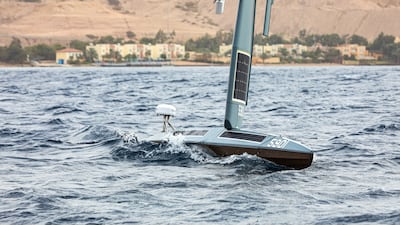
A Saildrone Explorer vessel during tests in the Gulf of Aqaba off of Jordan.


Iran briefly seized several of the American drones being tested in the region in late August and early September, although there have been no similar incidents since.
The Mast-13 now is operating in the Gulf of Oman, where a maritime shadow war has played out as oil tankers have been seized by Iranian forces and suspicious explosions struck vessels in the region, including those linked to Israeli and western companies. Iran has denied involvement in the explosions, despite evidence from the West to the contrary.
The Mast-13's video feeds can transmit images back to shore and to ships at sea, helping sailors to see ships before approaching them, Cmdr Hawkins said. That can come in handy, particularly because the US Navy and western allies have increasingly seized weapons it believes were from Iran bound for Yemen.
“It puts more eyes out on the water, enabling us to better monitor what is happening,” Cmdr Hawkins said.

