
Saudi Arabia will mark Flag Day every year on March 11, it announced on Wednesday.
The decision came by order of King Salman, the Saudi Press Agency reported.
March 11, 1937, which corresponds to the 27th of Dhu Al Hijja 1355 on the Islamic calendar, was the day former King Abdulaziz endorsed the design of the flag.
The modern flag with some minor differences has been used since 1973. A green background features the shahada, or inscription, in white above a sword.
The shahada, the profession of faith, reads: “There is no deity but God. Mohammed is the Messenger of God.”
Before King Abdulaziz Ibn Saud established the Kingdom of Saudi Arabia in 1932, several variations of the flag were used.
The king's army carried a banner featuring just the shahada during conflicts with other Arabian tribes and rival families. Ibn Saud, who captured Riyadh in 1902, later added the sword.
Last year, Saudi Arabia announced that February 22 would be an annual holiday to mark the founding of the state.
A decree at the time said the move was made “out of pride in the well-established roots of this state and the close connection of its citizens with its leaders since the era of Imam Muhammad bin Saud three centuries ago”.
-

Founding day celebrations take place at Boulevard Riyadh. Photo: Swipe Upe Agency -

Basamh employees celebrate founding day at their office in Jeddah. Photo: Basamh group -
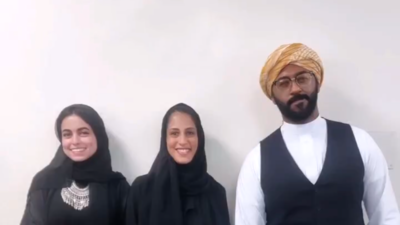
Basamh employees celebrate founding day at their office in Jeddah. Photo: Basamh group -

Basamh employees celebrate founding day at their office in Jeddah. Photo: Basamh group -

Basamh employees celebrate founding day at their office in Jeddah. Photo: Basamh group -

Basamh employees celebrate founding day at their office in Jeddah. Photo: Basamh group -

Founding day offers and accessories on sale in Riyadh. Photo: The National -

Founding day offers and accessories on sale in Riyadh. Photo: The National
Mohammed bin Zayed Majlis
Mercer, the investment consulting arm of US services company Marsh & McLennan, expects its wealth division to at least double its assets under management (AUM) in the Middle East as wealth in the region continues to grow despite economic headwinds, a company official said.
Mercer Wealth, which globally has $160 billion in AUM, plans to boost its AUM in the region to $2-$3bn in the next 2-3 years from the present $1bn, said Yasir AbuShaban, a Dubai-based principal with Mercer Wealth.
“Within the next two to three years, we are looking at reaching $2 to $3 billion as a conservative estimate and we do see an opportunity to do so,” said Mr AbuShaban.
Mercer does not directly make investments, but allocates clients’ money they have discretion to, to professional asset managers. They also provide advice to clients.
“We have buying power. We can negotiate on their (client’s) behalf with asset managers to provide them lower fees than they otherwise would have to get on their own,” he added.
Mercer Wealth’s clients include sovereign wealth funds, family offices, and insurance companies among others.
From its office in Dubai, Mercer also looks after Africa, India and Turkey, where they also see opportunity for growth.
Wealth creation in Middle East and Africa (MEA) grew 8.5 per cent to $8.1 trillion last year from $7.5tn in 2015, higher than last year’s global average of 6 per cent and the second-highest growth in a region after Asia-Pacific which grew 9.9 per cent, according to consultancy Boston Consulting Group (BCG). In the region, where wealth grew just 1.9 per cent in 2015 compared with 2014, a pickup in oil prices has helped in wealth generation.
BCG is forecasting MEA wealth will rise to $12tn by 2021, growing at an annual average of 8 per cent.
Drivers of wealth generation in the region will be split evenly between new wealth creation and growth of performance of existing assets, according to BCG.
Another general trend in the region is clients’ looking for a comprehensive approach to investing, according to Mr AbuShaban.
“Institutional investors or some of the families are seeing a slowdown in the available capital they have to invest and in that sense they are looking at optimizing the way they manage their portfolios and making sure they are not investing haphazardly and different parts of their investment are working together,” said Mr AbuShaban.
Some clients also have a higher appetite for risk, given the low interest-rate environment that does not provide enough yield for some institutional investors. These clients are keen to invest in illiquid assets, such as private equity and infrastructure.
“What we have seen is a desire for higher returns in what has been a low-return environment specifically in various fixed income or bonds,” he said.
“In this environment, we have seen a de facto increase in the risk that clients are taking in things like illiquid investments, private equity investments, infrastructure and private debt, those kind of investments were higher illiquidity results in incrementally higher returns.”
The Abu Dhabi Investment Authority, one of the largest sovereign wealth funds, said in its 2016 report that has gradually increased its exposure in direct private equity and private credit transactions, mainly in Asian markets and especially in China and India. The authority’s private equity department focused on structured equities owing to “their defensive characteristics.”
Kareem Shaheen on Canada
While you're here
National Editorial: World trade has started to look inwards
Callum Patton: ‘Arrival of Asian century’ has eclipsed US
Robin Mills: Importance of China's energy markets clearer
England's all-time record goalscorers:
Wayne Rooney 53
Bobby Charlton 49
Gary Lineker 48
Jimmy Greaves 44
Michael Owen 40
Tom Finney 30
Nat Lofthouse 30
Alan Shearer 30
Viv Woodward 29
Frank Lampard 29
Ten tax points to be aware of in 2026
1. Domestic VAT refund amendments: request your refund within five years
If a business does not apply for the refund on time, they lose their credit.
2. E-invoicing in the UAE
Businesses should continue preparing for the implementation of e-invoicing in the UAE, with 2026 a preparation and transition period ahead of phased mandatory adoption.
3. More tax audits
Tax authorities are increasingly using data already available across multiple filings to identify audit risks.
4. More beneficial VAT and excise tax penalty regime
Tax disputes are expected to become more frequent and more structured, with clearer administrative objection and appeal processes. The UAE has adopted a new penalty regime for VAT and excise disputes, which now mirrors the penalty regime for corporate tax.
5. Greater emphasis on statutory audit
There is a greater need for the accuracy of financial statements. The International Financial Reporting Standards standards need to be strictly adhered to and, as a result, the quality of the audits will need to increase.
6. Further transfer pricing enforcement
Transfer pricing enforcement, which refers to the practice of establishing prices for internal transactions between related entities, is expected to broaden in scope. The UAE will shortly open the possibility to negotiate advance pricing agreements, or essentially rulings for transfer pricing purposes.
7. Limited time periods for audits
Recent amendments also introduce a default five-year limitation period for tax audits and assessments, subject to specific statutory exceptions. While the standard audit and assessment period is five years, this may be extended to up to 15 years in cases involving fraud or tax evasion.
8. Pillar 2 implementation
Many multinational groups will begin to feel the practical effect of the Domestic Minimum Top-Up Tax (DMTT), the UAE's implementation of the OECD’s global minimum tax under Pillar 2. While the rules apply for financial years starting on or after January 1, 2025, it is 2026 that marks the transition to an operational phase.
9. Reduced compliance obligations for imported goods and services
Businesses that apply the reverse-charge mechanism for VAT purposes in the UAE may benefit from reduced compliance obligations.
10. Substance and CbC reporting focus
Tax authorities are expected to continue strengthening the enforcement of economic substance and Country-by-Country (CbC) reporting frameworks. In the UAE, these regimes are increasingly being used as risk-assessment tools, providing tax authorities with a comprehensive view of multinational groups’ global footprints and enabling them to assess whether profits are aligned with real economic activity.
Contributed by Thomas Vanhee and Hend Rashwan, Aurifer
Red flags
- Promises of high, fixed or 'guaranteed' returns.
- Unregulated structured products or complex investments often used to bypass traditional safeguards.
- Lack of clear information, vague language, no access to audited financials.
- Overseas companies targeting investors in other jurisdictions - this can make legal recovery difficult.
- Hard-selling tactics - creating urgency, offering 'exclusive' deals.
Courtesy: Carol Glynn, founder of Conscious Finance Coaching
Brief scoreline:
Liverpool 2
Mane 51', Salah 53'
Chelsea 0
Man of the Match: Mohamed Salah (Liverpool)
Indoor Cricket World Cup Dubai 2017
Venue Insportz, Dubai; Admission Free
Fixtures - Open Men 2pm: India v New Zealand, Malaysia v UAE, Singapore v South Africa, Sri Lanka v England; 8pm: Australia v Singapore, India v Sri Lanka, England v Malaysia, New Zealand v South Africa
Fixtures - Open Women Noon: New Zealand v England, UAE v Australia; 6pm: England v South Africa, New Zealand v Australia
UAE Rugby finals day
Games being played at The Sevens, Dubai
2pm, UAE Conference final
Dubai Tigers v Al Ain Amblers
4pm, UAE Premiership final
Abu Dhabi Harlequins v Jebel Ali Dragons
AGUERO'S PREMIER LEAGUE RECORD
Apps: 186
Goals: 127
Assists: 31
Wins: 117
Losses: 33
The specs
Engine: 2.0-litre 4cyl turbo
Power: 261hp at 5,500rpm
Torque: 405Nm at 1,750-3,500rpm
Transmission: 9-speed auto
Fuel consumption: 6.9L/100km
On sale: Now
Price: From Dh117,059
Dubai Bling season three
Cast: Loujain Adada, Zeina Khoury, Farhana Bodi, Ebraheem Al Samadi, Mona Kattan, and couples Safa & Fahad Siddiqui and DJ Bliss & Danya Mohammed
Rating: 1/5
Company%20Profile
Persuasion
While you're here
Johann Chacko: Why Maldives has become a theatre for US-China rivalry
C Uday Bhaskar: What is India's Indo-Pacific strategy?
C Uday Bhaskar: The 'Asian Century' depends on China and India working together
While you're here
National Editorial: Donald Trump has left his mark on the Middle East
Con Coughlin: The thorn in the side of Biden's foreign policy team
James Reinl: Biden’s Yemen U-turn gets thumbs-up overseas
Raghida Dergham: Will Biden's 'maximum diplomacy' with Iran work?
While you're here
Inside%20Out%202
The End of Loneliness
Benedict Wells
Translated from the German by Charlotte Collins
Sceptre
While you're here
Hussein Ibish: Could it be game over for Donald Trump?
Joyce Karam: Trump's campaign thrown off balance
Trump tests positive: everything we know so far
More from Rashmee Roshan Lall
While you're here
More from this story
KEY%20DATES%20IN%20AMAZON'S%20HISTORY
TO%20CATCH%20A%20KILLER
The specs
Engine: 3.6 V6
Transmission: 8-speed auto
Power: 295bhp
Torque: 353Nm
Price: Dh155,000
On sale: now
Company profile
Name: Fruitful Day
Founders: Marie-Christine Luijckx, Lyla Dalal AlRawi, Lindsey Fournie
Based: Dubai, UAE
Founded: 2015
Number of employees: 30
Sector: F&B
Funding so far: Dh3 million
Future funding plans: None at present
Future markets: Saudi Arabia, potentially Kuwait and other GCC countries
THE BIO: Martin Van Almsick
Hometown: Cologne, Germany
Family: Wife Hanan Ahmed and their three children, Marrah (23), Tibijan (19), Amon (13)
Favourite dessert: Umm Ali with dark camel milk chocolate flakes
Favourite hobby: Football
Breakfast routine: a tall glass of camel milk
Timeline
2012-2015
The company offers payments/bribes to win key contracts in the Middle East
May 2017
The UK SFO officially opens investigation into Petrofac’s use of agents, corruption, and potential bribery to secure contracts
September 2021
Petrofac pleads guilty to seven counts of failing to prevent bribery under the UK Bribery Act
October 2021
Court fines Petrofac £77 million for bribery. Former executive receives a two-year suspended sentence
December 2024
Petrofac enters into comprehensive restructuring to strengthen the financial position of the group
May 2025
The High Court of England and Wales approves the company’s restructuring plan
July 2025
The Court of Appeal issues a judgment challenging parts of the restructuring plan
August 2025
Petrofac issues a business update to execute the restructuring and confirms it will appeal the Court of Appeal decision
October 2025
Petrofac loses a major TenneT offshore wind contract worth €13 billion. Holding company files for administration in the UK. Petrofac delisted from the London Stock Exchange
November 2025
180 Petrofac employees laid off in the UAE


