

The heritage commission of Saudi Arabia will open a research centre to explore the Red Sea for submerged artefacts.
The commission will also conduct a vast underwater survey to look for submerged ships and other items from Umluj to Ras Al Sheikh Hameed, in partnership with King Abdulaziz University and the University of Naples in Italy.
Heritage Authority chief executive Dr Jasser bin Sulaiman Al Harbish, said the commission wanted to share findings with the public on cultural discoveries, underwater heritage sites and its efforts with international scientific experts and institutions.
He said the Red Sea could hold many secrets about the kingdom's cultural history and he voiced his hopes that the commission would contribute to their discovery.
King Abdullah University of Science and Technology (Kaust) is also involved in the project.
Dr Najah Ashri, Kaust vice president and senior co-president for strategic national progress, said the discovery of the underwater heritage in Red Sea waters would be an excellent example of what can be achieved through co-operation with Saudi universities and government sectors in the kingdom.
Kaust laboratories and technological infrastructure will contribute to research and exploration of the secrets beneath the surface.
The area of study covers 600 sq kilometres in the northern part of the Red Sea, documenting more than 25 underwater sites.
A team of Saudi and Italian researchers are conducting a survey of Umluj, where a sunken Ottoman-era vessel contains hundreds of Chinese porcelain pieces in pristine condition. More discoveries are expected as work continues until September 5.
Through the implementation of a marine survey of sites containing submerged archaeological monuments using marine sonar, authorities are able to derive marine maps, mosaic maps and high-resolution images of all sites for data collection and analysis.
The maritime survey ships are equipped with tools to explore Saudi Arabia’s undiscovered treasures and include tools for underwater photography.
-
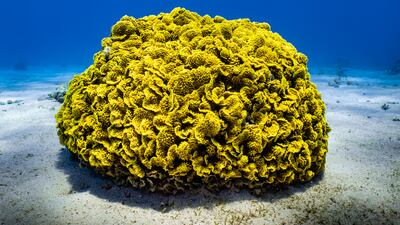
Despite sea temperatures in the Gulf of Aqaba rising faster than the global average rate, the coral reef at the northernmost point of the Red Sea seems immune to the effects of global warming. All photos: Getty -
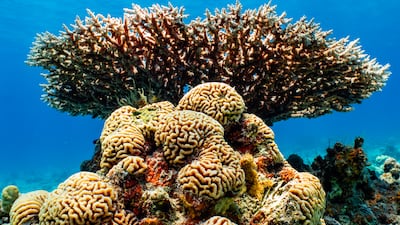
Academics at Israel's Interuniversity Institute for Marine Scientists are trying to understand the biological capacity of these corals that allows them to thrive at higher temperatures. -

Graduate student Ayala Porat and academic intern Kerem Citak set traps to catch coral larvae at a depth of six metres. -
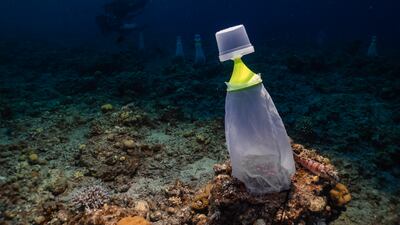
Divers return the following morning to collect the larvae collected in a jar at the top of the net. -
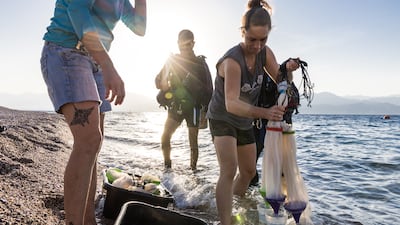
Collected coral larvae are used in experiments to assess the environment's impact on their development and survival. -

The Underwater Observatory Marine Park in Eilat with its easily recognisable tower and the Interuniversity Institute for Marine Sciences building on the right. -

Graduate student Chen Azulay performs a coral dissection under microscope. Ms Azulay performs coral dissections twice a month to understand their reproduction cycle much better. -
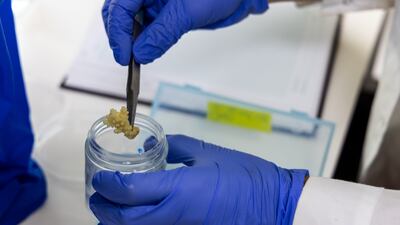
Samples collected from the coral nursery at a depth of six metres are prepared for processing. -
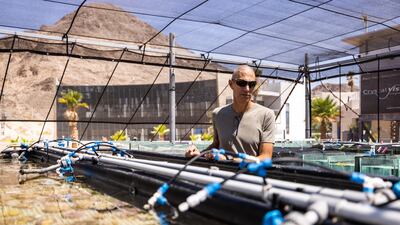
Prof Maoz Fine, head of the Laboratory for Coral Reef Ecology at the university institute, looks over a Red Sea Simulator. Rising atmospheric carbon dioxide levels have resulted in a lowering of pH conditions and higher temperatures in the oceans. -

Prof Fine maintains on a coral monitoring station in Eilat, Israel. The station is the first monitoring station installed in the Gulf of Aqaba and the Red Sea. -
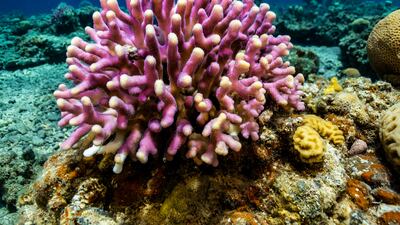
The scientific community estimates that more than 90 per cent of reefs will die by 2050 due to climate change and direct human impact. -

Coral reefs are complete ecosystems, and although the reef in Eilat is, perhaps, capable of withstanding climate change, it is also under threat from human factors such as tourism development, waste run-off into the sea and light pollution. -
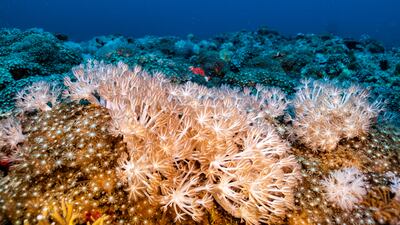
The corals in this Red Sea gulf might be one of the last remaining complete ecosystems by 2100. -

However, there is a possibility that this surviving coral reef could be used as a blueprint for an entirely new climate-resistant ecosystem.



