A large explosion rocked the site of a Houthi missile base in Thamar province in Yemen on Sunday, causing civilian casualties and damaging houses, a witness told The National.
The blast, 138 kilometres south-east of Sanaa, caused damage to the populated district of Al Najda in Thamar city.
We heard the sirens of the ambulances rushing to the area, going back and forth to the public hospital in the city many times
Local witness
“The explosion occurred at a military base in the residential area of Al Najda, causing a large blaze with a plume of dark smoke over the residential area,” he said.
Houthi militias have been using the police training centre in southern Thamar as a missile launch pad for years.
The explosion caused damage to many houses surrounding the base and caused civilian casualties.
“We heard the sirens of the ambulances rushing to the area, going back and forth to the public hospital in the city many times,” the source said.
A report by the investigative website Bellingcat in February concluded that the Houthis used the same military base to launch ballistic missiles aimed at Yemen’s power-sharing government as it arrived in Aden airport on December 30, last year, killing more than 35 people.
“Using the intersection method, it was possible to identify the vicinity from which these missiles were launched,” the website reported.
“This location is marked as a police training centre on Google Maps, which is consistent with multiple social media posts claiming that a missile launch occurred at a police base.”
The explosion at the site comes as fierce clashes between the Houthi rebels and tribes loyal to the Yemeni government continue in the province of Marib, the last government stronghold in the country's north.
Tribal sources told The National on Sunday that fighting has been raging in the Al Naja area, in Al Jubah district, southern Marib.
“We launched a large-scale offensive against the Houthi militias in the southern outskirts of Al Jubah,” said Sheikh Mohammed Al Qardaie, a tribal leader in southern Marib.
“We regained control over strategic posts during the attack” he said. Dozens of Houthi fighters were killed in the offensive, he added.
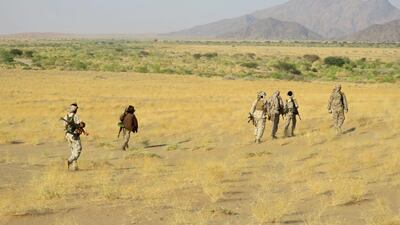
Hundreds of Houthi militias, visible in the treeless terrain around Marib, have been killed by Saudi-led coalition air strikes in recent weeks, local commanders and Saudi Arabia's air force said.
Fighting intensified in southern Marib while thousands of civilians were still reportedly trapped in the rugged, parched terrain of the oil-rich province.
But there is no sign of a ceasefire on the horizon and international aid agencies, including Unicef and the International Committee of the Red Cross, are warning of impending famine.
“The ICRC remains deeply concerned about the humanitarian situation in Marib. We continue to urge those involved in the hostilities to facilitate the evacuation of the sick and wounded, create conditions for humanitarian aid to reach those in need, and protect civilians from harm” Basheer Omar, the Yemen-ICRC spokesman, told The National.
According to Mr Omar, the ICRC succeeded in delivering emergency aid to medical centres in Marib on both sides of the front lines.
“Last Sunday, Marib Military Hospital was resupplied with surgical materials, and on the same day, we sent a lorry with medical supplies to Al Abdiyah,” Mr Omar said.

Mercer, the investment consulting arm of US services company Marsh & McLennan, expects its wealth division to at least double its assets under management (AUM) in the Middle East as wealth in the region continues to grow despite economic headwinds, a company official said.
Mercer Wealth, which globally has $160 billion in AUM, plans to boost its AUM in the region to $2-$3bn in the next 2-3 years from the present $1bn, said Yasir AbuShaban, a Dubai-based principal with Mercer Wealth.
“Within the next two to three years, we are looking at reaching $2 to $3 billion as a conservative estimate and we do see an opportunity to do so,” said Mr AbuShaban.
Mercer does not directly make investments, but allocates clients’ money they have discretion to, to professional asset managers. They also provide advice to clients.
“We have buying power. We can negotiate on their (client’s) behalf with asset managers to provide them lower fees than they otherwise would have to get on their own,” he added.
Mercer Wealth’s clients include sovereign wealth funds, family offices, and insurance companies among others.
From its office in Dubai, Mercer also looks after Africa, India and Turkey, where they also see opportunity for growth.
Wealth creation in Middle East and Africa (MEA) grew 8.5 per cent to $8.1 trillion last year from $7.5tn in 2015, higher than last year’s global average of 6 per cent and the second-highest growth in a region after Asia-Pacific which grew 9.9 per cent, according to consultancy Boston Consulting Group (BCG). In the region, where wealth grew just 1.9 per cent in 2015 compared with 2014, a pickup in oil prices has helped in wealth generation.
BCG is forecasting MEA wealth will rise to $12tn by 2021, growing at an annual average of 8 per cent.
Drivers of wealth generation in the region will be split evenly between new wealth creation and growth of performance of existing assets, according to BCG.
Another general trend in the region is clients’ looking for a comprehensive approach to investing, according to Mr AbuShaban.
“Institutional investors or some of the families are seeing a slowdown in the available capital they have to invest and in that sense they are looking at optimizing the way they manage their portfolios and making sure they are not investing haphazardly and different parts of their investment are working together,” said Mr AbuShaban.
Some clients also have a higher appetite for risk, given the low interest-rate environment that does not provide enough yield for some institutional investors. These clients are keen to invest in illiquid assets, such as private equity and infrastructure.
“What we have seen is a desire for higher returns in what has been a low-return environment specifically in various fixed income or bonds,” he said.
“In this environment, we have seen a de facto increase in the risk that clients are taking in things like illiquid investments, private equity investments, infrastructure and private debt, those kind of investments were higher illiquidity results in incrementally higher returns.”
The Abu Dhabi Investment Authority, one of the largest sovereign wealth funds, said in its 2016 report that has gradually increased its exposure in direct private equity and private credit transactions, mainly in Asian markets and especially in China and India. The authority’s private equity department focused on structured equities owing to “their defensive characteristics.”
Formula%204%20Italian%20Championship%202023%20calendar
%3Cp%3EApril%2021-23%3A%20Imola%3Cbr%3EMay%205-7%3A%20Misano%3Cbr%3EMay%2026-28%3A%20SPA-Francorchamps%3Cbr%3EJune%2023-25%3A%20Monza%3Cbr%3EJuly%2021-23%3A%20Paul%20Ricard%3Cbr%3ESept%2029-Oct%201%3A%20Mugello%3Cbr%3EOct%2013-15%3A%20Vallelunga%3C%2Fp%3E%0A
Living in...
This article is part of a guide on where to live in the UAE. Our reporters will profile some of the country’s most desirable districts, provide an estimate of rental prices and introduce you to some of the residents who call each area home.
Paris%20Agreement
%3Cp%3EArticle%2014%3C%2Fp%3E%0A%3Cp%3E1.%20%5BThe%20Cop%5D%20shall%20periodically%20take%20stock%20of%20the%20implementation%20of%20this%20Agreement%20to%20assess%20the%20collective%20progress%20towards%20achieving%20the%20purpose%20of%20this%20Agreement%20and%20its%20long-term%20goals%20(referred%20to%20as%20the%20%22global%20stocktake%22)%3C%2Fp%3E%0A%3Cp%3E2.%20%5BThe%20Cop%5D%20shall%20undertake%20its%20first%20global%20stocktake%20in%202023%20and%20every%20five%20years%20thereafter%C2%A0%3C%2Fp%3E%0A
Ten tax points to be aware of in 2026
1. Domestic VAT refund amendments: request your refund within five years
If a business does not apply for the refund on time, they lose their credit.
2. E-invoicing in the UAE
Businesses should continue preparing for the implementation of e-invoicing in the UAE, with 2026 a preparation and transition period ahead of phased mandatory adoption.
3. More tax audits
Tax authorities are increasingly using data already available across multiple filings to identify audit risks.
4. More beneficial VAT and excise tax penalty regime
Tax disputes are expected to become more frequent and more structured, with clearer administrative objection and appeal processes. The UAE has adopted a new penalty regime for VAT and excise disputes, which now mirrors the penalty regime for corporate tax.
5. Greater emphasis on statutory audit
There is a greater need for the accuracy of financial statements. The International Financial Reporting Standards standards need to be strictly adhered to and, as a result, the quality of the audits will need to increase.
6. Further transfer pricing enforcement
Transfer pricing enforcement, which refers to the practice of establishing prices for internal transactions between related entities, is expected to broaden in scope. The UAE will shortly open the possibility to negotiate advance pricing agreements, or essentially rulings for transfer pricing purposes.
7. Limited time periods for audits
Recent amendments also introduce a default five-year limitation period for tax audits and assessments, subject to specific statutory exceptions. While the standard audit and assessment period is five years, this may be extended to up to 15 years in cases involving fraud or tax evasion.
8. Pillar 2 implementation
Many multinational groups will begin to feel the practical effect of the Domestic Minimum Top-Up Tax (DMTT), the UAE's implementation of the OECD’s global minimum tax under Pillar 2. While the rules apply for financial years starting on or after January 1, 2025, it is 2026 that marks the transition to an operational phase.
9. Reduced compliance obligations for imported goods and services
Businesses that apply the reverse-charge mechanism for VAT purposes in the UAE may benefit from reduced compliance obligations.
10. Substance and CbC reporting focus
Tax authorities are expected to continue strengthening the enforcement of economic substance and Country-by-Country (CbC) reporting frameworks. In the UAE, these regimes are increasingly being used as risk-assessment tools, providing tax authorities with a comprehensive view of multinational groups’ global footprints and enabling them to assess whether profits are aligned with real economic activity.
Contributed by Thomas Vanhee and Hend Rashwan, Aurifer
Section 375
Cast: Akshaye Khanna, Richa Chadha, Meera Chopra & Rahul Bhat
Director: Ajay Bahl
Producers: Kumar Mangat Pathak, Abhishek Pathak & SCIPL
Rating: 3.5/5
Jetour T1 specs
Engine: 2-litre turbocharged
Power: 254hp
Torque: 390Nm
Price: From Dh126,000
Available: Now
Living in...
This article is part of a guide on where to live in the UAE. Our reporters will profile some of the country’s most desirable districts, provide an estimate of rental prices and introduce you to some of the residents who call each area home.
The biog
Birthday: February 22, 1956
Born: Madahha near Chittagong, Bangladesh
Arrived in UAE: 1978
Exercise: At least one hour a day on the Corniche, from 5.30-6am and 7pm to 8pm.
Favourite place in Abu Dhabi? “Everywhere. Wherever you go, you can relax.”
MATCH INFO
Watford 1 (Deulofeu 80' p)
Chelsea 2 (Abraham 5', Pulisic 55')
Try out the test yourself
Q1 Suppose you had $100 in a savings account and the interest rate was 2 per cent per year. After five years, how much do you think you would have in the account if you left the money to grow?
a) More than $102
b) Exactly $102
c) Less than $102
d) Do not know
e) Refuse to answer
Q2 Imagine that the interest rate on your savings account was 1 per cent per year and inflation was 2 per cent per year. After one year, how much would you be able to buy with the money in this account?
a) More than today
b) Exactly the same as today
c) Less than today
d) Do not know
e) Refuse to answer
Q4 Do you think that the following statement is true or false? “Buying a single company stock usually provides a safer return than a stock mutual fund.”
a) True
b) False
d) Do not know
e) Refuse to answer
The “Big Three” financial literacy questions were created by Professors Annamaria Lusardi of the George Washington School of Business and Olivia Mitchell, of the Wharton School of the University of Pennsylvania.
Answers: Q1 More than $102 (compound interest). Q2 Less than today (inflation). Q3 False (diversification).
Tamkeen's offering
- Option 1: 70% in year 1, 50% in year 2, 30% in year 3
- Option 2: 50% across three years
- Option 3: 30% across five years
THE%20SPECS
%3Cp%3EBattery%3A%2060kW%20lithium-ion%20phosphate%3Cbr%3EPower%3A%20Up%20to%20201bhp%3Cbr%3E0%20to%20100kph%3A%207.3%20seconds%3Cbr%3ERange%3A%20418km%3Cbr%3EPrice%3A%20From%20Dh149%2C900%3Cbr%3EAvailable%3A%20Now%3C%2Fp%3E%0A