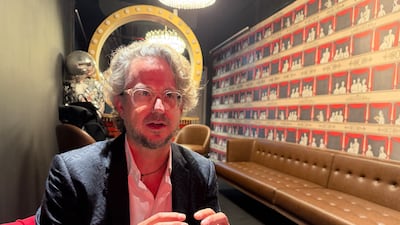

Artificial intelligence will be unable to replace human craft in the music industry because it lacks the ability to create original work, the chairman of German audio major Sennheiser has said.
While AI can be used as a tool to support the creation of music, the booming technology is largely only able to produce output based on what it has been trained on, raising questions about actual creativity, Daniel Sennheiser said.
"AI is a calculation of probability ... it comes out with basically everything that it knows, but it cannot create something new," Mr Sennheiser, who is also co-chief executive of the Wedemark-based company, told The National in an interview in Dubai.
"Therefore, if you make your own music, if you create something, you're always going to be safe. AI can support you in your creative process and actually even inspire you ... but it will never replace a [musician]."
Several industries have grown concerned with the growth of AI, as the technology becomes more powerful and is able to create works in music, film, arts and other endeavours that have relied on human skill and talent.
Music artists and unions have been protesting against copyright infringement and the overall lack of originality when it comes to AI-generated music.
Even streaming services are taking action. This week, Spotify said it had removed about 50 million songs it deemed as AI slop over the past year.
Generative AI in music, however, is growing to become big business: revenue in the market is projected to hit almost $2.8 billion by 2030, nearly triple the estimated $960.4 million this year, data from Grand View Research shows.
"Like with every new technology, initially you're very afraid of the substitution that it's doing. And, yes, [AI] is creating some what I call background music, which you can do very well with AI today," said Mr Sennheiser, the third-generation leader of the company founded in 1945.
"AI tools are allowing much more people to be creative with music ... it's more of a support than anything else."
Supply chains and UAE focus
Mr Sennheiser said the current supply chain disruptions, as a result of geopolitical conflicts and tariff battles, have not directly affected the company, owing to in-house operations and third-party relationships.
For instance, Sennheiser has its own assembly line for surface-mount devices, or those that place electronic components on circuit boards. The company is also not affected by shortages in chips and critical minerals such as neodymium, as the audio industry does not use those components on a broad scale unlike manufacturers of smartphones and computers.
It also helps that Sennheiser is based in Germany, considered the manufacturing hub of Europe that is home to key industries such as car making, chemicals, engineering and technology. "We were always able to deliver more or less every product ... we find our way around those shortages," Mr Sennsheiser said.
He did acknowledge, however, that Sennheiser raises prices based on the costs of raw materials, transport and manufacturing, which includes energy.
"We look at what is available in the market and what is sustainable, so we have a regular schedule of increasing prices based on the realities that are there," Mr Sennheiser said.
The company will also continue to invest in the Middle East, especially in the UAE, where its Dubai office serves the wider region, including CIS countries.
The company does not divulge market share numbers. Mr Sennheiser, however, noted that while the brand is underrepresented in some markets, they have a "fair share" in others, including the UAE.
"I see the market growing and that's why I want to invest in this region," he said, without providing details.

