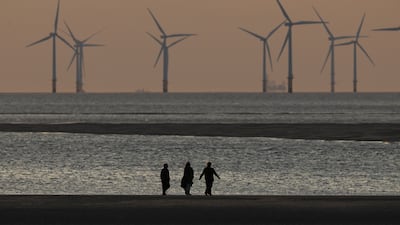

Offshore wind farms can enhance maritime security through greater co-operation and surveillance technology, a new analysis says.
The report from the Centre for Strategic and International Studies (CSIS) in Washington said that although offshore wind infrastructure has become more prevalent in recent decades, too little progress has been made in looking at how it could benefit national security.
“By planning for dual-use capability from the outset, the United States can turn energy infrastructure into a force multiplier for national security, one that strengthens surveillance and warning in an increasingly contested maritime environment,” the CSIS report said.
The analysis pointed out that in recent years, maritime and subsea infrastructure have become increasingly important – and also vulnerable to attack.
“Subsea cables, which carry roughly 95 per cent of the world’s internet traffic, are particularly vulnerable to disruption,” the report said.
In May, undersea internet and data cables were damaged in the Red Sea, causing connectivity problems for users in the Middle East, India and Pakistan.

The cables were eventually repaired and most experts said that they had probably been severed by accident, but the incident still put subsea cable vulnerability in the spotlight.
CSIS's report indicated that the proliferation of aerial drones, autonomous naval tools and unmanned underwater vehicles were also putting maritime security and subsea infrastructure in a more vulnerable position. It added that, concerningly, drone threats no longer come from state actors, but also from gangs and drug traffickers.
The report concluded that if private offshore wind farm developers and governments could reach a consensus on how to best equip turbines with surveillance, sensors and data tracking tools, the end result could be “enhanced maritime domain awareness”. It highlighted the addition of surveillance systems to wind farms in and around Norway, Belgium, Poland and the UK.
During a round-table discussion on Wednesday, Allegra Dawes, an energy security fellow at CSIS, said greater co-operation in enhancing offshore wind farms for maritime security could create a “force multiplier” effect, particularly for the US.
“I think it gives guidance on the technologies that can actually create a stronger national security environment and also a stronger infrastructure backbone for energy,” she explained.
Doug Wolfe, chief technology officer for Mighty Waves Energy, added that artificial intelligence could also be used along with the surveillance-enhanced wind turbines to bolster security on several levels.
AI, he said, could help automate a lot of different maritime security workflows, while also helping to better understand what's happening under the sea.
“It could very quickly characterise and detect whales, different types of whales and frequencies and all of those kinds of things,” he said.

