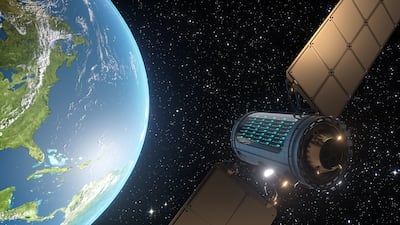

Opposition to data centres is growing in many parts of the world. Google plans to deal with this by launching a data centre into space - sort of.
The Alphabet-owned company recently announced that Project Suncatcher, which has been in the research and development stage for several years, is ready for a trial. Google says the purpose of Project Suncatcher is to explore “whether space could one day host scalable machine learning infrastructure” necessary to fuel the AI boom.
Data centres are often criticised for their noise, size and intense energy needs, but setting at least some of them up in outer space could solve some problems.
The company said it would be sending its AI hardware to test that idea onboard the Transporter-18 ride-share mission with SpaceX, which will make it possible for the company to test how well its processing operates in space.
Part of the space test will involve seeing if the company's technology can generate enough computing power in space to answer basic AI queries.
“In low Earth orbit, satellites can access near-constant sunlight, generating up to eight times more solar power than on Earth,” the California technology giant explained. It added that if successful, all concerns about data centres might be nullified.
“It could be possible to link together multiple constellations of satellites, allowing them to manage larger AI workloads while in orbit.”
The concept of using the sun to power data centres in space isn't new, but Google is the first to attempt to take it from theory into practice. In January, during a discussion at the World Economic Forum's Annual Meeting in Davos, Switzerland, technology tycoon and SpaceX chief executive Elon Musk spoke about putting AI infrastructure in orbit.
“There's so much room in space, and it's enormous what you can scale to,” he said. “I think, ultimately, you can have hundreds of terawatts in the air.” A few weeks later, Mr Musk predicted that SpaceX might be able to put a working data centre in space as soon as 2027.
In March, Nvidia announced what it called the Space-1 Vera Rubin Module, which the company said would help to eventually bring “AI compute to orbital data centres”. Nvidia's press release also made use of the acronym ODC for “orbital data centres”.
While Google's forthcoming launch has generated plenty of interest, actually putting data centres in space is far from close. Experts have pointed out that there are many obstacles to making the idea a reality, though Google's launch on Thursday will still be viewed as an important moment.
During an appearance at the Semafor World Economy Summit in April, Ariel Ekblaw, founder and chief executive of non-profit space architecture lab the Aurelia Institute, said some of the more aggressive timelines for making space data centres a reality are not realistic.
She pointed out that space is far colder than most people realise, and that alone means that “it is not an advantageous arena to deploy a really hot little volcano of a bunch of computers in”.
Ms Ekblaw added that the climate issue was only one of several engineering challenges that come with the territory of orbital data centres. The radiation of space, she explained, would also prove problematic, along with the fact that data centres on Earth often need to upgrade their CPUs, GPUs and other technology.
“There's the fact that if you want to swap your chips out from Nvidia every six months, now you have to go all the way to space to do it, so that's not a trivial concern,” she said, adding that there will probably be a great deal of red tape and permitting processes to complicate placing data centres in orbit.
“It's not a simple challenge,” she said. She added that if all these obstacles could be overcome, orbital data centres could be a perfect way to reduce AI's carbon footprint.
In its recent announcement of a forthcoming space launch, however, Google seemed aware of the challenges it will face.
“Every transformative technology we’ve built at Google began with an audacious goal – and the discipline of working backwards to solve hard problems all along the way,” Google's announcement read. “As our latest moonshot heads to the launchpad, our team is excited to share what we learn and the science driving this work forward.”

