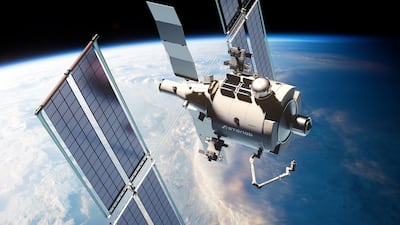
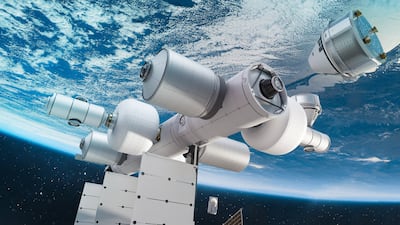
A rendering of the Starlab station. Photo: Starlab

Las Vegas Sphere team to design Starlab space station with well-being in mind


Sarwat Nasir
  • English
  • Arabic

A new commercial space station is being designed to feel “less like a machine”, as competition heats up to replace the ageing International Space Station.

Starlab, being built by Voyager Space and Airbus, is working with design company Journey and hospitality company Hilton to shape the interior of the station, scheduled for launch in 2029.

The International Space Station (ISS) has been operational since 2000, with Nasa, Russian and other international astronauts who have continuously occupied the outpost.

But the station is set to retire in 2030, and Nasa is backing projects such as Starlab, Blue Origin’s Orbital Reef and Axiom Space’s Axiom Station to maintain a US presence in low-Earth orbit, otherwise, China’s Tiangong would be the only operational station. Vast Space, not part of Nasa’s programme, is also developing its Haven stations.

Brad Henderson, chief commercial officer at Starlab told The National that a space station should have a “sense of place”.

“Journey is helping us ask the right questions: where will people gather at the end of a long day? How do you create a psychological balance between work and rest in microgravity? They're real, daily considerations for astronauts spending months in orbit, not abstract design challenges,” he said.

“One area where this really comes through is in the design of communal zones. Instead of sterile corridors, these areas are being shaped as spaces that invite collaboration, reflection and routine.”

An artist's impression of the Starlab station orbiting Earth. Photo: Starlab

Journey is a global design agency whose portfolio includes the Sphere in Las Vegas, the Empire State Building observatory in New York and the Sun Princess Dome for Princess Cruises.

It is bringing hospitality and environmental design experience into the station and will combine it with decades of aerospace and astronaut insights from Voyager Space and Airbus.

“That partnership allows us to test concepts through human evaluations and analogue environments,” said Mr Henderson.

“Journey observes and adapts, and we help shape scenarios that mimic the operational tempo and physical demands of space flight.”

Hilton is contributing its experience in comfort, wellness and service. Together, they are exploring how elements like lighting, acoustics and personalised storage can support rest and recovery, something critical for both physical and mental health in long-duration missions.

Technology is also being built into Starlab from the start, with autonomous operations that would help improve the crew experience.

Starlab has selected Palantir Technologies to handle the station’s data and software systems.

The company will create virtual models of the station, known as “digital twins”, to track its performance, forecast maintenance work and manage resources.

The tools are intended to support mission planning and routine operations to reduce workload on the crew.

On designing for microgravity, Mr Henderson said: “Instead of simply minimising the disorientation of microgravity, we’re asking how the environment can embrace it. How can we guide movement, orient the body, or signal zones without relying on gravity?”

How Starlab compares to other private stations

Unlike the ISS, which was assembled in orbit, Starlab is designed to launch fully assembled on a single SpaceX Starship flight.

It will consist of a habitat and laboratory module, as well as a service module for propulsion and power. The station will have about half the habitable volume of the ISS but is expected to match its scientific capacity.

The other private stations also have a different design approach, Orbital Reef’s mixed-use model to Vast’s smaller, rapidly launched platforms.

Vast Space’s Haven-1 started as a single-module station designed for short-duration missions, with plans to expand into Haven-2 by docking additional modules and including artificial gravity.

Axiom Space is building a modular station that will first attach to the ISS before becoming independent, with an expected launch date of no earlier than 2027.

Starlab, in comparison, is much larger and fully integrated from the start, requiring SpaceX’s Starship for launch because no other rocket is powerful enough to carry its single, large module into orbit.

Starlab has passed several Nasa safety and design reviews and is building a full-scale mock-up for astronaut testing.

“Our goal is to build a station where astronauts can carry out critical research while living in an environment that supports their well-being,” Mr Henderson said.

“It’s about making sure they can perform at their best, day after day, in one of the most challenging environments imaginable.”


The%20specs
%3Cp%3E%3Cstrong%3EEngine%3A%20%3C%2Fstrong%3E2.3-litre%204cyl%20turbo%0D%3Cbr%3E%3Cstrong%3EPower%3A%20%3C%2Fstrong%3E299hp%20at%205%2C500rpm%0D%3Cbr%3E%3Cstrong%3ETorque%3A%20%3C%2Fstrong%3E420Nm%20at%202%2C750rpm%0D%3Cbr%3E%3Cstrong%3ETransmission%3A%20%3C%2Fstrong%3E10-speed%20auto%0D%3Cbr%3E%3Cstrong%3EFuel%20consumption%3A%20%3C%2Fstrong%3E12.4L%2F100km%0D%3Cbr%3E%3Cstrong%3EOn%20sale%3A%20%3C%2Fstrong%3ENow%0D%3Cbr%3E%3Cstrong%3EPrice%3A%20%3C%2Fstrong%3EFrom%20Dh157%2C395%20(XLS)%3B%20Dh199%2C395%20(Limited)%3C%2Fp%3E%0A
BMW M5 specs

Engine: 4.4-litre twin-turbo V-8 petrol enging with additional electric motor

Power: 727hp

Torque: 1,000Nm

Transmission: 8-speed auto

Fuel consumption: 10.6L/100km

On sale: Now

Price: From Dh650,000

HOW TO WATCH

Facebook: TheNationalNews  

Twitter: @thenationalnews  

Instagram: @thenationalnews.com  

TikTok: @thenationalnews 

Mercer, the investment consulting arm of US services company Marsh & McLennan, expects its wealth division to at least double its assets under management (AUM) in the Middle East as wealth in the region continues to grow despite economic headwinds, a company official said.

Mercer Wealth, which globally has $160 billion in AUM, plans to boost its AUM in the region to $2-$3bn in the next 2-3 years from the present $1bn, said Yasir AbuShaban, a Dubai-based principal with Mercer Wealth.

Within the next two to three years, we are looking at reaching $2 to $3 billion as a conservative estimate and we do see an opportunity to do so,” said Mr AbuShaban.

Mercer does not directly make investments, but allocates clients’ money they have discretion to, to professional asset managers. They also provide advice to clients.

“We have buying power. We can negotiate on their (client’s) behalf with asset managers to provide them lower fees than they otherwise would have to get on their own,” he added.

Mercer Wealth’s clients include sovereign wealth funds, family offices, and insurance companies among others.

From its office in Dubai, Mercer also looks after Africa, India and Turkey, where they also see opportunity for growth.

Wealth creation in Middle East and Africa (MEA) grew 8.5 per cent to $8.1 trillion last year from $7.5tn in 2015, higher than last year’s global average of 6 per cent and the second-highest growth in a region after Asia-Pacific which grew 9.9 per cent, according to consultancy Boston Consulting Group (BCG). In the region, where wealth grew just 1.9 per cent in 2015 compared with 2014, a pickup in oil prices has helped in wealth generation.

BCG is forecasting MEA wealth will rise to $12tn by 2021, growing at an annual average of 8 per cent.

Drivers of wealth generation in the region will be split evenly between new wealth creation and growth of performance of existing assets, according to BCG.

Another general trend in the region is clients’ looking for a comprehensive approach to investing, according to Mr AbuShaban.

“Institutional investors or some of the families are seeing a slowdown in the available capital they have to invest and in that sense they are looking at optimizing the way they manage their portfolios and making sure they are not investing haphazardly and different parts of their investment are working together,” said Mr AbuShaban.

Some clients also have a higher appetite for risk, given the low interest-rate environment that does not provide enough yield for some institutional investors. These clients are keen to invest in illiquid assets, such as private equity and infrastructure.

“What we have seen is a desire for higher returns in what has been a low-return environment specifically in various fixed income or bonds,” he said.

“In this environment, we have seen a de facto increase in the risk that clients are taking in things like illiquid investments, private equity investments, infrastructure and private debt, those kind of investments were higher illiquidity results in incrementally higher returns.”

The Abu Dhabi Investment Authority, one of the largest sovereign wealth funds, said in its 2016 report that has gradually increased its exposure in direct private equity and private credit transactions, mainly in Asian markets and especially in China and India. The authority’s private equity department focused on structured equities owing to “their defensive characteristics.”

COMPANY%20PROFILE
%3Cp%3E%3Cstrong%3ECompany%3A%3C%2Fstrong%3E%20Eco%20Way%3Cbr%3E%3Cstrong%3EStarted%3A%3C%2Fstrong%3E%20December%202023%3Cbr%3E%3Cstrong%3EFounder%3A%3C%2Fstrong%3E%20Ivan%20Kroshnyi%3Cbr%3E%3Cstrong%3EBased%3A%3C%2Fstrong%3E%20Dubai%2C%20UAE%3Cbr%3E%3Cstrong%3EIndustry%3A%3C%2Fstrong%3E%20Electric%20vehicles%3Cbr%3E%3Cstrong%3EInvestors%3A%3C%2Fstrong%3E%20Bootstrapped%20with%20undisclosed%20funding.%20Looking%20to%20raise%20funds%20from%20outside%3Cbr%3E%3C%2Fp%3E%0A
JAPANESE GRAND PRIX INFO

Schedule (All times UAE)
First practice: Friday, 5-6.30am
Second practice: Friday, 9-10.30am
Third practice: Saturday, 7-8am
Qualifying: Saturday, 10-11am
Race: Sunday, 9am-midday 

Race venue: Suzuka International Racing Course
Circuit Length: 5.807km
Number of Laps: 53
Watch live: beIN Sports HD

What vitamins do we know are beneficial for living in the UAE

Vitamin D: Highly relevant in the UAE due to limited sun exposure; supports bone health, immunity and mood.Vitamin B12: Important for nerve health and energy production, especially for vegetarians, vegans and individuals with absorption issues.Iron: Useful only when deficiency or anaemia is confirmed; helps reduce fatigue and support immunity.Omega-3 (EPA/DHA): Supports heart health and reduces inflammation, especially for those who consume little fish.

Trump v Khan

2016: Feud begins after Khan criticised Trump’s proposed Muslim travel ban to US

2017: Trump criticises Khan’s ‘no reason to be alarmed’ response to London Bridge terror attacks

2019: Trump calls Khan a “stone cold loser” before first state visit

2019: Trump tweets about “Khan’s Londonistan”, calling him “a national disgrace”

2022:  Khan’s office attributes rise in Islamophobic abuse against the major to hostility stoked during Trump’s presidency

July 2025 During a golfing trip to Scotland, Trump calls Khan “a nasty person”

Sept 2025 Trump blames Khan for London’s “stabbings and the dirt and the filth”.

Dec 2025 Trump suggests migrants got Khan elected, calls him a “horrible, vicious, disgusting mayor”

Ferrari 12Cilindri specs

Engine: naturally aspirated 6.5-liter V12

Power: 819hp

Torque: 678Nm at 7,250rpm

Price: From Dh1,700,000

Available: Now

WRESTLING HIGHLIGHTS
Drivers’ championship standings after Singapore:

1. Lewis Hamilton, Mercedes - 263
2. Sebastian Vettel, Ferrari - 235
3. Valtteri Bottas, Mercedes - 212
4. Daniel Ricciardo, Red Bull - 162
5. Kimi Raikkonen, Ferrari - 138
6. Sergio Perez, Force India - 68

THE SPECS


Engine: 1.5-litre


Transmission: 6-speed automatic


Power: 110 horsepower 


Torque: 147Nm 


Price: From Dh59,700 


On sale: now  

 
Updated: August 11, 2025, 1:53 PM