

Russia is preparing to leave the International Space Station (ISS) at the end of this decade but faces major hurdles in building its own replacement, the Russian Orbital Service Station (ROSS).
With sanctions restricting access to key space technologies, a shrinking space budget and growing delays in rocket and satellite development, experts say Russia’s ambitions for an independent space station may not materialise as planned. Despite publicly announced plans to launch ROSS's first module by 2027, analysts warn that the project is already facing technical and financial challenges, with little certainty over whether Russia can maintain its role as a leading space power.
“Russia's ability to develop its own orbital station is questionable,” Dr Pavel Luzin, a Russian political analyst and visiting scholar at The Fletcher School of Law and Diplomacy, told The National. “What we know is that there is one orbital module under construction since the early 2010s, the Scientific and Energy Module, and this module needs to be redesigned because at the beginning it was aimed for the ISS, not for a standalone mission.”
Russia joined forces with the US, Europe, Japan and Canada in 1998 to build the ISS, marking one of the most successful examples of post-Cold War collaboration. As geopolitical divisions deepen, however, Russia is looking for space partners outside the West, particularly China and other non-aligned nations.
-
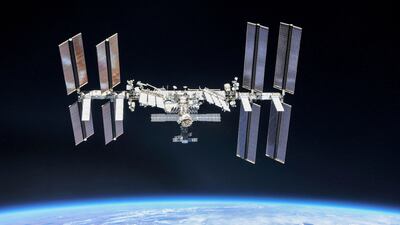
Russia announced plans to leave the International Space Station after 2024 and build an independent one. Reuters -

A Russian Soyuz 2.1a rocket booster at the Baikonur Cosmodrome spaceport, in an area of southern Kazakhstan leased to Russia. Reuters -
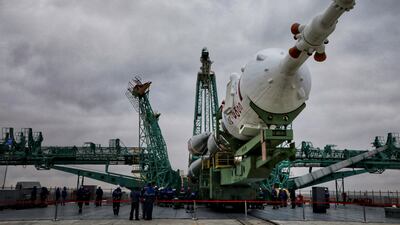
A Soyuz-2.1a is readied for launch. Nasa has announced that it will resume flights to the International Space Station with Russia. -
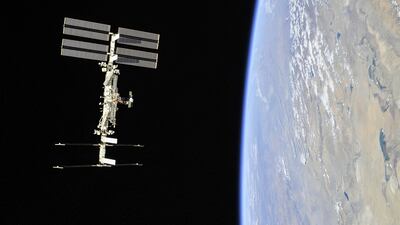
This is taking place despite Washington's attempts to isolate Russia over its invasion of Ukraine. AFP -

Nasa's announcement came hours Dmitry Rogozin was dismissed as head of Russia's Roscosmos space agency. AFP -

A vocal backer of Russia's invasion, Mr Rogozin, had said US astronauts should get to the ISS 'on trampolines' rather than Russian rockets. AFP -
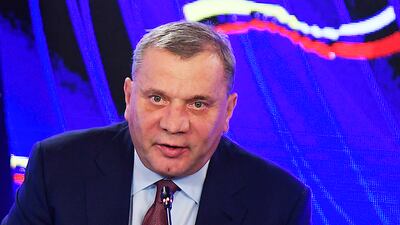
Earlier this month, Russia's former Deputy Prime Minister Yuri Borisov was appointed as the new director-general of Roscosmos. AP -
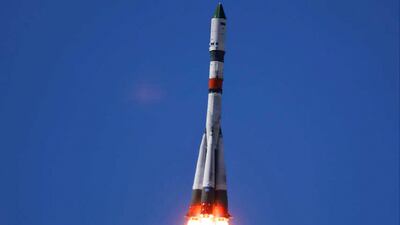
A Russian rocket to the ISS launched since the invasion bore the inscription Donbas and its nose cone and had the flags of breakaway enclaves painted on it. AP -
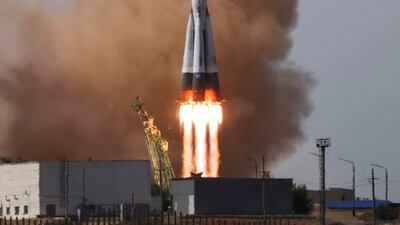
The Soyuz rocket blasts off from the Baikonur Cosmodrome. The last Nasa astronaut to take a Soyuz to the ISS was Mark Vande Hei in 2021. AP -
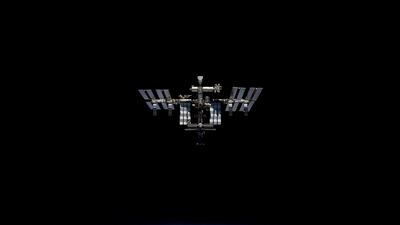
Nasa said the ISS was always designed to be operated jointly. Reuters -

The space agencies of the US, Russia, Europe, Japan and Canada participate. Reuters -
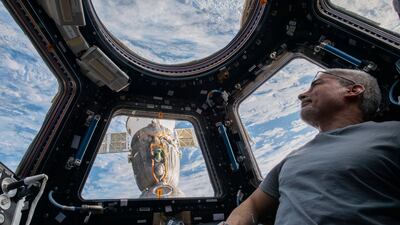
US astronaut Mark Vande Hei has a spectacular view of Earth from inside the ISS. AP -

Nasa astronaut Mark Vande Hei of Nasa, left, returns from the ISS with cosmonauts Anton Shkaplerov, centre, and Pyotr Dubrov. EPA -
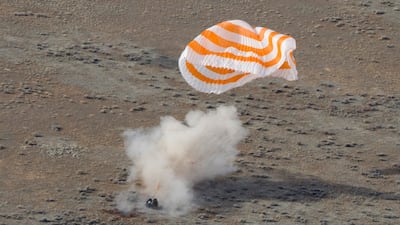
Their Russian Soyuz MS-19 space capsule lands south-east of the town of Zhezkazgan in Kazakhstan. AP -

A Soyuz MS-21 spacecraft carrying Russian cosmonauts Oleg Artemyev, Denis Matveev and Sergey Korsakov approaches to dock with the ISS. Reuters -
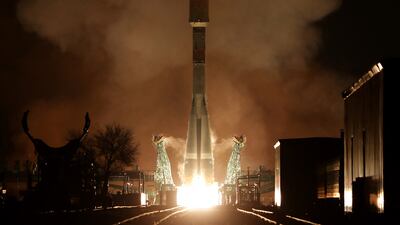
A spectacular night-time Soyuz launch. AFP


Challenges on the horizon
But the development of ROSS comes as Russia’s space industry struggles with severe workforce shortages, ageing infrastructure and geopolitical isolation. “Actually, Russia is trying to keep its manned and military programme at any cost, but the space industry of Russia is not doing well. The number of engineers is decreasing, and the number of well-qualified engineers is decreasing even faster,” said Dr Luzin.
Sanctions imposed by the US, UK, Canada and other allied nations after Russia’s invasion of Ukraine in 2022 have crippled its ability to source advanced space technologies, particularly in satellite manufacturing.
“The sanctions have damaged Russia's space capabilities significantly,” said Dr Luzin. “Russia almost lost the ability to develop advanced satellites. All the big satellites orbited in 2022-2024 and planned for orbiting in 2025 are made with Western components imported before 2022 and sometimes before 2014.”
Scepticism over space plans
Sahith Madara, an aerospace engineer and founder of the advisory firm Bumi and Space, based in Paris, echoed Mr Luzin’s thoughts on how realistic a goal the project is. “ROSS seems like a tough bet given Russia’s shrinking space budget. With funding around $2 billion a year – way behind Nasa or China – it’s hard to see how they’ll fully finance and build an independent station on schedule,” he told The National.
“Sanctions and supply chain issues aren’t helping either, making things even more complicated. Delays feel almost inevitable. Russia has a history of slipping timelines (just look at the Angara rocket or the Luna-25 mission), and a project as big as ROSS is no exception. They’re aiming for 2027, but without major outside funding, maybe from China or other allies, it could easily drag into the 2030s.”
Military space ambitions take priority
To compensate, Moscow is increasingly prioritising military space activities, strengthening ties with China and other non-Western partners as it moves away from international co-operation in civilian space flight. “The plan for the Russian Orbital Service Station is ambitious, but at the same time, their military space ambitions are picking up speed,” said Mr Madara.

Since 2022, Russia has launched satellites with clear defence applications, including reconnaissance, electronic warfare and early warning systems. It has also reportedly been experimenting with anti-satellite weapons: military-grade weapons designed to destroy satellites.
“Space is becoming another front in the global defence competition, and Russia isn’t sitting this one out,” said Mr Madara. “Their growing collaborations, like launching satellites for Iran, suggest they’re building alliances in space that align with their geopolitical strategy, rather than relying on Western-led initiatives."
China: Russia's new friend in space
One question that looms over Russia’s ambition to build ROSS is whether China will step in as a key partner. The two countries have strengthened their collaboration in recent years, with China offering an alternative market for Russian technology and a potential ally in lunar exploration. In 2021, China and Russia officially announced their partnership for the International Lunar Research Station (ILRS), a long-term project aimed at establishing a permanent base on the Moon.
The agreement marked one of the most significant space collaborations between the two nations. Despite this partnership, China appears to be firmly in the driver’s seat, while Russia’s role remains secondary. But despite their geopolitical alignment, experts say a partnership beyond ILRS is unlikely, especially in low-Earth orbit.
"China is hardly going to join Russia there because it has its own orbital station and own space strategy," said Dr Luzin. "Moreover, the planned parameters of the new station's orbit will make it hard to get there from other launch sites except Vostochny on Russian territory." China’s Tiangong space station is already operational, with astronauts who are currently living and working there.

