


Nasa’s Parker Solar Probe is set to make its closest approach to the Sun in an effort to bolster research into the effects of space weather on Earth.
It became the first spacecraft to “touch the Sun” when it flew 10.46 million km from its surface in 2021 and since then it has made 20 approaches, getting closer each time.
The pioneering probe is on course to reach within 6.12 million km of the vast star, the largest body in our solar system, by the end of this year.
It was launched in 2018 to uncover the Sun’s secrets by studying its outer atmosphere, helping scientists to learn more about solar wind and how it travels through space.
“The Parker probe is highly important for space weather because it studies the dynamic space conditions that are related to the Sun – coronal mass ejections, corona’s temperature and ionisation, solar wind and flares,” Dr Nidhal Guessoum, an astrophysicist and professor at the American University of Sharjah, told The National.
“These can have drastic impacts on both satellites and northern region power lines. It can also create beautiful scenes such as the auroras that we recently witnessed as far south as the Mediterranean Sea."
Edging closer each time
Its 20th approach was on June 30 when it came within 7.26 million km from the solar surface, flying at record speeds of 635,266kph.
It is the fastest spacecraft in history and was a designed in such a way that it can withstand the Sun's intense heat and radiation, allowing observations from closer than other spaceships have managed.

At the end of this year, it will attempt its closest approach to date, Nasa said.
"Parker will fly around the Sun at the same distance and speed one more time this year – on September 30 – before making the first of its three final planned closest approaches on December 24," the agency said.
To reach such high speeds and fly nearer to the Sun, the probe will use a gravity-assisted manoeuvre, using Venus's gravity to speed up its journey.
Solving the Sun's mysteries
The probe has already uncovered some mysteries of the Sun, including pinpointing the location of the Alfven critical surface, a point in space that marks the edge of the solar atmosphere and the beginning of the solar wind.
For decades, scientists had sought to determine the exact location of this surface because it represents the boundary where solar material, bound by the Sun's gravitational and magnetic forces, is pushed away by rising heat and pressure.
Beyond this point, the Sun's forces are too weak to contain the solar material, allowing it to stream out into space as the solar wind.
The charged particles carried by the solar wind stripped Mars of its atmosphere billions of years ago, making the planet uninhabitable.
Scientists now want to learn how solar wind affects Earth, as these charged particles can have significant effects on a planet's magnetic field and atmosphere.
-
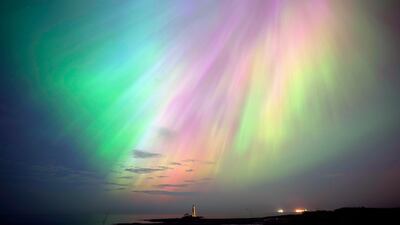
The aurora borealis, known as the Northern Lights, shine over St Mary's Lighthouse in Whitley Bay, Tyne and Wear, northern England, on Friday May 10. PA -
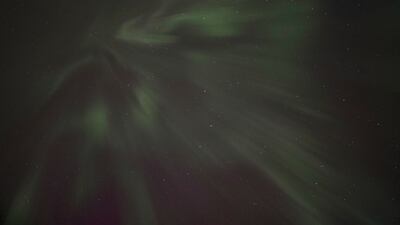
Northern Lights over St Croix State Forest near Markville, Minnesota. The most powerful solar storm in more than two decades struck Earth on May 10, triggering spectacular light shows in skies from Tasmania to the UK. AP Photo -
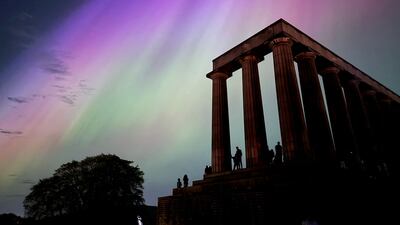
The aurora borealis over the National Monument of Scotland in Edinburgh. AFP -
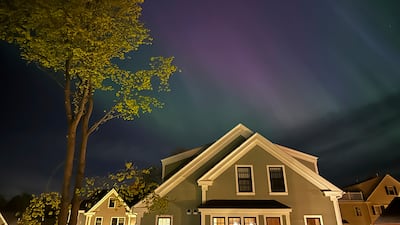
Northern Lights over Portsmouth, New Hampshire. AP Photo -

The aurora borealis over Crosby Beach, Liverpool, northern England. PA -
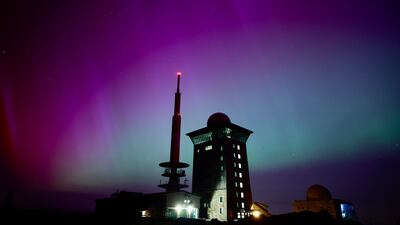
Northern Lights appear in the night sky above the Brocken in Schierke, northern Germany. AP Photo -
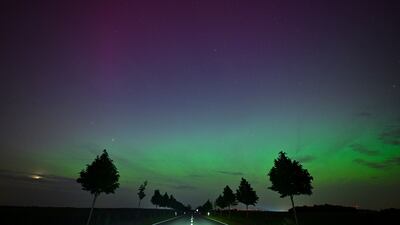
Hues in the night sky over East Brandenburg, Germany. AP Photo -
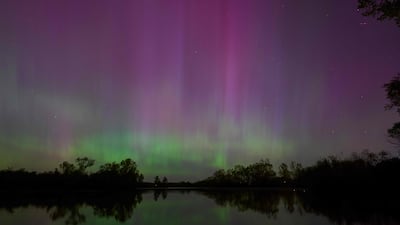
The aurora borealis illuminate the night sky near London, Ontario on May 10. AFP -
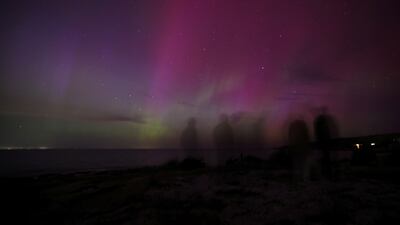
Admirers watch the aurora borealis over Gloucester, Massachusetts. Reuters -
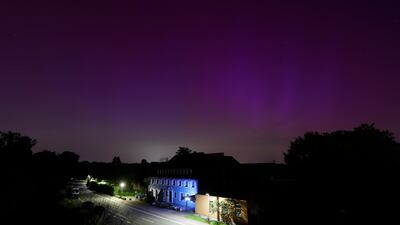
The Northern Lights shine above a hotel in Speyer, Germany. EPA -
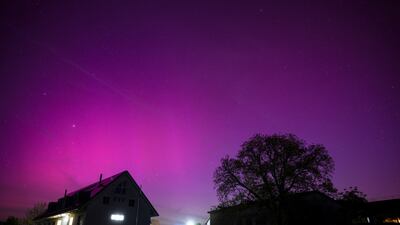
The Northern Lights in the night sky above the village of Daillens, Switzerland. EPA


Understanding this interaction is crucial for predicting and mitigating the effects of space weather, which can disrupt satellite communications, GPS systems and even power grids.
By studying the solar wind, researchers hope to develop better protective measures for technological infrastructure and improve the ability to forecast space weather events.
The solar storms that struck Earth this year shows how important this research is.
In March, a powerful solar storm caused radio blackouts and GPS navigation issues across Africa and the South Atlantic region, while also creating stunning auroras visible far beyond the usual polar regions.
As well as Nasa, other space agencies are also focusing on studying the Sun, including the European Space Agency, which launched its Solar Orbiter in 2020 to capture detailed images of the Sun's poles.
India's space agency launched its Aditya-L1 mission to study the solar corona and wind.

