Pollution in Dhaka, Bangladesh, which has topped a list of countries with the most-polluted air in the world. EPA

Bangladesh, Pakistan and India have world's most-polluted air, report finds


Daniel Bardsley
  • English
  • Arabic

Bangladesh, Pakistan and India have the worst air pollution in the world, with concentrations of particulate matter more than 10 times the recommended maximum, a report has found.

The 2023 World Air Quality Report, released by air purifier company IQAir, found 124 of 134 countries analysed exceeded World Health Organisation guidelines for particulate matter up to 2.5 microns in size (PM2.5).

These tiny particles are regarded as some of the most dangerous air pollutants and are linked to often-fatal conditions such as lung cancer and heart disease.

Many Middle Eastern cities have high levels of PM2.5, including Baghdad and Cairo, which are the world's fifth and 10th polluted capitals, respectively.

The Gulf nations fared poorly in the ranking, with the UAE seventh-worst for air pollution and Kuwait, Qatar and Bahrain all listed in the top 15. Meanwhile, fewer than 10 per cent of the countries or regions for which data was collected have pollution levels that adhere to WHO guidelines.

The report also found, however, that the PM2.5 concentration has fallen in the most polluted cities in West Asia, a region that includes the Middle East.

Aidan Farrow, a senior air-quality scientist at Greenpeace International, branded air pollution "a global health catastrophe" that required urgent action.

The report showed air pollution often had "inequitable consequences" and there was a "need to implement the many solutions that exist to this problem", he said.

Air-quality data saves lives. Where air quality is reported, action is taken and air quality improves
Frank Hammes,
IQAir’s global chief executive

"Local, national and international effort is urgently needed to monitor air quality in under-resourced places, manage the causes of transboundary haze and cut our reliance on combustion as an energy source," he said.

Ranked as the most-polluted country, Bangladesh has a PM2.5 concentration of 79.9 µg/m3 (micrograms per cubic metre), which is more than 15 times the World Health Organisation’s recommended maximum of 5µg/m3. In Pakistan and India, the concentrations are 73.7 µg/m3 and 54.4 µg/m3, respectively.

Human-made and natural factors mean that areas spanning these three countries have, the report says, "the worst air pollution conditions in the world".

Brick kilns, the burning of agricultural waste, cremations and the use of solid fuel for cooking and heating contribute to the poor air quality.

Road transport is another key source of PM2.5 in South Asia and around the world.

New Delhi is classed as the world’s most-polluted capital, with a PM2.5 concentration of 92.7 µg/m3, followed by Dhaka, the Bangladeshi capital, with 80.2 µg/m3. Islamabad in Pakistan is the world’s ninth-most polluted capital, with 42.4 µg/m3.

Tajikistan in the neighbouring region of Central Asia is also highly polluted, with a concentration of 49.0 µg/m3, the fourth-highest in the world.

Other heavily polluted countries are, from fifth to 10th worldwide, Burkina Faso (46.6 µg/m3), Iraq (43.8 µg/m3), the UAE (43.0 µg/m3), Nepal (42.4 µg/m3), Egypt (also 42.4 µg/m3) and the Democratic Republic of Congo (40.8 µg/m3).

The UAE is not the only Gulf nation high on the list, with Kuwait in 11th place (39.9 µg/m3), Bahrain in 12th (39.2 µg/m3) and Qatar 13th (37.6 µg/m3).

The Emirates has taken steps to tackle pollution through the launch in 2022 of the UAE National Air Quality Agenda 2031.

Sandstorms are also a factor in increased PM levels in desert countries found in the Middle East.

A study of Riyadh in Saudi Arabia, published in 2021 in the journal Science of the Total Environment, found that sandstorms were linked to increased PM levels and higher levels of ozone and CO.

While several of the world’s 20 most polluted capitals are in the Middle East, including Baghdad (45.8 µg/m3), Kuwait City (39.9 µg/m3), Manama (39.2 µg/m3), Abu Dhabi (38.2 µg/m3) and Doha (37.6 µg/m3), the report said pollution levels had fallen in West Asia’s nine most-polluted cities.

"In 2023, there is only one city with an annual average above 50 µg/m3, whereas there were five such cities in 2022," the report said.

Ras Al Khaimah is the most-polluted city in West Asia, with a PM2.5 concentration of 52.0 µg/m3, followed by Dhahran in Saudi Arabia (46.5 µg/m3), Baghdad, Dubai (43.6 µg/m3) and Kuwait City. The 10 least-polluted cities in the region, all in Israel, are typically much smaller.

Officials from Ras Al Khaimah, however, dispute the report, saying their own monitoring devices have measured particulate matter at far lower levels.

"Our national stations show the air quality index being 37 (good) and PM2.5 has a value of 25 µg/m3," Saif Al Ghais, director general of the Environment Protection and Development Authority in Ras Al Khaimah, told The National.

Other nations high on the most-polluted list are Indonesia, in 14th place, Rwanda (15th), Zimbabwe (16th), Ghana (17th), Kyrgyzstan (18th), China (19th) and Libya (20th).

The report uses PM2.5 readings from 30,000 air-quality monitoring stations at 7,812 sites in 134 nations or regions.

PM2.5 are considered among the most hazardous particulate pollution because their tiny size means they penetrate deep into the lungs and, the US Environmental Protection Agency reports, may enter the bloodstream.

The report also includes data for Mexico (46th with 20.1 µg/m3), Palestine (55th with 18.6 µg/m3), Israel (56th with 17.8 µg/m3), the Philippines (79th with 13.5 µg/m3), the US (102nd with 9.1 µg/m3) and the UK (112th with 7.7 µg/m3).

Africa is described as "the most under-represented continent" when it comes to air-quality monitoring.

"In many parts of the world the lack of air-quality data delays decisive action and perpetuates unnecessary human suffering," Frank Hammes, IQAir’s global chief executive, said in a statement.

"Air-quality data saves lives. Where air quality is reported action is taken, and air quality improves."

Only 10 of the 134 countries or regions analysed had pollution levels below the WHO recommended maximum, with many tending to be sparsely populated.

French Polynesia is the least polluted, with a PM2.5 concentration of 3.2 µg/m3, followed by Mauritius (3.5 µg/m3), Iceland (4.0 µg/m3), Grenada (4.1 µg/m3), Bermuda (also 4.1 µg/m3), New Zealand (4.3 µg/m3), Australia (4.5 µg/m3), Puerto Rico (4.5 µg/m3), Estonia (4.7 µg/m3) and Finland (4.9 µg/m3).

Climate tipping points - in pictures

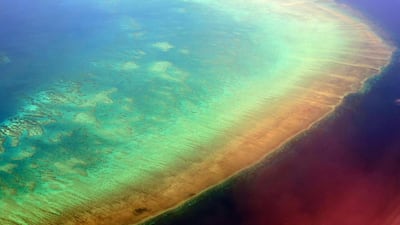
  • An aerial shot of the Great Barrier Reef in Australia, showing parts of the reef that has been subjected to coral bleaching.
    An aerial shot of the Great Barrier Reef in Australia, showing parts of the reef that has been subjected to coral bleaching.
  • A house located on land that has been deformed by permafrost thaw at a former airfield in Churapcha, Russia. Reuters
    A house located on land that has been deformed by permafrost thaw at a former airfield in Churapcha, Russia. Reuters
  • Native vegetation has been cut down to give space for eucalyptus plantations in the Setubinha region in Brazil. AFP
    Native vegetation has been cut down to give space for eucalyptus plantations in the Setubinha region in Brazil. AFP
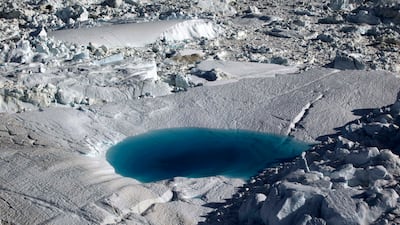
  • A large melt pool forms in the Ilulissat ice fjord below the Jakobshavn Glacier at the fringe of the Greenland ice sheet. AP
    A large melt pool forms in the Ilulissat ice fjord below the Jakobshavn Glacier at the fringe of the Greenland ice sheet. AP
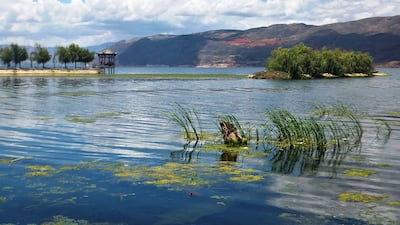
  • Lake Erhai in China has become eutrophic (where an entire body of water becomes enriched with nutrients and minerals) which caused algal growth that destroyed other life. Photo: Ronan O'Connell
    Lake Erhai in China has become eutrophic (where an entire body of water becomes enriched with nutrients and minerals) which caused algal growth that destroyed other life. Photo: Ronan O'Connell
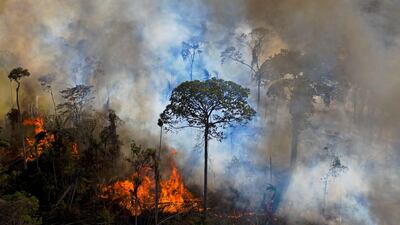
  • Deforestation in Para state, Brazil. AFP
    Deforestation in Para state, Brazil. AFP
  • Moai statues in Easter Island, Chile, were damaged after a wildfire. Reuters
    Moai statues in Easter Island, Chile, were damaged after a wildfire. Reuters
'Cheb%20Khaled'
%3Cp%3E%3Cstrong%3EArtist%3A%20%3C%2Fstrong%3EKhaled%3Cbr%3E%3Cstrong%3ELabel%3A%20%3C%2Fstrong%3EBelieve%3Cbr%3E%3Cstrong%3ERating%3A%3C%2Fstrong%3E%204%2F5%3C%2Fp%3E%0A
Marathon results

Men:

 1. Titus Ekiru(KEN) 2:06:13 

2. Alphonce Simbu(TAN) 2:07:50 

3. Reuben Kipyego(KEN) 2:08:25 

4. Abel Kirui(KEN) 2:08:46 

5. Felix Kemutai(KEN) 2:10:48  

Women:

1. Judith Korir(KEN) 2:22:30 

2. Eunice Chumba(BHR) 2:26:01 

3. Immaculate Chemutai(UGA) 2:28:30 

4. Abebech Bekele(ETH) 2:29:43 

5. Aleksandra Morozova(RUS) 2:33:01  

BUNDESLIGA FIXTURES

Friday (UAE kick-off times)

Cologne v Hoffenheim (11.30pm)

Saturday

Hertha Berlin v RB Leipzig (6.30pm)

Schalke v Fortuna Dusseldof (6.30pm)

Mainz v Union Berlin (6.30pm)

Paderborn v Augsburg (6.30pm)

Bayern Munich v Borussia Dortmund (9.30pm)

Sunday

Borussia Monchengladbach v Werder Bremen (4.30pm)

Wolfsburg v Bayer Leverkusen (6.30pm)

SC Freiburg v Eintracht Frankfurt (9on)

Ten tax points to be aware of in 2026

1. Domestic VAT refund amendments: request your refund within five years

If a business does not apply for the refund on time, they lose their credit.

2. E-invoicing in the UAE

Businesses should continue preparing for the implementation of e-invoicing in the UAE, with 2026 a preparation and transition period ahead of phased mandatory adoption. 

3. More tax audits

Tax authorities are increasingly using data already available across multiple filings to identify audit risks. 

4. More beneficial VAT and excise tax penalty regime

Tax disputes are expected to become more frequent and more structured, with clearer administrative objection and appeal processes. The UAE has adopted a new penalty regime for VAT and excise disputes, which now mirrors the penalty regime for corporate tax.

5. Greater emphasis on statutory audit

There is a greater need for the accuracy of financial statements. The International Financial Reporting Standards standards need to be strictly adhered to and, as a result, the quality of the audits will need to increase.

6. Further transfer pricing enforcement

Transfer pricing enforcement, which refers to the practice of establishing prices for internal transactions between related entities, is expected to broaden in scope. The UAE will shortly open the possibility to negotiate advance pricing agreements, or essentially rulings for transfer pricing purposes. 

7. Limited time periods for audits

Recent amendments also introduce a default five-year limitation period for tax audits and assessments, subject to specific statutory exceptions. While the standard audit and assessment period is five years, this may be extended to up to 15 years in cases involving fraud or tax evasion. 

8. Pillar 2 implementation 

Many multinational groups will begin to feel the practical effect of the Domestic Minimum Top-Up Tax (DMTT), the UAE's implementation of the OECD’s global minimum tax under Pillar 2. While the rules apply for financial years starting on or after January 1, 2025, it is 2026 that marks the transition to an operational phase.

9. Reduced compliance obligations for imported goods and services

Businesses that apply the reverse-charge mechanism for VAT purposes in the UAE may benefit from reduced compliance obligations. 

10. Substance and CbC reporting focus

Tax authorities are expected to continue strengthening the enforcement of economic substance and Country-by-Country (CbC) reporting frameworks. In the UAE, these regimes are increasingly being used as risk-assessment tools, providing tax authorities with a comprehensive view of multinational groups’ global footprints and enabling them to assess whether profits are aligned with real economic activity. 

Contributed by Thomas Vanhee and Hend Rashwan, Aurifer

if you go
%20Ramez%20Gab%20Min%20El%20Akher
%3Cp%3E%3Cstrong%3ECreator%3A%3C%2Fstrong%3E%20Ramez%20Galal%3C%2Fp%3E%0A%3Cp%3E%3Cstrong%3EStarring%3A%3C%2Fstrong%3E%20Ramez%20Galal%3C%2Fp%3E%0A%3Cp%3E%3Cstrong%3EStreaming%20on%3A%20%3C%2Fstrong%3EMBC%20Shahid%3C%2Fp%3E%0A%3Cp%3E%3Cstrong%3ERating%3A%20%3C%2Fstrong%3E2.5%2F5%3C%2Fp%3E%0A
The%C2%A0specs%20
%3Cp%3E%3Cstrong%3EEngine%3A%3C%2Fstrong%3E%204-cylinder%202.0L%20TSI%0D%3Cbr%3E%3Cstrong%3ETransmission%3A%3C%2Fstrong%3E%20Dual%20clutch%207-speed%0D%3Cbr%3E%3Cstrong%3EPower%3A%3C%2Fstrong%3E%20320HP%20%2F%20235kW%0D%3Cbr%3E%3Cstrong%3ETorque%3A%3C%2Fstrong%3E%20400Nm%0D%3Cbr%3E%3Cstrong%3EPrice%3A%20%3C%2Fstrong%3Efrom%20%2449%2C709%20%0D%3Cbr%3E%3Cstrong%3EOn%20sale%3A%3C%2Fstrong%3E%20now%3C%2Fp%3E%0A
The 12 breakaway clubs

England

Arsenal, Chelsea, Liverpool, Manchester City, Manchester United, Tottenham Hotspur

Italy
AC Milan, Inter Milan, Juventus

Spain
Atletico Madrid, Barcelona, Real Madrid

Company Profile:

Name: The Protein Bakeshop

Date of start: 2013

Founders: Rashi Chowdhary and Saad Umerani

Based: Dubai

Size, number of employees: 12

Funding/investors:  $400,000 (2018) 

RIDE%20ON
%3Cp%3EDirector%3A%20Larry%20Yang%3C%2Fp%3E%0A%3Cp%3EStars%3A%20Jackie%20Chan%2C%20Liu%20Haocun%2C%20Kevin%20Guo%3C%2Fp%3E%0A%3Cp%3ERating%3A%202%2F5%3C%2Fp%3E%0A
Our family matters legal consultant

Name: Hassan Mohsen Elhais

Position: legal consultant with Al Rowaad Advocates and Legal Consultants.

MATCH INFO

What: 2006 World Cup quarter-final
When: July 1
Where: Gelsenkirchen Stadium, Gelsenkirchen, Germany

Result:
England 0 Portugal 0
(Portugal win 3-1 on penalties)

MATCH INFO

Uefa Champions League semi-finals, first leg
Liverpool v Roma

When: April 24, 10.45pm kick-off (UAE)
Where: Anfield, Liverpool
Live: BeIN Sports HD
Second leg: May 2, Stadio Olimpico, Rome

Living in...

This article is part of a guide on where to live in the UAE. Our reporters will profile some of the country’s most desirable districts, provide an estimate of rental prices and introduce you to some of the residents who call each area home.

Bullet%20Train
%3Cp%3E%3Cstrong%3EDirector%3A%3C%2Fstrong%3E%20David%20Leitch%3Cbr%3E%3Cstrong%3EStars%3A%3C%2Fstrong%3E%20Brad%20Pitt%2C%20Aaron%20Taylor-Johnson%2C%20Brian%20Tyree%20Henry%2C%20Sandra%20Bullock%3Cbr%3E%3Cstrong%3ERating%3A%3C%2Fstrong%3E%203%2F5%3C%2Fp%3E%0A
The chef's advice

Troy Payne, head chef at Abu Dhabi’s newest healthy eatery Sanderson’s in Al Seef Resort & Spa, says singles need to change their mindset about how they approach the supermarket.

“They feel like they can’t buy one cucumber,” he says. “But I can walk into a shop – I feed two people at home – and I’ll walk into a shop and I buy one cucumber, I’ll buy one onion.”

Mr Payne asks for the sticker to be placed directly on each item, rather than face the temptation of filling one of the two-kilogram capacity plastic bags on offer.

The chef also advises singletons not get too hung up on “organic”, particularly high-priced varieties that have been flown in from far-flung locales. Local produce is often grown sustainably, and far cheaper, he says.

Updated: March 27, 2024, 1:16 PM