
Morocco goalkeeper Bono described his side’s historic World Cup victory against Spain as a “gift to all of Morocco”.
The North Africans, competing in the tournament’s knockouts for the first time in 36 years, defeated the 2010 champions on penalties at Education City Stadium on Tuesday after the match had finished goalless.
The win ensured Morocco became the first Arab team to reach the World Cup quarter-finals.
Yassine Bounou, known as Bono, would prove the hero for his national team, the Sevilla goalkeeper saving two of Spain's three penalties in the shoot-out to leave Paris Saint-Germain full-back Achraf Hakimi to seal a famous victory.
Referencing the vocal and partisan backing Morocco had in the stands, as well as back home, Bono said: "We felt the support of our fans in Morocco and elsewhere, and that gave us momentum in the stadium.
"On behalf of all the players, I want to thank the fans who helped us in this task. I congratulate all the players and I offer this gift to all the Moroccan people."
In the shoot-out, after Pablo Sarabia struck the post, Bono saved from Carlos Soler and Sergio Busquets to consign Spain to their second successive exit on penalties from the World Cup.
"You know penalties, it's a little bit of intuition, a little bit of luck," Bono told beIN Sports. "We won, that's the most important thing. Hats off to the whole team – they did the job. It was incredible.
"It's not easy to stay focused for 120 minutes, against a Spanish team that dominates the ball well, who has possession.
"When you live moments like this, sometimes it's hard to realise it. We will try to avoid the noise around us, stay focused on ourselves, on our job, our recovery."
Morocco, who also became the fourth African side to advance to the last 16, will face Portugal in the quarter-finals.
"I'm so happy for the team ... they did a great job all through the game," Bono said. "We understood the game from the start, so I'm so happy for this win."
Best and worst 'Panenkas' after Hakimi's daring penalty against Spain - in pictures
Here is a list of five of the best paneka penatlies – as well as five of the worst fails.
-
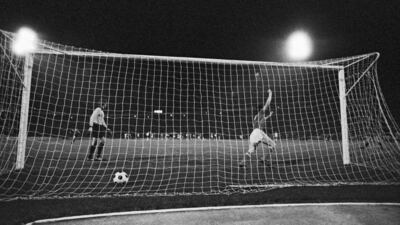
HITS: Antonin Panenka (Czechoslovakia v West Germany, 1976). Beating the Germans on penalties is flash enough. Doing it in such cool fashion the manoeuvre would forever be named after you? What a dude. AP -
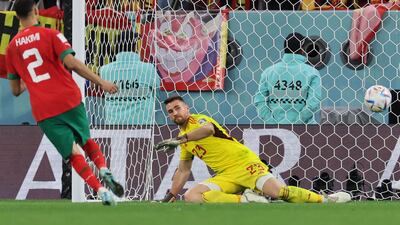
Achraf Hakimi (Morocco v Spain, 2022). Against the country of his birth. To give his country of origin their greatest ever win. Not so much cool as Arctic. AFP -
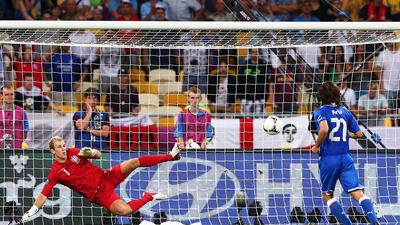
Andrea Pirlo (Italy v England, 2012). The epitome of cool. And the penalty wasn’t bad, either. Getty -
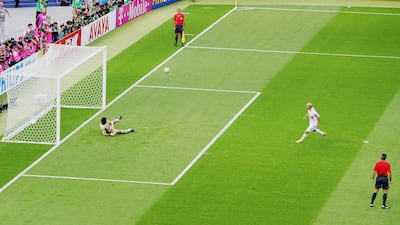
Zinedine Zidane (France v Italy, 2006). Added a frisson of drama by chipping it in off the underside of the bar, and just over the line. All part of a nice quiet night for the retiring France great … Getty -

Omar Abdulrahman (UAE v Japan, 2015). One of the biggest upsets in Asian Cup history, and perhaps UAE’s greatest ever win. In the midst of the shoot-out, their maestro dinked in a Panenka. Getty -
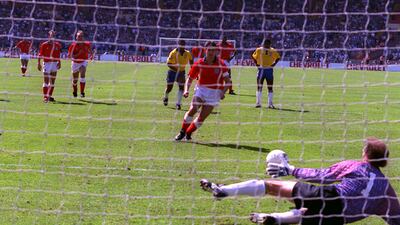
MISSES: Gary Lineker (England v Brazil, 1992). One short of Sir Bobby Charlton’s record number of goals for England, he botched his showy penalty in a pre-Euro 1992 friendly at Wembley. Getty -
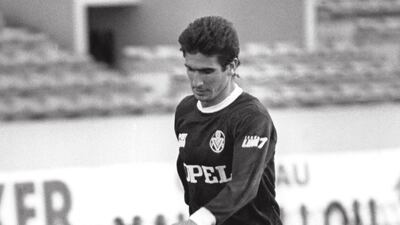
Eric Cantona (Bordeaux v Beauvais, 1989). So much swagger, he juggled the ball all the way from halfway to the spot in a French Cup shoot out. Then his chip was so heroically limp in barely reached the goalline. Getty -
Sergio Aguero (Manchester City v Chelsea, 2021). Chipped the ball into Edouard Mendy’s hands, sparking a comeback which at least briefly delayed City’s inevitable Premier League title charge. Reuters -
Aleksandar Mitrovic (Serbia v Montenegro, 2018). Thrillingly prolific - except when attempting Panenkas. “I have no idea why I’ve done that,” he said, after ballooning his penalty over the bar. Reuters -
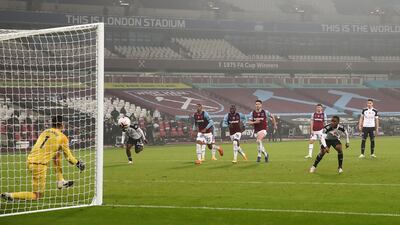
Ademola Lookman (Fulham v West Ham United, 2020). His horror effort cost his side vital points in the battle against relegation. “I couldn't even describe the devastation,” he later said of the incident. Getty
ABU DHABI T10: DAY TWO
Bangla Tigers v Deccan Gladiators (3.30pm)
Delhi Bulls v Karnataka Tuskers (5.45pm)
Northern Warriors v Qalandars (8.00pm)
More from this story
U19 WORLD CUP, WEST INDIES
UAE group fixtures (all in St Kitts)
- Saturday 15 January: UAE beat Canada by 49 runs
- Thursday 20 January: v England
- Saturday 22 January: v Bangladesh
UAE squad:
Alishan Sharafu (captain), Shival Bawa, Jash Giyanani, Sailles
Jaishankar, Nilansh Keswani, Aayan Khan, Punya Mehra, Ali Naseer, Ronak Panoly,
Dhruv Parashar, Vinayak Raghavan, Soorya Sathish, Aryansh Sharma, Adithya
Shetty, Kai Smith
List of alleged parties
May 12, 2020: PM and his wife Carrie attend 'work meeting' with at least 17 staff
May 20, 2020: They attend 'bring your own booze party'
Nov 27, 2020: PM gives speech at leaving party for his staff
Dec 10, 2020: Staff party held by then-education secretary Gavin Williamson
Dec 13, 2020: PM and his wife throw a party
Dec 14, 2020: London mayoral candidate Shaun Bailey holds staff event at Conservative Party headquarters
Dec 15, 2020: PM takes part in a staff quiz
Dec 18, 2020: Downing Street Christmas party
Various Artists
Habibi Funk: An Eclectic Selection Of Music From The Arab World (Habibi Funk)
Saudi National Day
Ahmed Raza
UAE cricket captain
Age: 31
Born: Sharjah
Role: Left-arm spinner
One-day internationals: 31 matches, 35 wickets, average 31.4, economy rate 3.95
T20 internationals: 41 matches, 29 wickets, average 30.3, economy rate 6.28
Other acts on the Jazz Garden bill
Sharrie Williams
The American singer is hugely respected in blues circles due to her passionate vocals and songwriting. Born and raised in Michigan, Williams began recording and touring as a teenage gospel singer. Her career took off with the blues band The Wiseguys. Such was the acclaim of their live shows that they toured throughout Europe and in Africa. As a solo artist, Williams has also collaborated with the likes of the late Dizzy Gillespie, Van Morrison and Mavis Staples.
Lin Rountree
An accomplished smooth jazz artist who blends his chilled approach with R‘n’B. Trained at the Duke Ellington School of the Arts in Washington, DC, Rountree formed his own band in 2004. He has also recorded with the likes of Kem, Dwele and Conya Doss. He comes to Dubai on the back of his new single Pass The Groove, from his forthcoming 2018 album Stronger Still, which may follow his five previous solo albums in cracking the top 10 of the US jazz charts.
Anita Williams
Dubai-based singer Anita Williams will open the night with a set of covers and swing, jazz and blues standards that made her an in-demand singer across the emirate. The Irish singer has been performing in Dubai since 2008 at venues such as MusicHall and Voda Bar. Her Jazz Garden appearance is career highlight as she will use the event to perform the original song Big Blue Eyes, the single from her debut solo album, due for release soon.
While you're here
Watch: Davos 2021 panel discusses the future of work for women
Alice Haine: Investing in gender parity 'makes good business sense'
Kareem Shaheen: How the pandemic could set Arab women back
Simon Rushton: Home schooling forces UK mothers to quit jobs
The Vile
Starring: Bdoor Mohammad, Jasem Alkharraz, Iman Tarik, Sarah Taibah
Director: Majid Al Ansari
Rating: 4/5
The team
Videographer: Jear Velasquez
Photography: Romeo Perez
Fashion director: Sarah Maisey
Make-up: Gulum Erzincan at Art Factory
Models: Meti and Clinton at MMG
Video assistant: Zanong Maget
Social media: Fatima Al Mahmoud
While you're here
Richard Heydarian: Decoding Asean's deliberate silence over the Myanmar coup
Kareem Shaheen: Our Myanmar reactions shaped by simplistic narratives
Sholto Byrnes: Washington tells South-East Asians to pick a side
The%20end%20of%20Summer
Bawaal%20
While you're here
Ed Husain: The far left is trying to hijack Muslim minds in the West
Sulaiman Hakemy: Why it is very important to lose elections
Rashmee Roshan Lall: US race relations in three words
The specs
Engine: Two permanent-magnet synchronous AC motors
Transmission: two-speed
Power: 671hp
Torque: 849Nm
Range: 456km
Price: from Dh437,900
On sale: now
How to help
Call the hotline on 0502955999 or send "thenational" to the following numbers:
2289 - Dh10
2252 - Dh50
6025 - Dh20
6027 - Dh100
6026 - Dh200
MATCH INFO
Tottenham 4 (Alli 51', Kane 50', 77'. Aurier 73')
Olympiakos 2 (El-Arabi 06', Semedo')
• Remittance charges will be tackled by blockchain
• UAE's monumental and risky Mars Mission to inspire future generations, says minister
• Could the UAE drive India's economy?
• News has a bright future and the UAE is at the heart of it
• Architecture is over - here's cybertecture
• The National announces Future of News journalism competition
• Round up: Experts share their visions of the world to come
More coverage from the Future Forum
• Remittance charges will be tackled by blockchain
• UAE's monumental and risky Mars Mission to inspire future generations, says minister
• Could the UAE drive India's economy?
• News has a bright future and the UAE is at the heart of it
• Architecture is over - here's cybertecture
• The National announces Future of News journalism competition
• Round up: Experts share their visions of the world to come
The specs: 2019 Jeep Wrangler
Price, base: Dh132,000
Engine: 3.6-litre V6
Gearbox: Eight-speed automatic
Power: 285hp @ 6,400rpm
Torque: 347Nm @ 4,100rpm
Fuel economy, combined: 9.6L to 10.3L / 100km
Email sent to Uber team from chief executive Dara Khosrowshahi
From: Dara
To: Team@
Date: March 25, 2019 at 11:45pm PT
Subj: Accelerating in the Middle East
Five years ago, Uber launched in the Middle East. It was the start of an incredible journey, with millions of riders and drivers finding new ways to move and work in a dynamic region that’s become so important to Uber. Now Pakistan is one of our fastest-growing markets in the world, women are driving with Uber across Saudi Arabia, and we chose Cairo to launch our first Uber Bus product late last year.
Today we are taking the next step in this journey—well, it’s more like a leap, and a big one: in a few minutes, we’ll announce that we’ve agreed to acquire Careem. Importantly, we intend to operate Careem independently, under the leadership of co-founder and current CEO Mudassir Sheikha. I’ve gotten to know both co-founders, Mudassir and Magnus Olsson, and what they have built is truly extraordinary. They are first-class entrepreneurs who share our platform vision and, like us, have launched a wide range of products—from digital payments to food delivery—to serve consumers.
I expect many of you will ask how we arrived at this structure, meaning allowing Careem to maintain an independent brand and operate separately. After careful consideration, we decided that this framework has the advantage of letting us build new products and try new ideas across not one, but two, strong brands, with strong operators within each. Over time, by integrating parts of our networks, we can operate more efficiently, achieve even lower wait times, expand new products like high-capacity vehicles and payments, and quicken the already remarkable pace of innovation in the region.
This acquisition is subject to regulatory approval in various countries, which we don’t expect before Q1 2020. Until then, nothing changes. And since both companies will continue to largely operate separately after the acquisition, very little will change in either teams’ day-to-day operations post-close. Today’s news is a testament to the incredible business our team has worked so hard to build.
It’s a great day for the Middle East, for the region’s thriving tech sector, for Careem, and for Uber.
Uber on,
Dara
BRAZIL%20SQUAD
Ten tax points to be aware of in 2026
1. Domestic VAT refund amendments: request your refund within five years
If a business does not apply for the refund on time, they lose their credit.
2. E-invoicing in the UAE
Businesses should continue preparing for the implementation of e-invoicing in the UAE, with 2026 a preparation and transition period ahead of phased mandatory adoption.
3. More tax audits
Tax authorities are increasingly using data already available across multiple filings to identify audit risks.
4. More beneficial VAT and excise tax penalty regime
Tax disputes are expected to become more frequent and more structured, with clearer administrative objection and appeal processes. The UAE has adopted a new penalty regime for VAT and excise disputes, which now mirrors the penalty regime for corporate tax.
5. Greater emphasis on statutory audit
There is a greater need for the accuracy of financial statements. The International Financial Reporting Standards standards need to be strictly adhered to and, as a result, the quality of the audits will need to increase.
6. Further transfer pricing enforcement
Transfer pricing enforcement, which refers to the practice of establishing prices for internal transactions between related entities, is expected to broaden in scope. The UAE will shortly open the possibility to negotiate advance pricing agreements, or essentially rulings for transfer pricing purposes.
7. Limited time periods for audits
Recent amendments also introduce a default five-year limitation period for tax audits and assessments, subject to specific statutory exceptions. While the standard audit and assessment period is five years, this may be extended to up to 15 years in cases involving fraud or tax evasion.
8. Pillar 2 implementation
Many multinational groups will begin to feel the practical effect of the Domestic Minimum Top-Up Tax (DMTT), the UAE's implementation of the OECD’s global minimum tax under Pillar 2. While the rules apply for financial years starting on or after January 1, 2025, it is 2026 that marks the transition to an operational phase.
9. Reduced compliance obligations for imported goods and services
Businesses that apply the reverse-charge mechanism for VAT purposes in the UAE may benefit from reduced compliance obligations.
10. Substance and CbC reporting focus
Tax authorities are expected to continue strengthening the enforcement of economic substance and Country-by-Country (CbC) reporting frameworks. In the UAE, these regimes are increasingly being used as risk-assessment tools, providing tax authorities with a comprehensive view of multinational groups’ global footprints and enabling them to assess whether profits are aligned with real economic activity.
Contributed by Thomas Vanhee and Hend Rashwan, Aurifer
EMIRATES'S%20REVISED%20A350%20DEPLOYMENT%20SCHEDULE
Company%20profile
EVIL%20DEAD%20RISE
Generation Start-up: Awok company profile
Started: 2013
Founder: Ulugbek Yuldashev
Sector: e-commerce
Size: 600 plus
Stage: still in talks with VCs
Principal Investors: self-financed by founder
Players Selected for La Liga Trials
U18 Age Group
Name: Ahmed Salam (Malaga)
Position: Right Wing
Nationality: Jordanian
Name: Yahia Iraqi (Malaga)
Position: Left Wing
Nationality: Morocco
Name: Mohammed Bouherrafa (Almeria)
Position: Centre-Midfield
Nationality: French
Name: Mohammed Rajeh (Cadiz)
Position: Striker
Nationality: Jordanian
U16 Age Group
Name: Mehdi Elkhamlichi (Malaga)
Position: Lead Striker
Nationality: Morocco
EMERGENCY PHONE NUMBERS
Estijaba – 8001717 – number to call to request coronavirus testing
Ministry of Health and Prevention – 80011111
Dubai Health Authority – 800342 – The number to book a free video or voice consultation with a doctor or connect to a local health centre
Emirates airline – 600555555
Etihad Airways – 600555666
Ambulance – 998
Knowledge and Human Development Authority – 8005432 ext. 4 for Covid-19 queries
Biog
Mr Kandhari is legally authorised to conduct marriages in the gurdwara
He has officiated weddings of Sikhs and people of different faiths from Malaysia, Sri Lanka, Russia, the US and Canada
Father of two sons, grandfather of six
Plays golf once a week
Enjoys trying new holiday destinations with his wife and family
Walks for an hour every morning
Completed a Bachelor of Commerce degree in Loyola College, Chennai, India
2019 is a milestone because he completes 50 years in business
Temple numbers
Expected completion: 2022
Height: 24 meters
Ground floor banquet hall: 370 square metres to accommodate about 750 people
Ground floor multipurpose hall: 92 square metres for up to 200 people
First floor main Prayer Hall: 465 square metres to hold 1,500 people at a time
First floor terrace areas: 2,30 square metres
Temple will be spread over 6,900 square metres
Structure includes two basements, ground and first floor
What is blockchain?
Blockchain is a form of distributed ledger technology, a digital system in which data is recorded across multiple places at the same time. Unlike traditional databases, DLTs have no central administrator or centralised data storage. They are transparent because the data is visible and, because they are automatically replicated and impossible to be tampered with, they are secure.
The main difference between blockchain and other forms of DLT is the way data is stored as ‘blocks’ – new transactions are added to the existing ‘chain’ of past transactions, hence the name ‘blockchain’. It is impossible to delete or modify information on the chain due to the replication of blocks across various locations.
Blockchain is mostly associated with cryptocurrency Bitcoin. Due to the inability to tamper with transactions, advocates say this makes the currency more secure and safer than traditional systems. It is maintained by a network of people referred to as ‘miners’, who receive rewards for solving complex mathematical equations that enable transactions to go through.
However, one of the major problems that has come to light has been the presence of illicit material buried in the Bitcoin blockchain, linking it to the dark web.
Other blockchain platforms can offer things like smart contracts, which are automatically implemented when specific conditions from all interested parties are reached, cutting the time involved and the risk of mistakes. Another use could be storing medical records, as patients can be confident their information cannot be changed. The technology can also be used in supply chains, voting and has the potential to used for storing property records.
Mercer, the investment consulting arm of US services company Marsh & McLennan, expects its wealth division to at least double its assets under management (AUM) in the Middle East as wealth in the region continues to grow despite economic headwinds, a company official said.
Mercer Wealth, which globally has $160 billion in AUM, plans to boost its AUM in the region to $2-$3bn in the next 2-3 years from the present $1bn, said Yasir AbuShaban, a Dubai-based principal with Mercer Wealth.
“Within the next two to three years, we are looking at reaching $2 to $3 billion as a conservative estimate and we do see an opportunity to do so,” said Mr AbuShaban.
Mercer does not directly make investments, but allocates clients’ money they have discretion to, to professional asset managers. They also provide advice to clients.
“We have buying power. We can negotiate on their (client’s) behalf with asset managers to provide them lower fees than they otherwise would have to get on their own,” he added.
Mercer Wealth’s clients include sovereign wealth funds, family offices, and insurance companies among others.
From its office in Dubai, Mercer also looks after Africa, India and Turkey, where they also see opportunity for growth.
Wealth creation in Middle East and Africa (MEA) grew 8.5 per cent to $8.1 trillion last year from $7.5tn in 2015, higher than last year’s global average of 6 per cent and the second-highest growth in a region after Asia-Pacific which grew 9.9 per cent, according to consultancy Boston Consulting Group (BCG). In the region, where wealth grew just 1.9 per cent in 2015 compared with 2014, a pickup in oil prices has helped in wealth generation.
BCG is forecasting MEA wealth will rise to $12tn by 2021, growing at an annual average of 8 per cent.
Drivers of wealth generation in the region will be split evenly between new wealth creation and growth of performance of existing assets, according to BCG.
Another general trend in the region is clients’ looking for a comprehensive approach to investing, according to Mr AbuShaban.
“Institutional investors or some of the families are seeing a slowdown in the available capital they have to invest and in that sense they are looking at optimizing the way they manage their portfolios and making sure they are not investing haphazardly and different parts of their investment are working together,” said Mr AbuShaban.
Some clients also have a higher appetite for risk, given the low interest-rate environment that does not provide enough yield for some institutional investors. These clients are keen to invest in illiquid assets, such as private equity and infrastructure.
“What we have seen is a desire for higher returns in what has been a low-return environment specifically in various fixed income or bonds,” he said.
“In this environment, we have seen a de facto increase in the risk that clients are taking in things like illiquid investments, private equity investments, infrastructure and private debt, those kind of investments were higher illiquidity results in incrementally higher returns.”
The Abu Dhabi Investment Authority, one of the largest sovereign wealth funds, said in its 2016 report that has gradually increased its exposure in direct private equity and private credit transactions, mainly in Asian markets and especially in China and India. The authority’s private equity department focused on structured equities owing to “their defensive characteristics.”



