



The clock registered just over three minutes. Morocco conceded a corner and via a simple, floated cross, the damage was done. The 2018 World Cup had barely entered its second matchday, Cristiano Ronaldo had headed in his fourth goal of the tournament and Herve Renard’s team were heading for their early exit.
Renard, the much-travelled coach who on Tuesday sets out his plan for Saudi Arabia to stifle Argentina, goes into his second World Cup hopeful that the chances of progress to the second round at least lasts longer than it did at his first taste of the event.
In Russia four years ago, he was the sharp-dressed touchline animator of a Morocco team whose defeats in their first two matches consigned them to the foot of their group but whose performances hinted at better. They would twice take in the lead against Spain in their last, drawn, group game.
Renard had by then been painfully reminded of the match-shaping power of a megastar. The Ronaldo header, the only goal of Portugal-Morocco, sealed his team’s exit. For his next go at the great showpiece, Renard is immediately confronted with another all-time great, Lionel Messi.
“I’m not really one for focussing on superstars,” Renard told Le Figaro, “but you can only respect a fantastic player, his great career and what he represents. Argentina have the capacity to win this World Cup and as Messi has never done that, it’s a fierce desire for him.”
Renard may resist too much focus on individual superstars, but they have marked his life in football. He was a solid defender as a player in his native France but recognised the ceiling of his ambitions while at Cannes. Keeping up with a brilliant young dribbler named Zinedine Zidane, a Cannes prodigy while Renard was reaching senior level, was one of the challenges.
Renard would find his ideal vocation as a coach, studious, charismatic, a strong communicator, and open to learning experiences as diverse as assisting at Cambridge United, of the fourth tier of English football; the Chinese league, in the early 2000s before it became fashionable and monied; and the club game in Vietnam.
By the time he took the assistant manager’s position with Ghana in 2007, Renard, not yet 40, had already coached in four different countries on two continents.
-

Argentina star Lionel Messi trains alone alongside medical officer Javier Hernandez at Qatar University on November 19, 2022 in Doha. Getty -

Argentina's Lionel Messi trains away from the squad. Getty -
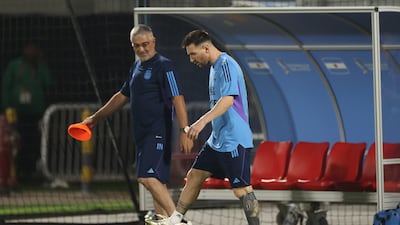
Lionel Messi walks alongside medical staff member Javier Martinez. Getty -

Lionel Messi trains away from the Argentina squad. Getty -

Lionel Messi is watched by the Argentina medical team. Getty -

Lionel Messi is put through his paces. Getty -

Lionel Messi trains alone from the main squad. Getty -

Argentina forward Paulo Dybala (L) watches goalkeeper Emiliano Martinez. AFP -

Angel Di Maria and midfielder Rodrigo De Paul. AFP -

Argentina goalkeeper Emiliano Martinez. AFP -

Argentina midfielder Leandro Paredes. AFP -
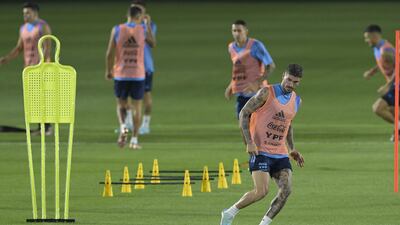
Argentina midfielder Rodrigo De Paul. AFP -
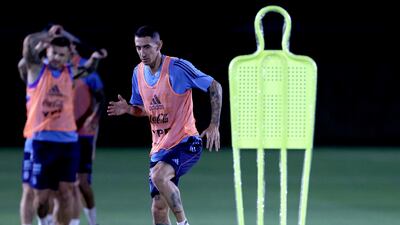
Angel Di Maria of Argentina warms up during the training session at Qatar University. Getty


In Africa, his third continent, he would make himself a superstar manager, instantly recognisable in his crisp, pressed white shirts, a trademark touchline outfit for a long period. He has overseen two Africa Cup of Nations triumphs, the first in 2012 with unfancied Zambia, the second with Ivory Coast in 2015, bringing to an end a long sequence of Ivorian near-misses in the tournament. In qualifying Morocco for Russia 2018, he ended the Atlas Lions’ 20-year absence from World Cups.
The challenge with Saudi Arabia is distinct. This is the country’s sixth World Cup in eight editions. A tantalising bar was set at their first, in 1994, when a second-placed group finish, thanks to Saeed Al-Owairan’s timelessly brilliant goal against Belgium, put them into the last 16.
The tale since has been of first-phase elimination each time, and, as Renard is acutely aware as he surveys Messi’s form and drive and an Argentina fresh from their five-goal win over UAE, some notoriously poor starts: an 8-0 loss against Germany on matchday one in 2002; 5–0 to Russia on the opening night four years ago.
Renard was appointed in 2019, following a last-16 exit, under Juan Antonio Pizzi, at the Asia Cup, and, drawing heavily on the Al-Hilal players who have twice been Asian club champions during his time in charge, built a formidable momentum during World Cup qualifying - 13 victories and a single defeat, to Japan, in 18 matches across the two group stages.

His win record already makes him the most successful foreign coach Saudi Arabia have employed. And there have been several distinguished ones: Pizzi came into the job on the back of winning the Copa America with Chile. Bert Van Marwijk, in the post until 2017, took the Netherlands to a World Cup final; Frank Rijkaard, in charge for two years to 2013, won the European Champions League with Barcelona.
Renard’s privilege is to be in the post for the World Cup closest to home, the beneficiary of strong on-site support from fans who have travelled over the border into Qatar. But there are extra pressures on Saudi Arabia because it is the first World Cup in the region.
“Supporters aren’t always realistic and, in some minds, if we don’t go through to the next round, it’s a failure,” said Renard. “It’s our dream to qualify from the group but Argentina, Mexico and Poland, the group opponents, are above us.”
Well above: at third, 13th, and 26th in the Fifa rankings, to Saudi Arabia’s 51st. And it’s a group with super-concentrated superstar presence. Once he and his players have come through the Messi experience, Renard has four days to prepare for Poland and Robert Lewandowski.

