


Scientists at Boston University have developed a form of coronavirus that killed 80 per cent of the mice they tested it on — reigniting the debate over the use of experimental lab research involving deadly pathogens.
Amid the furore, the university hit back at “false and inaccurate” media coverage that “sensationalised” the research.
It insisted that the experiments did not result in the creation of a more virulent form of Sars-CoV-2, the virus that causes Covid-19.
The researchers were interested in whether the Omicron variant really was less pathogenic than the original form of coronavirus.
University of Edinburgh
It was not, the university said, “gain-of-function” research, which are studies in which scientists create a more dangerous form of a pathogen, such as bacteria or viruses, for research purposes.
While Boston University officials criticised the media, the coverage highlighted concerns that date back many years over laboratory research on pathogens.
Prof Paul Digard, chairman of the virology department at the University of Edinburgh in the UK, said it was “absolutely beyond doubt” that studies on genetically modified viruses were “more than justified”.
“Without it, we wouldn’t have half the antivirals or vaccines we do have,” said Prof Digard, whose lab at the university’s Roslin Institute “makes mutant flu viruses routinely”, although these are not necessarily more harmful forms.
“It is vital to make mutant viruses to understand how they work. If you don’t understand them, it is much harder to design an intervention.”
-
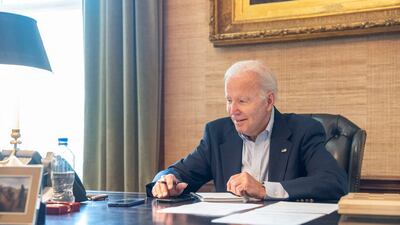
US President Joe Biden tested positive for Covid-19 in July 2022. Reuters -
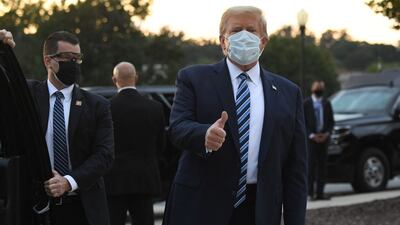
Former US president Donald Trump gives the thumbs-up after leaving the Walter Reed Medical Centre in Bethesda, Maryland, where he was treated for Covid-19 in October 2020. AFP -

Mr Trump removes his mask after returning to the White House from hospital in October 2020. AFP -

Algerian President Abdelmadjid Tebboune spent a month in Germany in January 2021, where he had surgery after developing complications linked to Covid-19. AFP -

Britain's Queen Elizabeth II had Covid-19 in February 2022, months before her death. AFP -

Britain's Prime Minister Boris Johnson caught Covid-19 in March 2020. AFP -
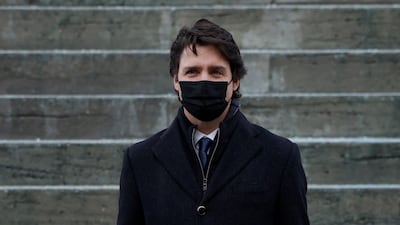
Canadian Prime Minister Justin Trudeau tested positive for Covid-19 a second time in July 2022, six months after he first contracted the virus. Reuters -
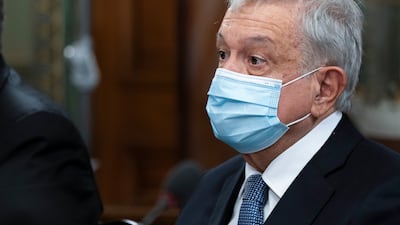
Mexican President Andres Manuel Lopez Obrador tested positive for Covid-19 in January 2022, after having first contracted the coronavirus in early 2021. AP -

Brazil's President Jair Bolsonaro tested positive for Covid-19 in July 2020. Reuters -

Departing Italian Prime Minister Mario Draghi contracted the virus that causes Covid-19 in April 2022. EPA


Bird flu experiments
In the US, a funding ban on certain gain-of-function research in place under former president Barack Obama was lifted under his successor Donald Trump.
Undertaken by researchers in the US and the Netherlands, the work involved making the H5N1 bird flu virus more transmissible in mammals, something that could potentially lead to the virus’s spread between people.
Prof Digard, who was not connected to the studies, insisted such research could offer valuable information.
For example, by knowing which mutations make H5N1 more transmissible in mammals, scientists are better able to assess whether bird flu spreading among poultry could subsequently pass from person to person.
Such research is carried out at a high-security level.
“The important thing is that people who do the work think about what they’re doing. Nobody does this just for the sake of it,” he said.
'There have been lab accidents'

Among the academics concerned about some gain-of-function research is Prof Marc Lipsitch, a professor of epidemiology at Harvard University in the US.
In 2018, shortly after the US government's lifting of its moratorium on funding some gain-of-function research, he said that he and others were worried “that human error could lead to the accidental release of a virus that has been enhanced in the lab so that it is more deadly or more contagious than it already is”.
“There have already been accidents involving pathogens,” he said in an interview published by Harvard University.
“For example, in 2014, dozens of workers at a US Centres for Disease Control and Prevention lab were accidentally exposed to anthrax that was improperly handled.
“Another accident like that — if it involved a virus that was both newly created and highly contagious — has the potential to jeopardise [the lives of] millions of people.”
He said questions about what makes flu viruses more transmissible could be answered by experiments that used parts of the virus, rather than the whole live virus, and by comparisons of genetic sequences.
However, Soren Holm, a professor of bioethics at the University of Manchester, said there are “good reasons for performing gain-of-function studies”.
But while there are internationally recognised biosafety levels that labs have to adhere to when handling potentially dangerous material, Prof Holm cautioned that “you can never say” an accident could not happen.
Another concern sometimes expressed about gain-of-function research, he said, was that the knowledge could be misused, such as for terrorist purposes.
“There’s lots of speculation about this but, as far as I know, there has never been any effective bioterrorist attack,” he said.
While the recent Boston University research generated interest in the media, the coverage is dwarfed by the thousands of articles speculating on the possible laboratory origin of Sars-CoV-2.
Speculation centres on whether the virus, which emerged in Wuhan in China late 2019, came from a “wet market” selling wild animals or from the Wuhan Institute of Virology, which has carried out research on coronaviruses.
A 2015 paper in the journal Nature, written by scientists from the institute, described work to genetically engineer coronaviruses and said: “Our work suggests a potential risk of Sars-CoV re-emergence from viruses currently circulating in bat populations.”
Nature added a note to the paper saying that the article was “being used as the basis for unverified theories that the novel coronavirus causing Covid-19 was engineered” and that there was “no evidence that this is true”.
Paul Hunter, an infectious diseases specialist and professor in medicine at the University of East Anglia in the UK, said the true origin of Sars-CoV-2 would “never be proved 100 per cent, either way”.
However, he said the evidence was “very strongly against it being a lab escape”.
“Covid is almost certainly down to the illegal wildlife trade in China and not to a lab leak,” he said.

