

The US will share technology used to make Covid-19 vaccines through the World Health Organisation and is trying to expand rapid testing and antiviral treatments for hard-to-reach people, President Joe Biden said on Thursday.
“We are making available health technologies that are owned by the United States government, including stabilised spike protein that is used in many Covid-19 vaccines,” Mr Biden said in his opening speech to an international coronavirus summit.
The summit, jointly hosted by the US, Belize, Germany, Indonesia and Senegal, was held online on Thursday for countries to discuss efforts to end the pandemic and prepare for future health threats.
It is set to build on work and commitments made at the first global summit in September, including having more people vaccinated, sending tests and treatments to highest-risk populations, increasing protection to healthcare workers, and generating financing for pandemic preparedness.
It has gathered more than $3 billion in new funding to fight the pandemic, the White House said, including more than $2bn for immediate response and $962 million in commitments to the World Bank pandemic preparedness fund.
Mr Biden said the US would provide the World Bank's future pandemic preparedness fund with a total contribution of $450m in “seed funding”.
The UAE announced a contribution of $60m, with $10m to be disbursed to the Covid-19 tools accelerator and $50m as “in kind” donations to medical supplies.
“As a current member of the UN Security Council, the UAE will continue to deepen its commitment to improve cooperation and global health,” said Reem Al Hashimy, Minister of State for International Co-operation.
The EU said it was providing €300m ($311.1m) for vaccination support, and $450m for the preparedness fund. NGOs, philanthropies and the private sector made more than $700m in new commitments.
“We've learnt a lot during this pandemic that will allow us to prevent this happening again. But we don't have time to waste,” said Bill Gates, co-founder of the Gates Foundation.
Several generic drug makers that will produce versions of Pfizer's Covid-19 antiviral treatment Paxlovid have agreed to sell the medicine in low and middle-income countries for $25 a course or less, the Clinton Health Access Initiative said on Thursday.
-
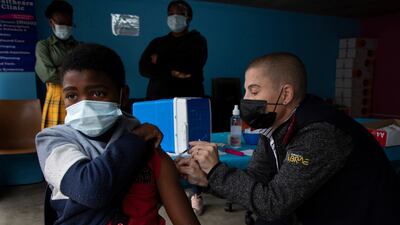
A boy receives a Covid-19 vaccination at a site near Johannesburg. The World Health Organisation's Africa director Matshidiso Moeti says the continent is moving into the ‘control phase’ of the pandemic. AP -

Vaccinations are prepared at a health centre in Nairobi, Kenya. AP -
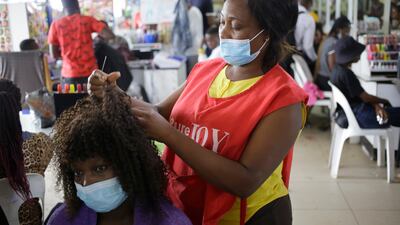
With masks on, hairdresser Tembi Ndlovu tends to a client in a salon in Harare, Zimbabwe. AP -
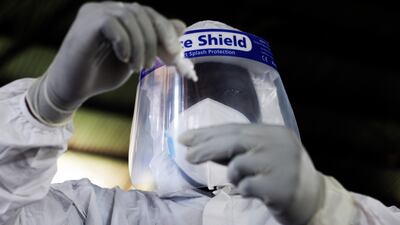
A health official takes a sample for tests at a private Covid-19 testing centre in Harare. AP -
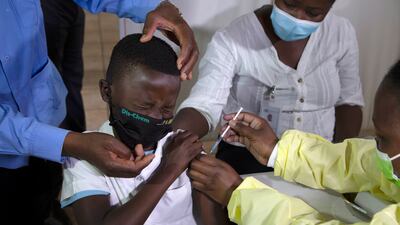
A child receives his Pfizer-BioNTech vaccine against Covi-19 in Diepsloot township near Johannesburg. AP -

Martin Lako prepares to vaccinate Timon Buga Kujo in Juba, South Sudan. Reuters -
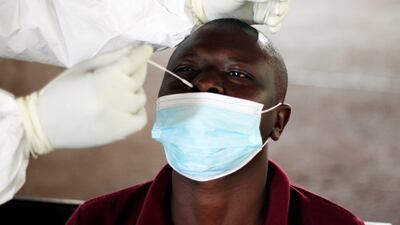
A man is tested for Covid-19 in Harare. AP Photo -
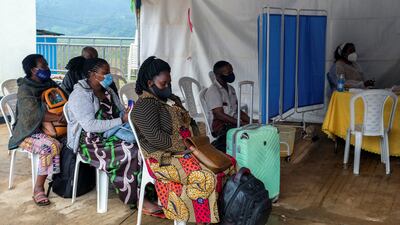
Travellers wait for a coronavirus test at the Gatuna border post at Gicumbi, northern Rwanda. Reuters -
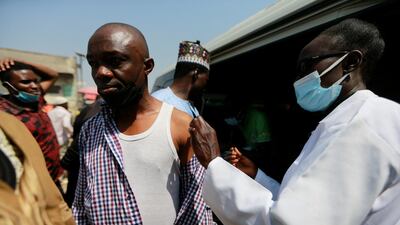
A man is vaccinated at Wuse market in Abuja, Nigeria. Reuters


“This summit is an opportunity to renew our efforts, to keep our foot on the gas when it comes to getting this pandemic under control, and preventing future health crises,” Mr Biden said.
The US commitment to share 11 Covid-19 technologies with the UN-backed Medicines Patent Pool should help to improve access to vaccines, treatments and tests in lower-income countries by allowing them to work on generic versions, the WHO said.
“It's through sharing and empowering lower-income countries to manufacture their own health tools that we can ensure a healthier future for everyone,” WHO Director General Tedros Adhanom Ghebreyesus said.
Reuters contributed to this report

