



A US health chief courted controversy this month after recommending “healthy children” should not be vaccinated against Covid-19.
Florida's surgeon general Dr Joseph Ladapo's declaration reignited debate over the need for younger members of society to be immunised.
Major inoculation campaigns across the world have been central to the fight against the pandemic, with multiple studies showing that, for adults, the benefits of being vaccinated greatly outweigh the risks.
Children who do not have medical conditions that make them vulnerable tend to be less likely than adults to become seriously ill from Covid-19, although the threat is not removed.
As American media have reported, it is partly for this reason that, earlier this month, the Sunshine State became the first in the country to recommend that children in good health are not vaccinated.
National medical organisations in the country were critical of the decision, with some suggesting that it was motivated by politics rather than science.
But how do the pro and cons of vaccination stack up for young children, in particular those aged from five to 11? We consider the evidence and offer the views of experts.
Vaccinating children: the argument for
-
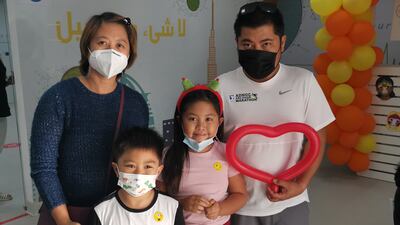
Len Apie, from the Philippines, brought her children Lewis, 9, and Clark, 6, to receive a dose of the Pfizer-BioNTech Covid-19 vaccine in Dubai. All photos: Shuchita Gautam -

There is a separate wing for children at the Oud Metha vaccination centre. -

The centre is decorated with balloons and cartoon cutouts. -

A child gets her face painted after receiving the vaccine. -

Parents said the experience was smooth on the first day and they were in and out in 10 to 15 minutes.


Covid-19 vaccines are “a controlled, safe route to prevention and preventing people from a very serious infection”, according to Dr Bharat Pankhania, a senior clinical lecturer and senior consultant in communicable disease control at the University of Exeter in the UK.
He said a key reason in favour of vaccination was the risk of post-Covid syndrome, also known as Long Covid, in which symptoms persist for weeks and months after the initial infection.
At the moment, he said PCS had an “unknown endpoint” because it had not yet been determined how long it could last.
“For these reasons, it’s important to protect the next generation; therefore vaccination is a very safe way to do it,” he said.
People who are vaccinated are, said Dr Pankhania, less likely to become infected and, if they are infected, tend to remain infectious for a shorter period.
So although vaccination does not completely stop people from becoming infected and spreading infections to others, Dr Pankhania said it did reduce the rate of infection.
As a result, he indicated that were wider benefits to society if younger children were vaccinated, on top of the benefits they received as individuals.
“Your little children may be perfectly okay, but they will spread their infection to granny and kill her,” said Dr Pankhania.
Among the most discussed side effects of the Pfizer-BioNTech vaccine, which is the shot given most often to five to 11-year-olds, are myocarditis (inflammation of the heart muscle) and pericarditis (inflammation of the heart’s outer lining).
These cases have been very rare and, said the US Centres for Disease Control and Prevention in online advice, they have been found “especially in male adolescents and young adults”. So the risk to 5 to 11-year-olds is extremely low.
The CDC continues to recommend that everyone aged 5 and above is vaccinated against Covid-19.
“The known risks of Covid-19 illness and its related, possibly severe complications, such as long-term health problems, hospitalisation and even death, far outweigh the potential risks of having a rare adverse reaction to vaccination, including the possible risk of myocarditis and pericarditis,” the organisation said.
Vaccinating children: the argument against
-
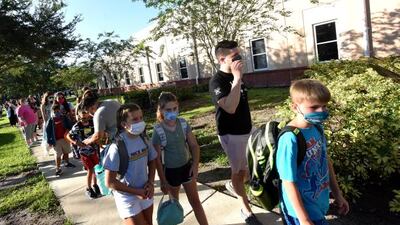
Students wearing face masks arrive with their parents on the first day of classes for the 2021-22 school year at Baldwin Park Elementary School in Florida. Getty Images -
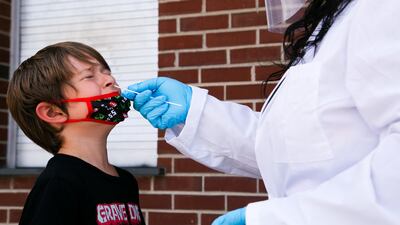
Nurse Alisa Ellis-Balogun tests 7-year-old Thomas Byrd for coronavirus at Seneca High School a day before returning to school in Louisville, Kentucky, US, on August 10, 2021. Reuters -
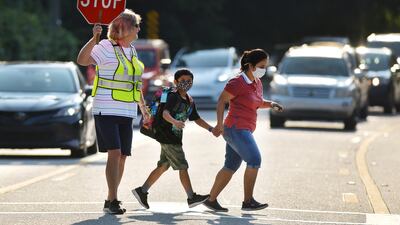
Crossing guard Kelly Linder helps a masked mother and son cross a road as they make their way to Loretto Elementary School on August 10, 2021, in Jacksonville, Florida, for the first day of the new school year. AP -
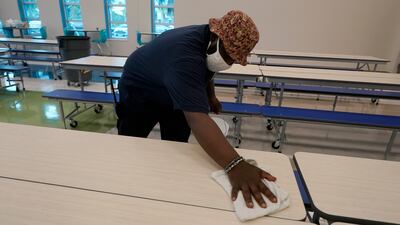
A school worker wipes down tables after students finished eating breakfast, on August 10, 2021, during the first day of school at Washington Elementary School in West Palm Beach, Florida, AP -
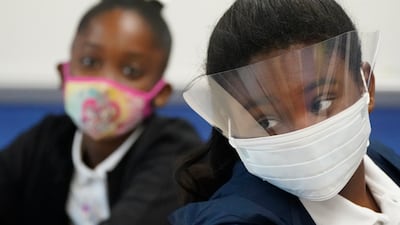
Fifth-grade students wearing masks to help prevent the spread of Covid-19, listen during class, on August 10, 2021, during the first day of school at Washington Elementary School in Riviera Beach, Florida. AP -
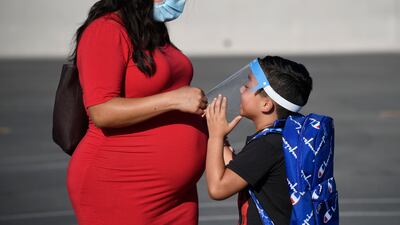
A parent adjusts her son's visor on the first day of school at Enrique Camarena Elementary School in Chula Vista, California, on July 21, 2021. AP -
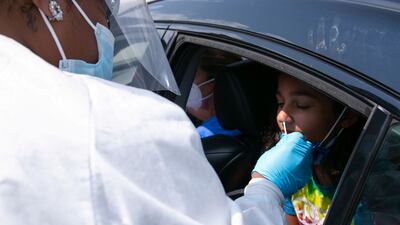
Nurse Celeste Moore, tests 11.5 years old Samira Javed for coronavirus at Seneca High School a day before returning to school in Louisville, Kentucky, US, on August 10, 2021. Reuters -

A student waits in the cafeteria after eating breakfast, on August, 10, 2021, during the first day of school at Washington Elementary School in Riviera Beach, Florida. AP -
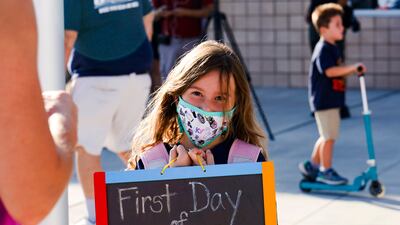
Charlie Gonzalez holds up a sign during the first day of school at the new Hannah Marie Brown Elementary School in Henderson, Nevada, US, on August 9, 2021. AP -
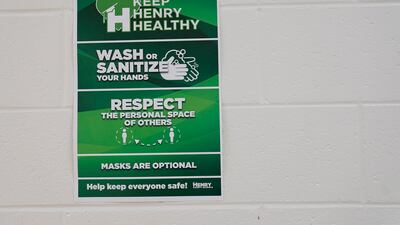
A sign hanging in the hallway reads "Keep Henry Healthy, wash or sanitize your hands, repeat the personal space of others and masks are optional" at Tussahaw Elementary school on August 4, 2021, in McDonough, Georgia, US. AP -
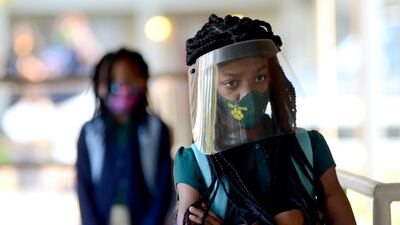
Victoria Dickens wears a mask and face shield as she waits for her class assignment at Summit Elementary School in Summit, Mississippi on August 5, 2021, during the first day of the 2021-22 school year. AP -
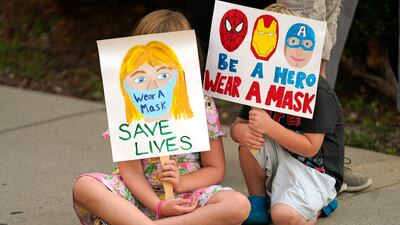
Lucie Phillips, 6, and her brother David Phillips, 3, join parents and students during a rally at Utah State School Board Office calling for mask mandate on August 6, 2021, in Salt Lake City. AP -
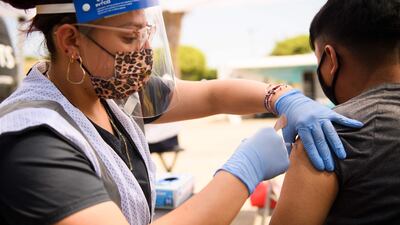
A 17-year-old receives a first dose of the Pfizer Covid-19 vaccine at a mobile vaccination clinic during a back to school event offering school supplies, Covid-19 vaccinations, face masks, and other resources for children and their families at the Weingart East Los Angeles YMCA in Los Angeles, California on August 7, 2021. AFP


A key argument sometimes used against vaccinating younger children is that their risk of falling seriously ill if they are infected with the coronavirus is low.
A study in The Lancet cited by US media gave the estimated infection fatality rate — the proportion of infections that result in death — for each year group from age 1 to 100. For children aged between 5 and 11, the rates varied between 0.0023 per cent and 0.0031 per cent.
Above this age group, death rates climbed, but remained low among young people, so that an 18-year-old has a 0.01 per cent (or one in 10,000) chance of dying from Covid-19.
“The evidence is the number of children who’ve got severely sick and at risk is very low and probably no higher than any other respiratory infection,” said Prof Ian Jones, a professor of virology at the University of Reading in the UK.
Figures for the US indicate that the number of younger children who have died from Covid-19 has been dwarfed by the numbers killed in accidents or homicides.
Another reason given to not vaccinate young children against Covid-19 is, said Prof Jones, that the vaccines reduced the chance of, but did not stop, infection.
“I’m generally of the view that medical intervention should be for a specific purpose. In the case of Covid transmission, that purpose is not entirely clear,” he said.
Although not convinced by the argument himself, Prof Jones said vaccinating younger children may sensitise children to vaccination and discourage them from seeking vaccination when they were older.
Indicating that the issues are finely balanced, Prof Jones said overall he was “slightly against” giving a Covid-19 vaccine to 5 to 11-year-olds but that he did not have “a particularly strong view”.
Opponents of vaccinating younger children have said that the benefits of jabs are limited because so many children have already been infected and so have some natural immunity against the coronavirus.
How is the world handling the issue?
UAE authorities moved early to provide vaccines to younger children, rolling out the Sinopharm jab for 3 to 17-year-olds in August. They made the Pfizer-BioNTech jab available for 5 to 11-year-olds in February.
The European Medicines Agency approved the Pfizer-BioNTech vaccine for 5 to 11-year-olds in late October, with this age group given one third the dose of people aged 12 and above.
Regulators cited a study of nearly 2,000 children that indicated the vaccine, known as Comirnaty, was around 90.7 per cent effective at preventing symptomatic Covid-19.
Typical side effects in 5 to 11-year-olds were similar to those in people aged 12 and above, being usually “mild or moderate and improving within a few days of vaccination”.
“The Committee for Medical Products for Human Use [an EMA committee] therefore concluded that the benefits of Comirnaty in children aged 5 to 11 outweigh the risks, particularly in those with conditions that increase the risk of severe Covid-19,” the EMA said in a briefing document.
Shortly after the EMA’s announcement, the Food and Drug Administration in the US also gave the go-ahead for the vaccine’s use in 5 to 11-year-olds, saying that “no serious side effects” were detected.
The UK’s Joint Committee on Vaccination and Immunisation recommended in December that the Pfizer-BioNTech vaccine be given to children aged 5 to 11 who have factors that make them more vulnerable should they become infected, or who live with an immunosuppressed person. Vaccination was extended to 5 to 11-year-olds who are not clinically vulnerable in February.
Israel started a campaign to vaccinate children as young as 5 in November.
Australia began to immunise children aged 5 to 11 in January.
India this month began vaccinating 12 to 14-year-olds, but has yet to start with younger children.

