



People infected with Covid-19 stand a much greater chance of suffering a heart attack or a stroke, a large US study found.
A comprehensive report based on the study carried out over the course of 10 months, involving tens of thousands of patients, laid bare the long-term effects of the coronavirus.
Researchers at the Washington University in St Louis found that persistent problems can include abnormalities in the heart’s rhythm, blood clots, coronary artery disease, strokes and heart attacks, with some patients dying as a result.
They said that some people are likely to be affected for the rest of their life as a result of complications from a coronavirus infection.
Continuing heart problems may be found even in people who were previously healthy and whose Covid-19 infection was mild, the university said.
It is the latest study to highlight how patients can suffer long after their body has cleared itself of Sars-CoV-2, the virus that causes Covid-19.
Dr Ziyad Al Aly, assistant professor at the university and senior author of the paper, said what was happening with Covid-19 patients’ hearts “wasn’t good”.
Covid-19 prompts surge in heart disease
“Covid-19 can lead to serious cardiovascular complications and death,” he said. “The heart does not regenerate or easily mend after heart damage. These are diseases that will affect people for a lifetime.”
He said the pandemic had resulted in an additional 15 million cases of heart disease across the globe.
Published in the journal Nature Medicine, the research used data from the US Department of Veterans Affairs on more than 150,000 people who had Covid-19 between March 2020 and January 2021 and who survived the first 30 days of their illness.
Because of when the data was collected, most people in the study were not vaccinated.
-

A young woman receives a Pfizer jab in Diepsloot Township near Johannesburg, South Africa. AP Photo -

A girl wearing a face mask rides on a merry-go-round at the Christmas market in Frankfurt, Germany. AP Photo -

People travel on a London underground tube train on the Jubilee Line, in London, during the pandemic. AP Photo -

People wait for the tram in Vienna, Austria, amid the crisis. AP Photo -

A woman passes by an empty terrace in the Marrolles quarter in Brussels, Belgium. AP Photo -

A teacher gives online lessons via webcam at the temporarily closed elementary school in the town of Trebisov, eastern Slovakia. TASR via AP -

Hairdressers and clients wear masks in Amsterdam, Netherlands. AFP -

A man disinfects seats for tourists at a beach in Kuta, Bali, Indonesia. EPA -
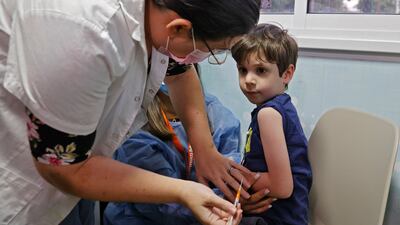
Israeli boy Itamar, 5, receives a dose of the Pfizer/BioNTech Covid-19 vaccine at the Meuhedet Healthcare Services Organisation in Tel Aviv. AFP -

A patient suffering from Covid-19 is admitted in the intensive care unit of the Basaksehir Cam and Sakura City Hospital in Istanbul, Turkey. Reuters -

A health worker prepares to administer the AstraZeneca jab in Abuja, Nigeria. AFP


To determine the effect of the coronavirus infection, this group was compared with 5.6 million individuals who did not have Covid-19 during the same period, and 5.8 million who were heart patients in 2018 or 2019, before the pandemic.
People who contracted Covid-19 were 72 per cent more likely to have coronary artery disease, 63 per cent more likely to have a heart attack and 52 per cent more likely to have a stroke.
Lingering effects of deadly virus
“For people who were clearly at risk for a heart condition before becoming infected with Sars-CoV-2, the findings suggest that Covid-19 may amplify the risk,” Dr Al Aly said.
“But most remarkably, people who have never had any heart problems and were considered low risk are also developing heart problems after Covid-19.”
Risks were increased for young and old people, for people of all races, for males and females, for people with or without obesity and for people with or without diabetes.
The results translate to about three million more people than expected suffering from heart problems in the US alone because of Covid-19.
Dr Bharat Pankhania, a senior clinical lecturer at the University of Exeter in the UK and consultant in communicable disease control who was not connected to the study, was “not surprised at all” that heart problems were found to persist.
The problem, he said, was the way that a coronavirus infection could trigger an autoimmune response that caused continuing organ damage.
Stark findings highlight importance of vaccination
“Be it the heart, be it the brain, be it the kidney, be it the liver,” he said. “There are some viruses that do so, and Sars-CoV-2 appears to trigger a continued reaction in your body after the virus has come and gone.”
The results of the study emphasised the importance, Dr Pankhania said, of becoming vaccinated against Covid-19, as this reduced the chance of a severe infection and an autoimmune response of the kind that caused continuing health issues.
Dr Pankhania said it was important for medical authorities to set up better monitoring systems of patients to understand better who was more likely to develop an autoimmune response and how it could be prevented.
As reported in The National last month, there have been predictions in the UAE that rehabilitation programmes for long Covid could last two to three years.
A variety of symptoms are seen, including fatigue, breathlessness, loss of smell, headaches, muscle aches and difficulty concentrating, sometimes called brain fog.
Reflecting the diversity of symptoms, an array of specialists are involved in treating long Covid patients, including cardiologists, rheumatologists, nephrologists, clinical psychologists and gastroenterologists.

