


A greater proportion of black and Asian people are dying with coronavirus than white people, despite higher case numbers for whites, a study says.
Death rates among black and Asian groups are higher than those in white people, which is “almost certainly” down to differences in vaccine take-up, a government adviser on Covid-19 and ethnicity said.
Deaths are lower than they were in the first and second waves after the introduction of the vaccination programme.
But disparities remain because of the gaps in vaccination rates, with experts calling on people to get their first, second and third shots as soon as possible.
Dr Raghib Ali, the UK government’s independent adviser on Covid-19 and ethnicity, said “nearly all” of the previous trends have reversed in the third wave.
Infection rates are now highest in white people, having risen between the second and third waves, in the least deprived and least densely populated areas that were previously less affected.
“This almost certainly reflects the overall immunity based on natural infection particularly, because London for example has the lowest vaccination rates but also the lowest infection rates at the moment, which really can be only due to differences in natural immunity," Dr Ali said.
“The problem, unfortunately, is that despite still having lower infection rates for South Asians and blacks in this third wave, their hospital rates and death rates are still higher than whites.
“And this almost certainly, sadly, reflects the difference in vaccination rates.”
Vaccination rates remain highest among white people and lowest in black groups, the report says.
It says that rates in older black African and Pakistani people had the biggest increase in the six months to October.
Dr Ali said there has been a “significant improvement” in vaccination among certain groups over the past months, but “the gap is still there”.
“Unfortunately, unless that changes it’s likely that the disproportionate risk for, particularly blacks but also South Asians, will still be there, even though in this third wave infection rates have decreased,” he said.
-
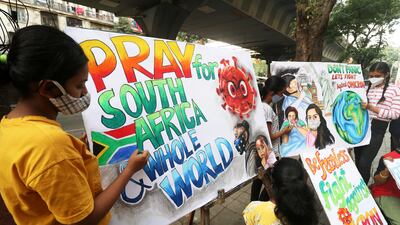
Indian students apply the finishing touches to paintings created to raise awareness of the variant in Mumbai. Reuters -

International travellers wearing personal protective equipment arrive at Melbourne's Tullamarine Airport as Australia records its first cases of the Omicron variant. AFP -
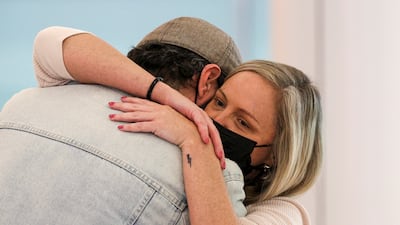
A greeting at the international terminal of Sydney Airport, as countries respond to the new variant. Reuters -
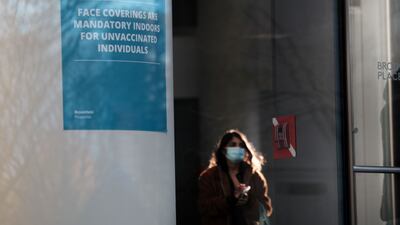
A sign asking people to wear face coverings in a building in Manhattan as the newly discovered Omicron variant appears in countries around the world. AFP -
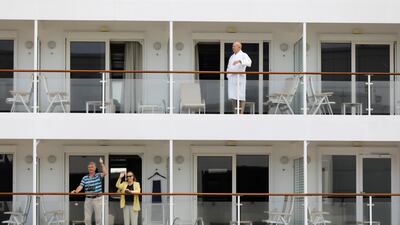
Tourists wave as the ‘Europa’ passenger liner arrives in South African waters off Cape Town as the new coronavirus variant Omicron spreads in other countries. Reuters -
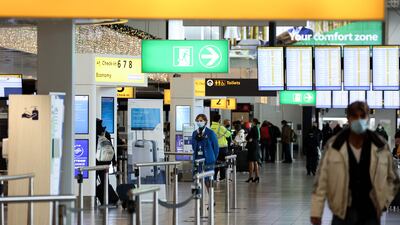
Schiphol airport in Amsterdam. Dutch health authorities said they have found another case of the Omicron Covid-19 variant among passengers arriving from South Africa, bringing the country’s total to 14. AFP -
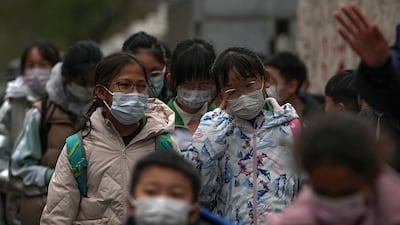
Pupils wear face masks in Beijing. Despite the global worry, scientists say it remains unclear whether the Omicron variant is more dangerous than other strains of the virus. AP -
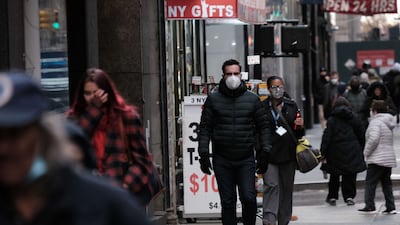
People wearing face masks in Manhattan. New York's governor has declared a state of emergency due to the risk of a surge of Covid-19 cases as winter sets in. AFP -

British Health Secretary Sajid Javid meets a member of staff at a vaccine centre in Guy's and St Thomas' Hospital, London. Getty Images -
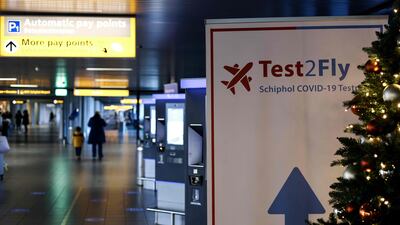
A sign points the way to a Covid-19 test centre at Schiphol Airport in the Netherlands. AFP -
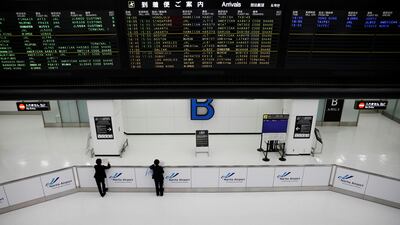
Narita International Airport in Japan is quiet after travel was restricted to prevent the spread of Omicron. Reuters -
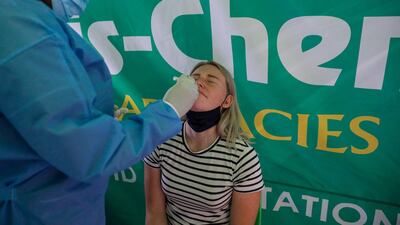
A PCR test at O.R. Tambo International Airport in Johannesburg. AFP -
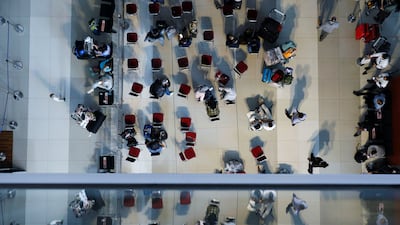
Soekarno Hatta International airport. Indonesia has banned the arrival of travellers who have recently been in eight southern African countries. Reuters -
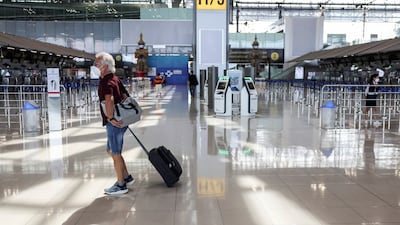
Suvarnabhumi Airport in Bangkok after Thailand banned entry from eight southern African countries due to the Omicron variant. Reuters -
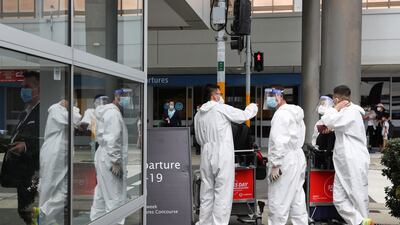
Travellers wear personal protective equipment outside the international terminal at Sydney Airport, Australia. Reuters -

Passengers wearing protective gear at Incheon International Airport in South Korea, where health authorities have imposed an entry ban on foreign arrivals from eight African countries, including South Africa. EPA -
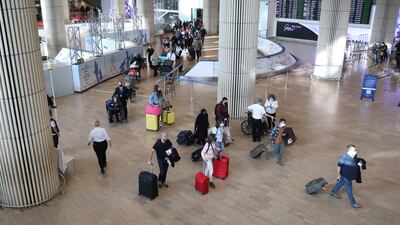
Ben Gurion International Airport near Tel Aviv. The Israeli government approved a 14-day ban on foreign arrivals over concerns about Omicron. EPA -
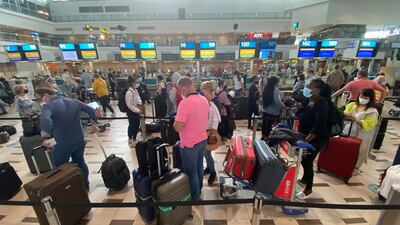
Travellers queuing in the hope of boarding an overbooked Lufthansa flight at Cape Town International Airport. Antonie Robertson / The National -

Covid-stricken Czech President Milos Zeman sits in a plastic cage as he appoints Petr Fiala as Prime Minister, near Prague. AFP -
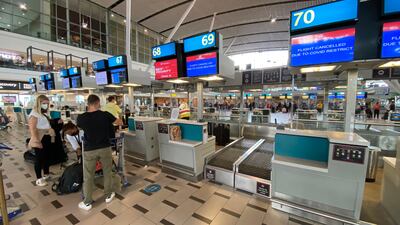
Tourists checking in at Cape Town International Airport in South Africa. Antonie Robertson / The National -
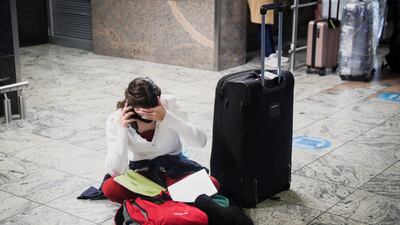
Several airlines have stopped flying out of South Africa amid the spread of the new variant, causing disruption at O.R. Tambo International Airport in Johannesburg. Reuters -
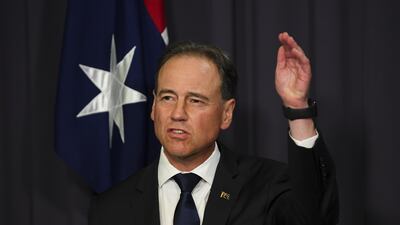
Australian Health Minister Greg Hunt at a press conference at Parliament House in Canberra. Two cases of the recently discovered Omicron variant were detected in New South Wales. EPA -
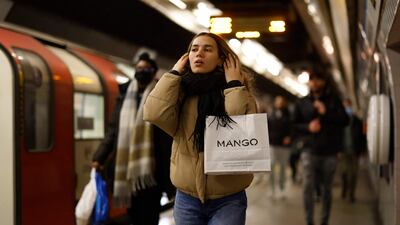
Passengers, many not wearing face coverings, on the London Underground. Health Secretary Sajid Javid said mandatory mask-wearing would return to shops and public transport in England but there are concerns over how the rule will be enforced. AFP -
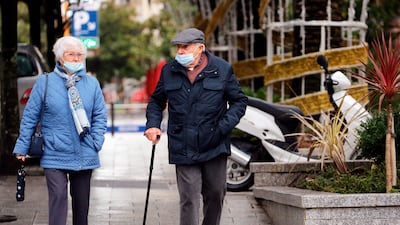
A stroll, with face masks, in Biarritz, south-western France. French Health Minister Olivier Veran said France had no confirmed cases of the Omicron variant and was not changing its strategy of increasing vaccinations and booster shots. AP -
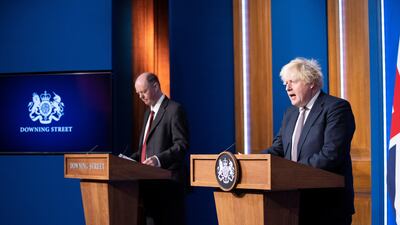
British Prime Minister Boris Johnson and Chief Medical Officer Chris Whitty during a press conference on the variant in London. Reuters


The final report into Covid-19 disparities, produced by the Cabinet Office’s race disparity unit and Dr Ali, outlines the main risk factors in ethnic minority groups.
These include: occupation, particularly for frontline workers; household size, particularly those containing schoolchildren and older relatives; and living in densely populated areas with higher levels of deprivation.
Factors for those infected such as being older, male, and having a disability or pre-existing health condition, were likely to increase the risk of dying.
The government said it used its findings to provide guidance and advice on how to reduce the risk of infection.
It issued guidance on preventing household transmission and measures to protect taxi drivers in the second wave as it emerged that the risk of dying with Covid was higher for Bangladeshi and Pakistani groups.
A higher percentage of people from these groups live in multigenerational households, while more than half of taxi drivers are from a minority ethnic background, the government said.
There have also been a host of initiatives to increase vaccine confidence and deal with misinformation by working with faith and community leaders, making vaccines available through pop-up clinics and places of worship, and holding information sessions.
Equalities Minister Kemi Badenoch said understanding of how different groups are affected by the virus has been “transformed” since the start of the outbreak.
“We know now that factors like the job someone does, where they live and how many people they live with impacts how susceptible they are to the virus and it’s imperative that those more at risk get their booster vaccine,” Ms Badenoch said.
A significant risk factor was living in multigenerational households in the second wave, when schools were open during lockdown periods, compared to the first wave when they were closed to most students.
Dr Ali said there is no “easy answer”, as keeping children home from school would damage their mental and physical health and education, adding that most grandparents would not want their grandchildren to suffer.
He said there was a need for better education for people in such households about ways they can best protect themselves.
Among the report’s recommendations is a warning for public health communications not to “stigmatise” ethnic minorities by singling them out and to improve the quality of health ethnicity data.
All recommendations in the report have been accepted by the government.

