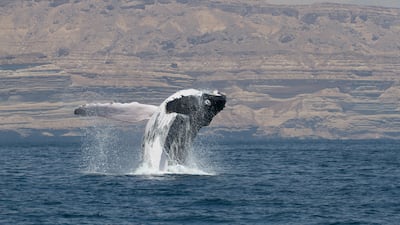

The Arabian Sea humpback whale’s unique song has long led scientists to believe that the animal was a subspecies of its own. Now, genetic research shows that the endangered mammal is distinct from other whale populations.
The study led by the US's Wildlife Conservation Society and the Environment Society of Oman (ESO) compared genetic samples from Arabian Sea humpback whales with populations from across the world’s oceans.
It found “compelling evidence” that the whale had its own evolutionary lineage, supporting its potential recognition as a fourth subspecies of humpback whale.

Researchers analysed mitochondrial DNA from 2,285 humpback whales. The results, published on Tuesday in Frontiers in Marine Science, revealed high levels of genetic differences between the Arabian Sea population and the three currently recognised humpback whale subspecies of the North Atlantic, North Pacific and Southern Hemisphere.
This indicates that the gene flow between them had been limited. The Arabian Sea population also showed the lowest genetic diversity among the ocean regions examined.
The Arabian Sea whale is now believed to have evolved tens of thousands of years ago, with different groups showing estimated divergence times ranging from about 43,000 to 113,000 years ago.

The next step will be to have the subspecies recognised formally by the Society for Marine Mammalogy’s Taxonomy Committee. The whales have “long been an enigma” to scientists, according to the study’s lead author Dr Rita Amaral, who co-ordinated the genetic analysis.
“Their ecology is unlike that of any other known humpback whale population, and this new genetic work represents an important milestone in understanding how that uniqueness developed,” she said.
“The results clearly indicate the Arabian humpback whales have followed their own evolutionary trajectory for tens of thousands of years and support their recognition as a distinct subspecies,” she said.
Earlier evidence that the Arabian Sea humpback whale was unique rested on its migratory patterns and song. Unlike other humpback whales that make long seasonal migrations across oceans, Arabian Sea humpbacks breed and feed in the same areas and remain in tropical and sub-tropical waters all year round.
The Arabian Sea humpback whale was also found to be closely related to humpback whales that were previously found on the Shatt Al Arab on the Iraqi coast. Researchers analysed the DNA of whale bones described as Megaptera indica collected in 1883 near Basra, which are held by the Musee National d’Histoire Naturelle in Paris.

Isolation
But the population’s isolation is also what makes it so vulnerable. The researchers wrote that the population is small, with no evidence of an increase over the past two decades, and called for more concerted efforts to manage the threats.
Arabian Sea humpback whales face threats from entanglement in fishing gear, vessel strikes, underwater noise and pollution, as well as natural stressors such as disease. Climate-driven changes to monsoons and ocean upwelling may also affect the availability of sardines and other prey.
Aida Al Jabri of the Environment Authority of Oman said they would act on the findings to respond to the pressures faced by these whales. “The growing body of research on Arabian Sea humpback whales has given Oman an increasingly clear understanding of both the importance of this population and the pressures it faces,” she said. “This evidence is now helping us move from scientific understanding towards practical conservation action.”
Oman’s study of humpback whales began 25 years ago, with huge leaps in the research technology available, according to co-author Suaad Al Harthi, executive director of ESO.
“What began with small-boat surveys to photograph individual whales and collect tiny tissue samples has developed into a much broader programme using satellite tracking, acoustic monitoring, health assessments and other techniques,” she said. “It is enormously rewarding to see samples collected during those early years now contributing to findings of such international scientific importance.”

