


Coral reefs offer wondrous, colourful images that mesmerise snorkellers, divers and indeed almost anyone who watches wildlife documentaries – but for how much longer?
The US National Oceanic and Atmospheric Administration (NOAA) has revealed these natural ecosystems are now being badly hit by a global bleaching event sparked by high temperatures – with climate change a likely cause.
The current incident is, the NOAA said, the fourth recorded global bleaching event and the second in the past decade.
Dr Derek Manzello, co-ordinator of NOAA’s Coral Reef Watch programme, said there has been "significant coral bleaching" in the Northern and Southern Hemispheres in each major ocean basin.
Bleaching events have been recorded in areas such as the Arabian Gulf, the Red Sea, Australia’s Great Barrier Reef, the Caribbean and much of the South Pacific.
Dwindling coral numbers
According to environmental organisation the WWF, half the world’s reefs have been lost over the past three decades because of harm caused by the likes of pollution, coastal development, shipping, fishing – and climate change.
Asher Minns, executive director of the Tyndall Centre for Climate Change Research at the University of East Anglia in the UK, said high temperatures were "clearly having devastating repercussions for important coral habitats".
He said: "2023 was the warmest year globally on record. We know at periods the 1.5°C target [to limit global temperature increases] was broken and corals are very sensitive to temperature."
As temperatures have increased, scientists have observed, as well as a loss of reefs, a natural shift from heat-sensitive species to more heat-tolerant species, but there are concerns this has come at the expense of coral diversity, with reefs becoming less able to support thriving ecosystems.
Corals, which are colonial marine invertebrates, live in symbiosis, or mutually beneficial relationships, with single-celled algae called zooxanthellae, which provide the corals with most of their energy.
When temperatures are too high or are unusually cold, the zooxanthellae are expelled, which causes the coral to turn white.
Coral can recover from bleaching but this does not always happen and the process can leave them vulnerable disease.
Few have seen more closely the effects of warming temperatures on coral than Dr John Burt, an associate professor of biology at New York University Abu Dhabi.
His team leads the UAE’s national coral-reef monitoring programme and has been conducting surveys at 29 coral reefs off the UAE coasts.
As regional co-ordinator for the Global Coral Reef Monitoring Network, Dr Burt also collates data from surrounding nations.
UAE coral has, he said, experienced several mass bleaching events, with these happening at the same time as bleaching has been seen globally.
"We had our first mass bleaching in 1996, when reefs across Abu Dhabi and Dubai lost over 90 per cent of their coral," Dr Burt said.
"However, conditions cooled and over the subsequent decades corals were able to recover across much of the area."
A further bleaching event occurred in 2010, Dr Burt said, but this was more modest and only around one fifth of coral was affected.
However, marine heatwaves have become "frequent and severe" under climate change and in the past decade there have been "several extreme summers".
'Alarming' climate threat
While they have evolved to live in warm water, corals in the Arabian Gulf are now, he said, living "very close to their upper thermal limits".
Sea temperatures in Abu Dhabi hit "an all-time high" in 2017 and nearly three quarters of corals from reefs in the southern Arabian Gulf were lost, Dr Burt said.
In 2021 there was an even more severe summer, when sea temperatures reached 37.7°C. Corals that had already been degraded suffered more loss, while the first mass bleaching was seen on the UAE’s east coast, where, Dr Burt said, upwards of 90 per cent of corals were lost on some reefs.
"Corals typically need 10 to 15 years to recover from mass bleaching events to turn to their pre-bleaching state, so the frequency of these events is alarming," he said. As climate change’s effects on the natural world become increasingly clear, analysts are emphasising the importance of climate action, with Mr Minns saying the world should "reduce immediately the amount of CO2 going into the atmosphere", referring to the main climate-warming gas.
"As well as reducing emissions, we need to understand how our ecosystems can be made less vulnerable to a changing climate and changing temperature extremes," he added.
Building up resilience
-
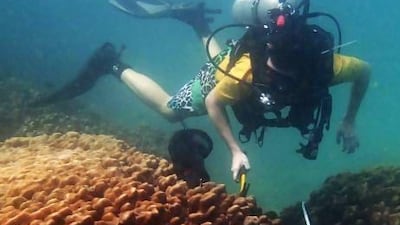
John Burt, associate professor of biology at New York University Abu Dhabi, has studied the region’s seas for the past 15 years. Photo: Joerg Wiedenmann -
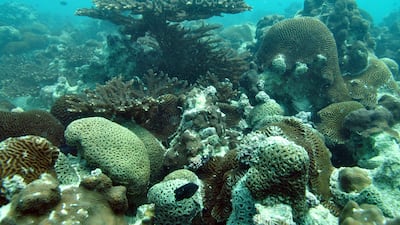
Table coral, such as the kind seen on the top left in Ghantoot, are among the heat-sensitive Acropora species. Photo: John Burt -
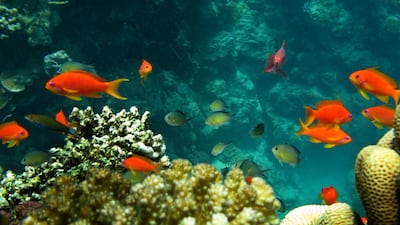
Researchers from NYU Abu Dhabi are looking for clues that could one day help coral reefs around the world survive the onslaught of global warming. Photo: John Burt -
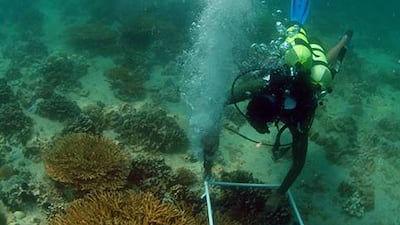
John Burt using a pneumatic drill to install coral monitoring equipment on the sea-bottom at Ras Ghanada reef in Ghantoot, UAE. Photo: John Burt -
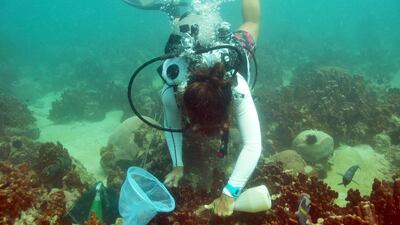
A scientist collects samples from a coral reef in Abu Dhabi, which scientists say have suffered a 'catastrophic event' because of warming waters. Photo: John Burt -
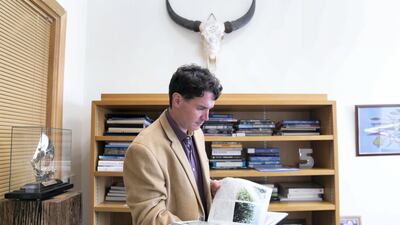
In 2017, John Burt, associate professor of biology at NYU Abu Dhabi calculated that 73 per cent of corals across all of the southern Gulf were lost. Reem Mohammed / The National -
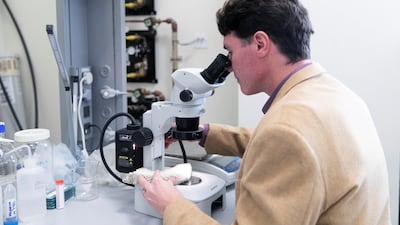
John Burt studied the corals from the Gulf waters for the far-reaching global report on warming waters and their affect on coral reefs. Reem Mohammed / The National -

High sea temperatures cause coral to bleach and die. Reem Mohammed / The National


When it comes to corals, scientists have been doing this by identifying types that are more resistant to high temperatures and breeding them. Dr Burt is among the researchers involved in this.
"The Arabian Gulf is home to the world’s most heat-tolerant corals, and [we] currently have research under way to cross-breed these heat-tolerant corals with those from cooler, but warming, environments in other regions," Dr Burt said.
"Our earlier research has shown that this can result in up to an 84 per cent increase in the survival of cross-bred corals compared with pure-bred native corals from those cooler environments when exposed to heat stress."
This, Dr Burt said, suggests the region’s "pre-adapted corals" may be able to help rescue corals from other parts of the world.
"For us this is a race against time and the next few years will be quite dynamic as we seek to scale up these programmes in the hope of saving the incredible natural assets that UAE corals represent," he said.
Another approach is to physically shade corals to protect them from the Sun.
In a study published last year, researchers from Southern Cross University and the University of Sydney in Australia found that shading corals, even if for only a few hours a day, could cut the risk of bleaching in shallow reefs.
"Our results suggest that intermittently shading corals for four hours [a day] can moderate light stress and slow bleaching in some corals, and could improve the efficiency of active solar radiation management in marine ecosystems," the scientists wrote in Frontiers in Marine Science.
While efforts are being made to try to safeguard coral reefs, they are continuing to be lost to heatwaves and other harmful environmental influences.
"We are now looking towards this coming summer with trepidation, as this may be the final nail in the coffin for coral communities in some of our reefs, as there has not been sufficient time for recovery from these earlier [bleaching] events," Dr Burt said.
"Given that these are – by far – the most biodiverse ecosystem in this region, the outlook is particularly heart-breaking for people like myself, who have been diving on the UAE’s spectacular reefs for decades."

