A delivery man unloads air condition units at a store in the Karada district of Baghdad in 2021, after temperatures exceeded 50°C. AFP

Middle East temperature surge may be overestimated, report suggests


Daniel Bardsley
  • English
  • Arabic

Temperature increases over the Arabian Peninsula prompted by climate change may not be as steep as some forecasts, a study shows.

The research, based on the latest satellite data, indicates that some climate models may use overestimates of carbon dioxide concentrations when calculating temperature rises.

However, the new finding do not dispute that temperatures will continue to rise, and experts have warned that effects from climate change are already being felt in the region.

One of the authors of the new study, Diana Francis, an assistant professor who heads the Environmental and Geophysical Sciences (Engeos) laboratory at Khalifa University in Abu Dhabi, said the study used “state-of-the-art observations” of carbon dioxide concentrations in the atmosphere. These, she said, were not available when the inputs for climate models were developed.

Diana Francis, heads the Environmental and Geophysical Sciences (Engeos) laboratory at Abu Dhabi's Khalifa University. Antonie Robertson / The National

“We found that the concentrations of CO2 were overestimated by 10 ppmv [parts per million by volume] in 2022, which could correspond to an overestimation of temperature increase,” she added.

The paper, co-written by Ricardo Fonseca, also of the Engeos laboratory, stated that this overestimation “can lead to an over-prediction of the projected increase in temperature in the region”, adding that this “needs to be investigated further”.

A 2022 study by 21 scientists across the Middle East and Europe, including Ms Francis, forecast that temperature increases up to now in the region, of about 0.45°C per decade, were set to continue.

Ms Francis said that because of the complex nature of the relationship between carbon dioxide levels and temperature, it was not possible from the latest study to estimate forthcoming temperature increases.

Accurate data is key

She added that there was a lack of ground-based observations of carbon dioxide levels in the Middle East, which had, until this latest satellite data became available, made it difficult to check the data used as inputs in climate models.

“This stresses the importance of having a good network of in-situ observations for greenhouse gases in general and CO2 in particular, so the numbers given to climate models are more accurate,” she said.

“Unfortunately, this is still missing in the UAE and the Middle East; the only source of data for now are satellite observations, the ones we used in our study.”

The study, which is titled Satellite-derived trends and variability of CO2 concentrations in the Middle East during 2014-2023, will be published in Frontiers in Environmental Sciences.

It uses data from the Orbiting Carbon Observatory 2 (OCO-2), a Nasa satellite launched in 2014 to show where carbon dioxide comes from and is stored, so that scientists can better understand its climate change input. The satellite makes about 100,000 measurements per day.

Researchers also analysed data from Orbiting Carbon Observatory 3, which was crafted from spare equipment from OCO-2. Launched in 2019, OCO-3 is attached to the International Space Station.

Concern over C02 surge

Data from 2015 to 2022 indicates that carbon dioxide concentrations in the Middle East are increasing by about 2.50 ppmv per year. Ms Francis said that this was significantly above the global average of about 2.13ppm.

According to the US government’s National Oceanic and Atmospheric Administration, the concentration of the gas in the atmosphere in preindustrial times, before humans began releasing vast quantities of carbon dioxide into the atmosphere by burning fossil fuels, was about 280 ppmv, but it is now above 420ppmv.

Prof Niklas Hoehne, founder of the NewClimate Institute for Climate Policy and Global Sustainability in Germany, who was not connected with the new study, said that climate change impacts were “already drastic in the Middle East”.

“It’s a region with limited water resources and very high temperatures,” he added. “We’ve seen in the last year peak temperatures of 50°C. In the long run, if temperatures are rising, the times the temperatures are above 50 °C [will increase].

“It really makes it a very difficult place to live or to live without a lot of energy – a lot of air conditioning and water desalination. It’s already a difficult situation and it will only get worse because of climate change.”

Stark impact of climate change

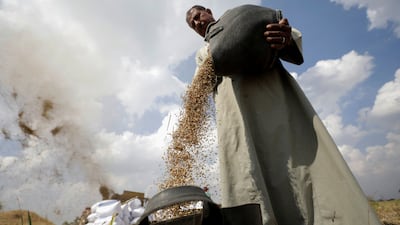
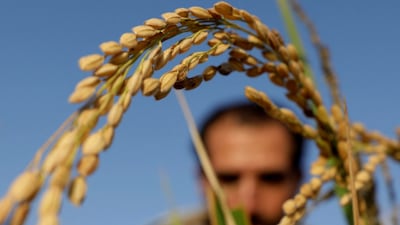
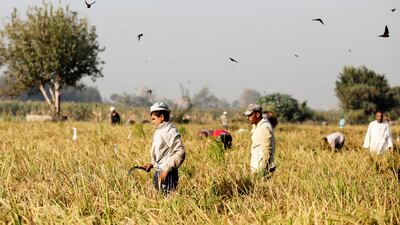
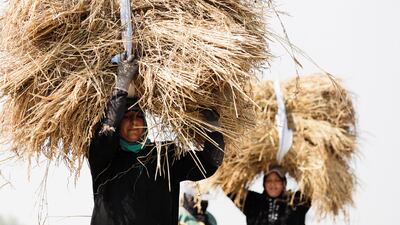
  • Farmer Ezzat Mostafa, 62, winnows rice in a field in Qaha, north of Cairo, Egypt. All photos: Reuters
    Farmer Ezzat Mostafa, 62, winnows rice in a field in Qaha, north of Cairo, Egypt. All photos: Reuters
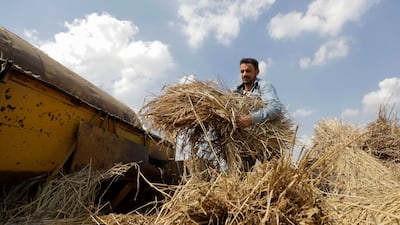
  • Mr Mostafa says this season has been difficult because of water shortages and severe heat.
    Mr Mostafa says this season has been difficult because of water shortages and severe heat.
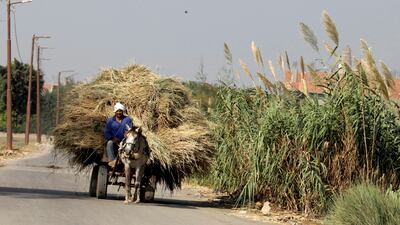
  • Qaha is located in the rich farmland of the southern part of the Nile Delta.
    Qaha is located in the rich farmland of the southern part of the Nile Delta.
  • As Egypt hosts the UN's Cop27 climate talks, the country’s leaders have said the changing conditions the Delta, known for millennia for its fertile soil, are a major concern.
    As Egypt hosts the UN's Cop27 climate talks, the country’s leaders have said the changing conditions the Delta, known for millennia for its fertile soil, are a major concern.
  • Saltwater intrusion, caused by rising seas, is the most challenging threat to the Delta, experts say.
    Saltwater intrusion, caused by rising seas, is the most challenging threat to the Delta, experts say.
  • The Nile Delta is home to about 40 per cent of Egypt’s 104 million people and accounts for half of the country’s economy, according to the UN food agency.
    The Nile Delta is home to about 40 per cent of Egypt’s 104 million people and accounts for half of the country’s economy, according to the UN food agency.
  • The government is introducing measures, including barriers and run-off systems, to protect the Delta's people from the effects of climate change.
    The government is introducing measures, including barriers and run-off systems, to protect the Delta's people from the effects of climate change.

The hottest weather in the Middle East is already “quite devastating” for those working outside, said Phillip Williamson, an honorary associate professor in the School of Environmental Sciences at the University of East Anglia in the UK.

“If critical temperatures increase a couple of degrees in one part of the world, it might have more impact than if it increases in other parts,” he said.

The new paper also indicates that carbon dioxide levels in the Middle East peak in the spring and are at their lowest in the autumn.

“This is related to the vegetation cycle in the Northern Hemisphere, where carbon dioxide in the atmosphere decreases during the growing season and increases during the rest of the year, which leads to maximum build-up in spring before photosynthesis begins to take over again,” Ms Francis said.

Aside from this general trend, the research revealed that there is a peak in carbon dioxide levels over the north-eastern part of the UAE and southern Iran in the summer.

This develops, Ms Francis said, mainly because of an increase in emissions in the surroundings areas from facilities such as power plants, desalination plants and oil and gas facilities.

The atmospheric circulation during this part of the year then tends to accumulate the emissions over the north-eastern UAE and southern Iran.

The European Space Agency has a major carbon dioxide monitoring programme that should provide researchers with a wealth of valuable data, with the first satellite linked to the initiative due for launch in 2025.


UAE Premiership

Results
Dubai Exiles 24-28 Jebel Ali Dragons
Abu Dhabi Harlequins 43-27 Dubai Hurricanes

Fixture
Friday, March 29, Abu Dhabi Harlequins v Jebel Ali Dragons, The Sevens, Dubai

Mercer, the investment consulting arm of US services company Marsh & McLennan, expects its wealth division to at least double its assets under management (AUM) in the Middle East as wealth in the region continues to grow despite economic headwinds, a company official said.

Mercer Wealth, which globally has $160 billion in AUM, plans to boost its AUM in the region to $2-$3bn in the next 2-3 years from the present $1bn, said Yasir AbuShaban, a Dubai-based principal with Mercer Wealth.

Within the next two to three years, we are looking at reaching $2 to $3 billion as a conservative estimate and we do see an opportunity to do so,” said Mr AbuShaban.

Mercer does not directly make investments, but allocates clients’ money they have discretion to, to professional asset managers. They also provide advice to clients.

“We have buying power. We can negotiate on their (client’s) behalf with asset managers to provide them lower fees than they otherwise would have to get on their own,” he added.

Mercer Wealth’s clients include sovereign wealth funds, family offices, and insurance companies among others.

From its office in Dubai, Mercer also looks after Africa, India and Turkey, where they also see opportunity for growth.

Wealth creation in Middle East and Africa (MEA) grew 8.5 per cent to $8.1 trillion last year from $7.5tn in 2015, higher than last year’s global average of 6 per cent and the second-highest growth in a region after Asia-Pacific which grew 9.9 per cent, according to consultancy Boston Consulting Group (BCG). In the region, where wealth grew just 1.9 per cent in 2015 compared with 2014, a pickup in oil prices has helped in wealth generation.

BCG is forecasting MEA wealth will rise to $12tn by 2021, growing at an annual average of 8 per cent.

Drivers of wealth generation in the region will be split evenly between new wealth creation and growth of performance of existing assets, according to BCG.

Another general trend in the region is clients’ looking for a comprehensive approach to investing, according to Mr AbuShaban.

“Institutional investors or some of the families are seeing a slowdown in the available capital they have to invest and in that sense they are looking at optimizing the way they manage their portfolios and making sure they are not investing haphazardly and different parts of their investment are working together,” said Mr AbuShaban.

Some clients also have a higher appetite for risk, given the low interest-rate environment that does not provide enough yield for some institutional investors. These clients are keen to invest in illiquid assets, such as private equity and infrastructure.

“What we have seen is a desire for higher returns in what has been a low-return environment specifically in various fixed income or bonds,” he said.

“In this environment, we have seen a de facto increase in the risk that clients are taking in things like illiquid investments, private equity investments, infrastructure and private debt, those kind of investments were higher illiquidity results in incrementally higher returns.”

The Abu Dhabi Investment Authority, one of the largest sovereign wealth funds, said in its 2016 report that has gradually increased its exposure in direct private equity and private credit transactions, mainly in Asian markets and especially in China and India. The authority’s private equity department focused on structured equities owing to “their defensive characteristics.”

On Instagram: @WithHopeUAE

Although social media can be harmful to our mental health, paradoxically, one of the antidotes comes with the many social-media accounts devoted to normalising mental-health struggles. With Hope UAE is one of them.
The group, which has about 3,600 followers, was started three years ago by five Emirati women to address the stigma surrounding the subject. Via Instagram, the group recently began featuring personal accounts by Emiratis. The posts are written under the hashtag #mymindmatters, along with a black-and-white photo of the subject holding the group’s signature red balloon.
“Depression is ugly,” says one of the users, Amani. “It paints everything around me and everything in me.”
Saaed, meanwhile, faces the daunting task of caring for four family members with psychological disorders. “I’ve had no support and no resources here to help me,” he says. “It has been, and still is, a one-man battle against the demons of fractured minds.”
In addition to With Hope UAE’s frank social-media presence, the group holds talks and workshops in Dubai. “Change takes time,” Reem Al Ali, vice chairman and a founding member of With Hope UAE, told The National earlier this year. “It won’t happen overnight, and it will take persistent and passionate people to bring about this change.”

COMPANY%20PROFILE
%3Cp%3E%3Cstrong%3EName%3A%20%3C%2Fstrong%3ESmartCrowd%0D%3Cbr%3E%3Cstrong%3EStarted%3A%20%3C%2Fstrong%3E2018%0D%3Cbr%3E%3Cstrong%3EFounder%3A%20%3C%2Fstrong%3ESiddiq%20Farid%20and%20Musfique%20Ahmed%0D%3Cbr%3E%3Cstrong%3EBased%3A%20%3C%2Fstrong%3EDubai%0D%3Cbr%3E%3Cstrong%3ESector%3A%20%3C%2Fstrong%3EFinTech%20%2F%20PropTech%0D%3Cbr%3E%3Cstrong%3EInitial%20investment%3A%20%3C%2Fstrong%3E%24650%2C000%0D%3Cbr%3E%3Cstrong%3ECurrent%20number%20of%20staff%3A%3C%2Fstrong%3E%2035%0D%3Cbr%3E%3Cstrong%3EInvestment%20stage%3A%20%3C%2Fstrong%3ESeries%20A%0D%3Cbr%3E%3Cstrong%3EInvestors%3A%20%3C%2Fstrong%3EVarious%20institutional%20investors%20and%20notable%20angel%20investors%20(500%20MENA%2C%20Shurooq%2C%20Mada%2C%20Seedstar%2C%20Tricap)%3C%2Fp%3E%0A
match info

Southampton 2 (Ings 32' & pen 89') Tottenham Hotspur 5 (Son 45', 47', 64', & 73', Kane 82')

Man of the match Son Heung-min (Tottenham)

The specs
  • Engine: 3.9-litre twin-turbo V8
  • Power: 640hp
  • Torque: 760nm
  • On sale: 2026
  • Price: Not announced yet
Results

2pm: Handicap (PA) Dh80,000 1,600m; Winner: AF Al Baher, Bernardo Pinheiro (jockey), Ernst Oertel (trainer).

2.30pm: Handicap (TB) Dh100,000 1,600m; Winner: Talento Puma, Xavier Ziani, Salem bin Ghadayer.

3pm: Handicap (TB) Dh90,000 1,950m; Winner: Tailor’s Row, Royston Ffrench, Salem bin Ghadayer.

3.30pm: Jebel Ali Stakes Listed (TB) Dh500,000 1,950m; Winner: Mark Of Approval, Patrick Cosgrave, Mahmood Hussain.

4pm: Conditions (TB) Dh125,000 1,400m; Winner: Dead-heat Raakez, Jim Crowley, Nicholas Bachalard/Attribution, Xavier Ziani, Salem bin Ghadayer.

4.30pm: Jebel Ali Sprint (TB) Dh500,000 1,000m; Winner: AlKaraama, Antonio Fresu, Musabah Al Muhairi.

5pm: Handicap (TB) Dh100,000 1,200m; Winner: Wafy, Richard Mullen, Satish Seemar.

5.30pm: Handicap (TB) Dh90,000 1,400m; Winner: Cachao, Tadhg O’Shea, Satish Seemar.

Updated: December 22, 2023, 5:33 AM