

A thriving nursery at the base of Hajar Mountains stands as a testament to a retired UAE army officer's dream of a green revolution.
Ahmed Al Hefeiti, an Emirati steeped in a rich farming tradition, imports rare and diverse plants from countries in Asia, Africa, Europe and the Middle East, and grows them in the UAE’s arid climate.
He has succeeded in harvesting a wide variety of fruits including mangoes and lemons from Pakistan, Chinese bayberries, Japanese oranges, South Africa's jujube as well as India’s cashews, chikoo, black jamun, jackfruit and passion fruit. From Thailand, Mr Al Hefeiti brought lychees, longan and star fruit.
Located about 20km outside Fujairah city on the Masafi road, the Wadi Dafta Plantation covers 2,000 square metres.
“I opened the nursery in 2018 because of my love for plants,” says Mr Al Hefeiti, who used to collect plants during his travels overseas and bring them home, following strict UAE regulations.
After the nursery was established, he obtained a licence to import plants.
“I have rare plants such as wood apple which I brought from Nepal even before opening the plantation.”
The nursery offers plants, seeds and fertilisers for sale.
Mr Al Hefeiti harvests Panama berries, guava, pineapples, pomegranates, papayas and Indian spices such as black pepper, cloves and cardamom. There are 13 types of banana plants including the red and blue varieties.
A plant imported from South Africa produces Black Sapote fruit that tastes like chocolate pudding. It is placed next to a tall mango tree to avoid direct sunlight.
Vegetables include aubergine, okra, chillies and peppers, and beehives provide a plentiful supply of honey. There are several flowering plants including Mohammadi rose from Iran that is used to create rose water.
Experimenting
-

Ahmed Al Hefeiti’s nursery at the Wadi Dafta Plantation in Fujairah. He is retired Emirati army officer and agriculture enthusiast. All photos: Pawan Singh / The National -

Ahmed Al Hefeiti showing off his plants -

Various types of fruits and vegetable plants at Ahmed Al Hefeiti’s nursery in Fujairah -

Ahmed Al Hefeiti grew up in the Fujairah village of Sakamkam next to his father’s farm -
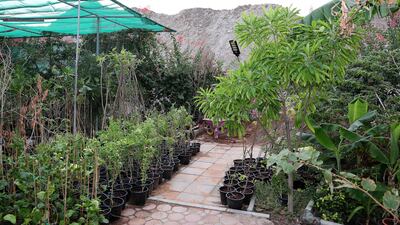
Nutrient-rich soil is prepared using compost, organic fertilisers and coco peat, a mixture made from the husks of coconuts -

Ahmed Al Hefeiti imports rare and diverse plants from countries in Asia, Africa, Europe and the Middle East, and grows them in the UAE’s arid climate -

'My wish is to have a green UAE, to grow more plants and to encourage the younger generation to do gardening in their house,' Ahmed Al Hefeiti says -

Ahmed Al Hefeiti shows off some of the organic aubergines from his plantation -
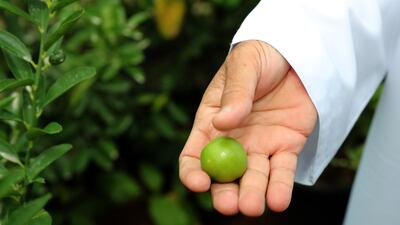
'We eat from what we grow,' Ahmed Al Hefeiti says. 'Everything is available in our farm — from fruit and vegetables to meat and milk' -

When plants arrive, they are kept in a greenhouse until they acclimatise to the new conditions -

Papaya is just one of the many fruits grown at the mountain farm -

Ahmed Al Hefeiti hopes the country can build an ‘agriculture city’, a community that houses local and global brands catering to all farming needs


When plants arrive, they are kept in a greenhouse until they acclimatise to the new conditions.
“I consider it [greenhouse] as an intensive care unit or ICU for my plants which I bring from abroad,” Mr Al Hefeiti says as he lifts a small pot. “For example, we brought these plants from Syria without soil. We kept them in pots in the greenhouse for a week and now they are doing OK.”
The plants are then moved under direct sunlight or to a shaded area, depending on their requirements.
“I see what works better because different plants need different environments. We try our best to provide the real environment for that kind of plant.”
Many plants such as black jamun, mangoes, guavas and chikoos are grown by grafting, a technique of connecting two severed plant segments together.
Nutrient-rich soil is prepared using compost, organic fertilisers and coco peat, a mixture made from the husks of coconuts. An in-house distillation system turns saline seawater into fresh water for irrigation. Water from a reservoir, which contains fish waste, is also used for irrigation and as fertiliser.
However, not all of Mr Al Hefeiti’s experiments have been successful.
“We tried Thailand’s rambutan but it didn’t grow in the UAE," he says. "Mangosteen also didn’t work. It was hard — maybe they needed a cooling system.”
Following in his father’s footsteps
Mr Al Hefeiti grew up in the Fujairah village of Sakamkam next to his father’s farm. After working in the UAE army’s medical corps for 15 years, he retired as a lieutenant colonel and then served as deputy chief executive of Al Sharq Healthcare. Now he can turn his undivided attention to his passion for agriculture.
“Since I was a child, I was helping my father on his farm, so he was teaching me all the time,” he recalls.
His family farm is still flourishing and is home to cattle and chicken.
“We eat from what we grow," Mr Al Hefeiti says. "Everything is available in our farm — from fruit and vegetables to meat and milk.”
Vision of a green UAE
In a country where 90 per cent of the food is imported, Mr Al Hefeiti is championing local, organic and sustainable food.
“My wish is to have a green UAE, grow more plants and to encourage the younger generation to do gardening in their house,” he says.
“When we import vegetables and fruits, they are not as fresh as the ones locally produced. We don't know what chemicals have been used.”
“Our winter season is long, from October until April. If you compare that to Europe, they have only three months that are favourable for agriculture. In Asia, people can do farming all year long but sometimes they get too much rain, which destroys their crops.”
He hopes the country can build an ‘agriculture city’, a community that houses local and global brands catering to all farming needs.
“It could have everything from seeds, plants, equipment to tools. It could also have universities for studying agriculture and exhibition centres.”
The agriculture city will boost our agritourism industry as it will attract visitors and generate income for our farms and businesses, he adds.

