


Live updates: Follow the latest news on Cop28
An Indian climate guru says the preservation of the Earth's soil is key to tackling the climate crisis.
Jaggi Vasudev, or Sadhguru as he is better known, said his key message at the Cop28 climate summit is that protecting the soil is imperative to saving the planet.
He said there is an urgent need to slow down forced migration and igniting mass awareness on soil nutrition will place it on the policy agenda of all governments.
Soil degradation causes millions to migrate every year and the UN has warned of a dangerous decline in food production over the next 30 years with Earth’s top soil at risk by 2050.
an Indian spiritual leader on strengthening the soil
Sadhguru has a mass following with a billion views on YouTube and more than 11 million followers on Instagram where his talks often merge spirituality and climate action.
At Cop28, being held in Dubai, he aims to whip up attention on soil regeneration at public events and panel discussions.
“Our messages are being tweeted daily by a few thousand people, this needs to become millions,” Sadhguru told The National.
“This is when political leaders will see this and it will become policy.
“We must understand that every extra green leaf we put on this planet means that we have taken one step towards climate mitigation.”
Green farming pledge
Despite many criticising the UAE – an oil rich country – hosting Cop28, Sadhguru said he thought the host was appropriate since it would encourage more solutions from the climate summit.
He acknowledged the recent landmark agriculture and food security declaration – Emirates Declaration – that has been signed by 134 countries including the UAE, the US and China, that aims to protect the lives and livelihoods of farmers on the front lines of climate change.
It also aims to transform 160 million hectares into regenerative agriculture by 2030, and engaging 3.6 million farmers worldwide.
“For the first time here in the UAE in Cop28, there is a shift from fossil fuels to soil and agriculture, this is happening, this is a big shift,” he said.
“At least the world’s focus has shifted in the right direction.
“The agricultural declaration is a big thing – such investments in agriculture and soil generation are huge.
“We are talking about regenerating the world’s agricultural soils – this is what we must transform.”
Sadhguru said consumption patterns needed to change and called for people, activists and governments to work together on conservation and sustainable farming solutions.
“There is a lot of criticism about this Cop, particularly because it's happening in the UAE which is essentially a hydrocarbon country.
“But hydrocarbons are being exploited not because the UAE population is drinking it. It's because the rest of the world is thirsty for it.
“Instead of reducing the thirst, you want to reduce the production – that's not the answer.”
Large-scale change
Wearing a Save Soil T-shirt over his orange robes, Sadhguru wants to spread the message that the organic content in soil must be replenished with leaves, vegetation and animal waste.
The 65-year-old launched the Save Soil movement last year, riding 30,000 kilometres over 100 days on a motorbike from London to South India to inspire mass awareness on soil nutrition.
He met students, activists, politicians and world leaders on the ride that was backed by the United Nations Environment Programme.
“I’m working at a large-scale movement,” he said.
“When I travel, I wear a Save Soil T-shirt, this is like a banner.
“I’m doing this because saving the soil has to become people’s priority only then administrations will take it up.
“Our business is to make sure that soil appeals to people, so they will stand up and say, 'Yes this matters to us, our children’s future matters to us.'”
Conscious Planet, Sadhuru's movement, is also working with UAE groups to exchange knowledge by connecting them with organisations in western India where the soil is also rich in salt to exchange information on how to revitalise the land.
“The soil is not one more resource like oil or coal,” he said,
“If there is no soil there is no life on this planet. We need to preserve our soil for the next generations to come.”
Cop28 – in pictures
-
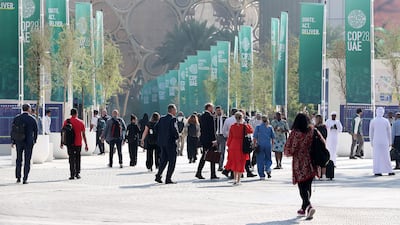
Delegates on the 11th day of the Cop28 summit at Expo City Dubai. Pawan Singh / The National -
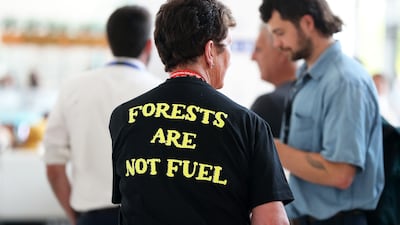
Cop28 is scheduled to conclude at 11am on Tuesday. Pawan Singh / The National -

Mariam Almheiri, UAE Minister of Climate Change and Environment, addresses a press conference on agriculture on the 11th day of Cop28 in Dubai. Pawan Singh / The National -
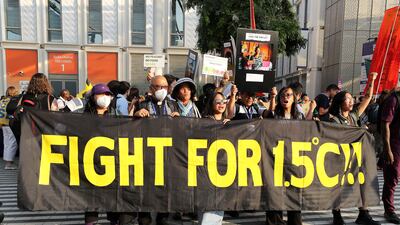
Activists called for a ceasefire in Gaza and measures to protect the climate on the 10th day of the summit. Pawan Singh / The National -
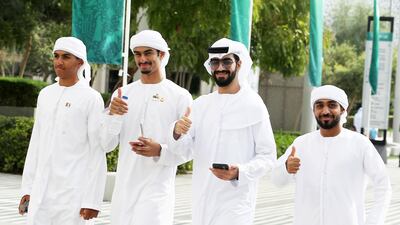
Visitors walk in the Green Zone, in Expo City Dubai’s Sustainability District. Pawan Singh / The National -

Models take part in the Sustainable Fashion Show held on the seventh day of the summit at Al Wasl Plaza. Pawan Singh / The National -

The summit heard from indigenous peoples, many of whom inhabit island nations and contribute the least to greenhouse emissions. Chris Whiteoak / The National -

UN climate change executive secretary Simon Stiell speaks to the media on the 12th day of Cop28. Chris Whiteoak / The National -

About 70,000 participants are attending the two-week event. Chris Whiteoak / The National -

The last two scheduled days of the summit have been left clear for final negotiations. Chris Whiteoak / The National -

The Wake Up experience with Sadhguru, on the sixth day of Cop28. Chris Whiteoak / The National -

Activists from youth organisation Engajamundo stage a protest about smog caused by deforestation in the Amazon. Chris Whiteoak / The National -
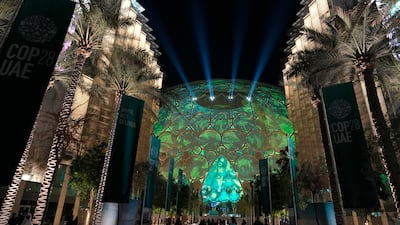
Lights shine from Al Wasl Dome at Expo City Dubai. AP -
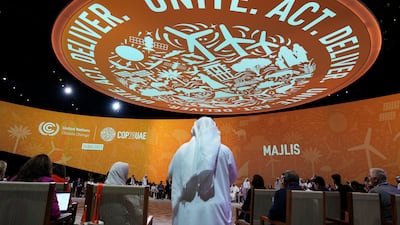
Delegates arrive for a meeting at the Cop28 summit. AP -
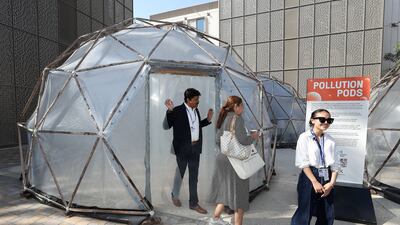
Cop28 attendees visit British artist Michael Pinsky's Pollution Pods, which replicate the air quality in Beijing, London and New Delhi, at Expo City in Dubai. Pawan Singh / The National -
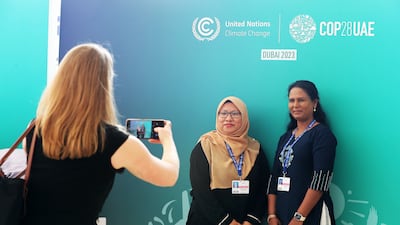
Delegates on the 10th day of the Cop28 UAE at the Expo City in Dubai. Pawan Singh / The National -
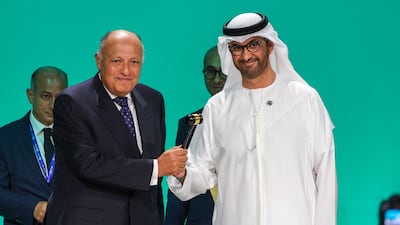
Cop27 President Sameh Shoukry, left, hands over the gavel to Cop28 President Dr Sultan Al Jaber at the UN climate conference's opening ceremony. AFP -
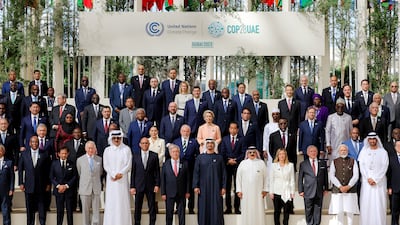
World leaders on day two of Cop28 in Dubai. Reuters -
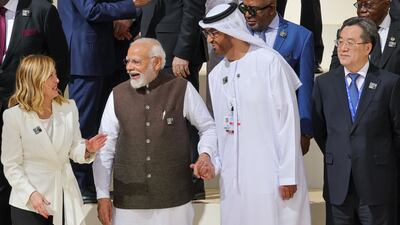
From left, Italy's Prime Minister Giorgia Meloni, Prime Minister Narendra Modi of India, Cop28 President Dr Sultan Al Jaber and Japan's Prime Minister Fumio Kishida arrive for a group photo. AFP -
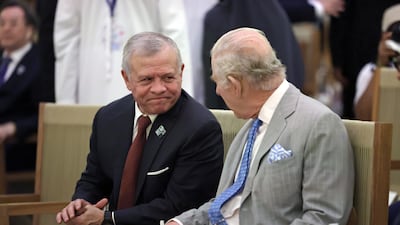
King Charles III with King Abdullah II of Jordan during the opening ceremony of the World Climate Action Summit at Cop28. PA -
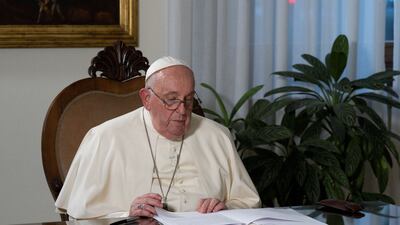
Pope Francis records a video message to be broadcast during the inauguration of the Faith Pavilion, at Casa Santa Marta, in the Vatican. Reuters -
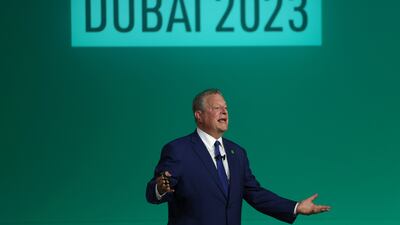
Al Gore, environmentalist and former US vice president, presents the Climate Trace global greenhouse gases emissions database on day four of Cop28. Getty Images -
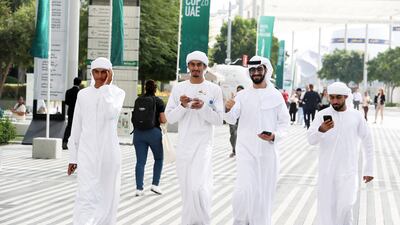
Visitors in the Green Zone at Expo City Dubai. Pawan Singh / The National -

Sheikh Abdullah bin Zayed, Minister of Foreign Affairs, Microsoft co-founder Bill Gates, Tanzanian President Samia Hassan and Reem Al Hashimy, Minister of State for International Co-operation, attend the Reaching the Last Mile Forum held alongside Cop28. Reuters -
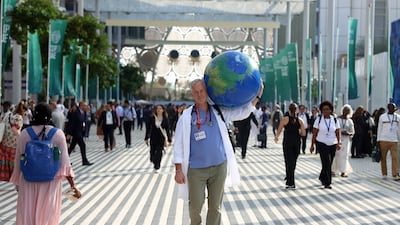
Joseph Vipond from the Canadian Association of Physicians for the Environment crosses the Blue Zone. Getty Images -
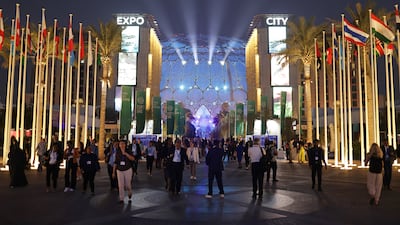
Participants walk among flagpoles on day four of the Cop28 summit in Dubai. Getty Images -
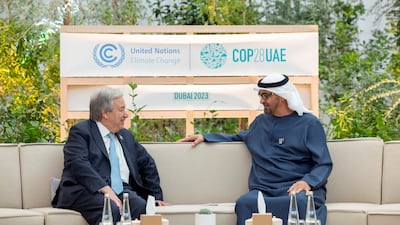
President Sheikh Mohamed and UN Secretary General Antonio Guterres hold a meeting at the Cop28 summit in Dubai. Photo: UAE Presidential Court



