


The negative impact of climate change will continue way into the next century even if the world starts to reduce the concentration of greenhouse gases in the atmosphere by 2050, a study has revealed.
According to the research, even in a scenario of “negative emissions” by the middle of the century – where more greenhouse gases are removed from the atmosphere than are released – or if the world is at net-zero, areas of permafrost will keep thawing and giving out both carbon dioxide and methane.
One of the study authors, Dr Norman Steinert, a senior researcher at the Cicero Centre for International Climate Research in Oslo, said that permafrost responded on timescales that were centuries or millennia long, so he was “not surprised to see projection of permafrost as a long-term source of carbon emissions”.
“As long as temperatures are net positive relative to pre-industrial [times], permafrost will be exposed to a warmer climate and therefore emit carbon,” he told The National.
Most permafrost is in the Northern Hemisphere, with large areas around the Arctic in Alaska, Siberia, Canada and the Tibetan Plateau, although there is permafrost around the Antarctic too.
When it thaws it releases carbon dioxide and methane – which has a warming effect more than 25 times that of CO2 – because the organic matter trapped within it is broken down by microorganisms.
Can permafrost ever recover?
The research, published in Science Advances and also carried out by scientists in South Korea and the United States, involved computer modelling of changes in permafrost between the years 2000 and 2300.
Dr Steinert said that the amount of carbon released was determined by the temperature the permafrost had been exposed to, not just at any given point, but over time.
He also said that with negative emission scenarios, permafrost would cool more slowly than the air, which is another factor causing the release of carbon emissions to continue.
Climate change-induced alterations to a major ocean circulation pattern, the Atlantic Meridional Overturning Circulation (AMOC), which brings warm water from the tropics north, could have a cooling effect on permafrost, but not enough to cancel out other warming effects.
Effects such as cooling from a slowdown in the AMOC “cannot be an excuse to delay climate action”, according to Dr Steinert.
The scientific community is, he said, “still debating a potential tipping point for permafrost”, meaning a point at which global-scale thawing and the release of carbon emissions from it cannot be stopped.
Alternatively, permafrost thaw and associated carbon loss may happen gradually with every increment of global warming, without there being a warming level that can be considered “safe” until crossed.
A study last year indicated that a runaway effect was less likely than had been feared, and the new research indicates that there could be some recovery in permafrost area if temperatures fell sufficiently.
However, Dr Steinert said that permafrost carbon loss due to human-induced warming was irreversible on human timescales.
Time to act
Bob Ward, of the Grantham Research Institute on Climate Change and the Environment, part of the London School of Economics, said that he hoped “all countries would be paying attention” to findings like those in the new study.
“It's one example of the many ways we're carrying out an experiment without being aware of the many consequences,” he said. “It just shows that we're in a worse situation, even worse situation, than we realise ... If we carry on our current path, we’re not just going to trigger thawing permafrost, but many other climate thresholds [could be breached].”
This could result in, he said, the destabilisation of the polar ice sheets, changes to circulations in the North Atlantic, and “major disruption” to monsoons.
Some climate change-induced processes, such as sea-level rises, are set to continue for thousands of years, even without further greenhouse gas emissions, highlighted Asher Minns, executive director of the Tyndall Centre for Climate Change Research at the University of East Anglia in the UK.
“We should have turned off the CO2 taps maybe 20 or so years ago, so we’re well beyond the threshold when we should have acted,” he said. “That means action is needed even more urgently across all sectors of the planetary economy.”
Mr Minns also said that as well as efforts to mitigate climate change, prompt action was needed to adapt to its looming effects, as it is cheaper to act now than later.
The impact of climate change on the Middle East – in pictures
-

Flooding in the Al Barsha area of Dubai. Chris Whiteoak / The National -
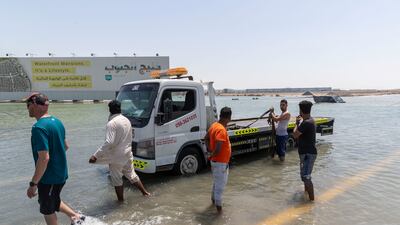
Vehicles being recovered near Al Maktoum airport in Dubai. Antonie Robertson / The National -

Flooding in the Al Barsha area of Dubai. Chris Whiteoak / The National -
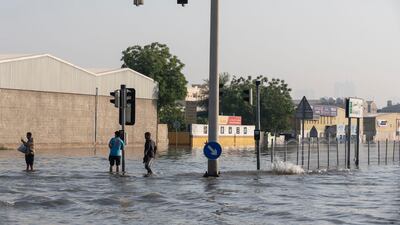
Flooding along Sheikh Zayed Road in Dubai. Antonie Robertson / The National -
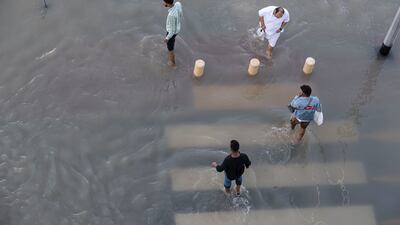
Flooding along Sheikh Zayed Road in Dubai. Antonie Robertson / The National -

Cars move through floodwater in Al Qudra, Dubai. Chris Whiteoak / The National -

Flooding on Dubai's Al Khail Road. Chris Whiteoak / The National -
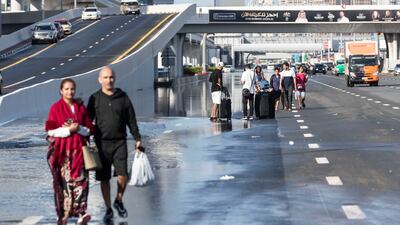
People abandon their cars on Sheikh Zayed Road due to heavy rain. Antonie Robertson/The National -

Flooding on Al Khail Road. Chris Whiteoak / The National -
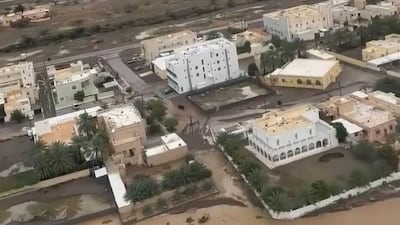
Flooding in Oman. Photo: Royal Oman Police -

A damaged car in Derna, Libya. Reuters -
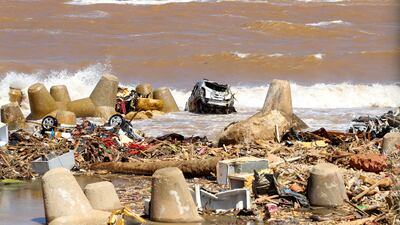
A destroyed vehicle in Derna. AFP -

Abdul Salam Ibrahim Al-Qadi walks on rubble in front of his house, searching for his missing father and brother, in Derna. Reuters -

An aerial view of the destruction in Derna. Reuters -
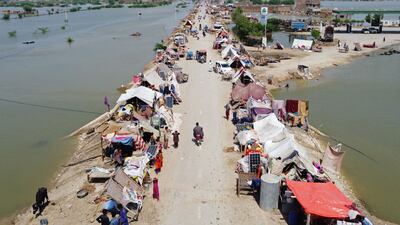
Flood-affected people taking refuge in a makeshift camp after heavy monsoon rains in Jaffarabad district of Balochistan province. AFP -
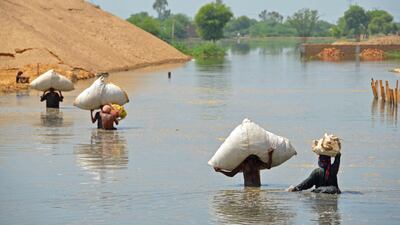
Internally displaced flood-affected people shift husk for their animals in a flood-hit area following heavy rains in Dera Allah Yar in Balochistan. AFP -
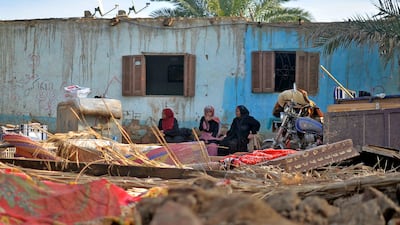
The aftermath of flooding in Egypt's southern city of Aswan, 920 kilometres south of the capital. AFP -

The Nile River from the top of Famine Stela, or Rock of Starvation, Egypt. Reuters -

Volunteers search for people in need following heavy rainfall in east Mosul, Iraq, in March 2020. Reuters -

People clean up after floods in Duhok, Iraq, on March 19. Reuters



