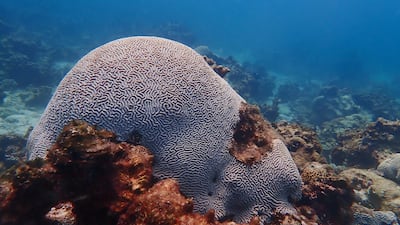
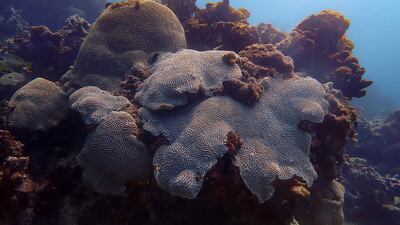
This is the first time corals have been selectively bred to enhance the survival of adult colonies. Photo: Liam Lachs

Coral that withstands heat bred for first time


Gillian Duncan
  • English
  • Arabic

Coral has been bred to survive intense marine heatwaves for the first time, although scientists stress it is not a “silver-bullet solution” to protect reefs from the effects of climate change.

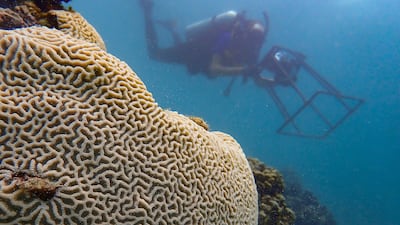
The breeding programme proves it is possible to boost heat tolerance of adult coral offspring in a single generation, said researchers. But the improvement was only “modest” when compared to future marine heatwaves expected under climate change, they added.

And selective breeding to withstand short periods of heat stress did not appear to enhance the ability of offspring to survive long-term heat exposure, they warned.

Coral has become increasingly prone to bleaching. Photo: Liam Lachs

Study author Adriana Humanes, a research associate at the Coralassist Lab based at Newcastle University in the UK, said the study represents the first time that corals have been "selectively bred" to enhance the survival of adult colonies when faced with marine heatwave stress. "Our study shows that assisted evolution via selective breeding is feasible, suggesting that current global efforts to develop assisted evolution techniques are warranted," she told The National.

However, study lead author, Liam Lachs, a postdoctoral research associate at the same university, said the work shows that although selective breeding is feasible, it is not a "silver-bullet solution". He said: "The enhancement we achieved was modest compared to the marine heatwaves that are expected to occur in the coming decades. This tells us that selective breeding interventions could have some beneficial outcomes but are not a panacea. Rapid action on reducing greenhouse gas emission is still urgently needed to give corals a chance."

The work provides an important proof of concept, showing that selective breeding could be used to help improve survival amid rising marine temperatures, said Dr James Guest, reader in coral reef ecology at the university’s School of Natural and Environmental Sciences. It might be possible to breed other coral but they might have less predictable spawning times than those in the study, which produce large numbers of eggs and spawn synchronously with quite predictable timing. "First we need to have a better understanding of their reproductive biology," he told The National.

Coral bleaching in Gulf 2024 - in pictures

“How many corals need to outplanted to benefit wild populations? Can we ensure there are no trade-offs – evidence so far suggests this is not a large risk? How can we avoid dilution of selected traits once added to the wild? How can we maximise responses to selection?

“Given the moderate levels of enhancement we achieved in this study, the effectiveness of such interventions will also depend on urgent climate action.” The researchers point out that selective breeding has been practised by humans for thousands of years to produce desirable characteristics in animals and plants.

Coral reefs support the well-being and livelihoods of close to 1 billion people, provide up to $9.9 trillion in ecosystem services, such as coastal protection, as well as boosting jobs and food, tourism and recreation.

Corals in the Arabian Gulf are able to survive at significantly higher temperatures than those in other areas, but they are operating at the edge of their limits and highly vulnerable to marine heatwaves, which can trigger mass bleaching of the kind that was recently discovered in the southern Arabian Gulf.

The breeding programme proves it is possible to boost heat tolerance of adult coral offspring in a single generation. Photo: James Guest

Last month it emerged there had been a near “total bleaching” of corals from Abu Dhabi to Umm Al Quwain, with about 40 per cent of reefs whitened in Ras Al Khaimah and off Khor Fakkan.

Bleaching occurs when heat stress forces a coral to lose its algae – which provides colour and most of its energy – turning them white. They remain alive but will die if temperatures do not return to normal.

The most recent event represented the fourth global mass bleaching after 1998, 2010 and 2014 to 2018, suggesting they are becoming more frequent, giving corals less time to recover.

Last year featured record sea surface temperatures around the world, in part due to El Nino, the natural weather phenomenon which also drives up the mercury on land. Data showed the weather phase ended in April, however, marine temperatures remained at “an unusually high level”.


The bio

Favourite book: Peter Rabbit. I used to read it to my three children and still read it myself. If I am feeling down it brings back good memories.

Best thing about your job: Getting to help people. My mum always told me never to pass up an opportunity to do a good deed.

Best part of life in the UAE: The weather. The constant sunshine is amazing and there is always something to do, you have so many options when it comes to how to spend your day.

Favourite holiday destination: Malaysia. I went there for my honeymoon and ended up volunteering to teach local children for a few hours each day. It is such a special place and I plan to retire there one day.

MATCH INFO

Who: UAE v USA
What: first T20 international
When: Friday, 2pm
Where: ICC Academy in Dubai

UAE currency: the story behind the money in your pockets
UAE%20v%20West%20Indies
%3Cp%3EFirst%20ODI%20-%20Sunday%2C%20June%204%20%0D%3Cbr%3ESecond%20ODI%20-%20Tuesday%2C%20June%206%20%0D%3Cbr%3EThird%20ODI%20-%20Friday%2C%20June%209%26nbsp%3B%3C%2Fp%3E%0A%3Cp%3EMatches%20at%20Sharjah%20Cricket%20Stadium.%20All%20games%20start%20at%204.30pm%0D%3Cbr%3E%0D%3Cbr%3E%3Cstrong%3EUAE%20squad%3C%2Fstrong%3E%0D%3Cbr%3EMuhammad%20Waseem%20(captain)%2C%20Aayan%20Khan%2C%20Adithya%20Shetty%2C%20Ali%20Naseer%2C%20Ansh%20Tandon%2C%20Aryansh%20Sharma%2C%20Asif%20Khan%2C%20Basil%20Hameed%2C%20Ethan%20D%E2%80%99Souza%2C%20Fahad%20Nawaz%2C%20Jonathan%20Figy%2C%20Junaid%20Siddique%2C%20Karthik%20Meiyappan%2C%20Lovepreet%20Singh%2C%20Matiullah%2C%20Mohammed%20Faraazuddin%2C%20Muhammad%20Jawadullah%2C%20Rameez%20Shahzad%2C%20Rohan%20Mustafa%2C%20Sanchit%20Sharma%2C%20Vriitya%20Aravind%2C%20Zahoor%20Khan%0D%3C%2Fp%3E%0A

Mercer, the investment consulting arm of US services company Marsh & McLennan, expects its wealth division to at least double its assets under management (AUM) in the Middle East as wealth in the region continues to grow despite economic headwinds, a company official said.

Mercer Wealth, which globally has $160 billion in AUM, plans to boost its AUM in the region to $2-$3bn in the next 2-3 years from the present $1bn, said Yasir AbuShaban, a Dubai-based principal with Mercer Wealth.

Within the next two to three years, we are looking at reaching $2 to $3 billion as a conservative estimate and we do see an opportunity to do so,” said Mr AbuShaban.

Mercer does not directly make investments, but allocates clients’ money they have discretion to, to professional asset managers. They also provide advice to clients.

“We have buying power. We can negotiate on their (client’s) behalf with asset managers to provide them lower fees than they otherwise would have to get on their own,” he added.

Mercer Wealth’s clients include sovereign wealth funds, family offices, and insurance companies among others.

From its office in Dubai, Mercer also looks after Africa, India and Turkey, where they also see opportunity for growth.

Wealth creation in Middle East and Africa (MEA) grew 8.5 per cent to $8.1 trillion last year from $7.5tn in 2015, higher than last year’s global average of 6 per cent and the second-highest growth in a region after Asia-Pacific which grew 9.9 per cent, according to consultancy Boston Consulting Group (BCG). In the region, where wealth grew just 1.9 per cent in 2015 compared with 2014, a pickup in oil prices has helped in wealth generation.

BCG is forecasting MEA wealth will rise to $12tn by 2021, growing at an annual average of 8 per cent.

Drivers of wealth generation in the region will be split evenly between new wealth creation and growth of performance of existing assets, according to BCG.

Another general trend in the region is clients’ looking for a comprehensive approach to investing, according to Mr AbuShaban.

“Institutional investors or some of the families are seeing a slowdown in the available capital they have to invest and in that sense they are looking at optimizing the way they manage their portfolios and making sure they are not investing haphazardly and different parts of their investment are working together,” said Mr AbuShaban.

Some clients also have a higher appetite for risk, given the low interest-rate environment that does not provide enough yield for some institutional investors. These clients are keen to invest in illiquid assets, such as private equity and infrastructure.

“What we have seen is a desire for higher returns in what has been a low-return environment specifically in various fixed income or bonds,” he said.

“In this environment, we have seen a de facto increase in the risk that clients are taking in things like illiquid investments, private equity investments, infrastructure and private debt, those kind of investments were higher illiquidity results in incrementally higher returns.”

The Abu Dhabi Investment Authority, one of the largest sovereign wealth funds, said in its 2016 report that has gradually increased its exposure in direct private equity and private credit transactions, mainly in Asian markets and especially in China and India. The authority’s private equity department focused on structured equities owing to “their defensive characteristics.”

Updated: October 14, 2024, 1:01 PM