


Climate change has long been a hot topic of discussion at intergovernmental summits, in national parliaments and at myriad conferences around the globe.
But in recent years the issue has increasingly been taking centre stage in another important arena: the courts.
Cases may be brought to force governments or companies to take tougher action over climate change, or to secure compensation from firms for the alleged harm that their activities have caused.
“It’s a growing risk, particularly for governments, but also for companies, including fossil fuel producers,” Bob Ward, of the Grantham Research Institute on Climate Change and the Environment, part of the London School of Economics, said.
“The trend is likely to continue and should already be something that’s being taken into account at the highest levels in government and companies.”
Legal battles loom

A recent case that has grabbed headlines involves the environmental organisation Greenpeace and eight citizens of Bonaire, a Dutch island in the Caribbean.
They are taking the government of the Netherlands to court over “human rights violations and insufficient climate action” and calling on the Dutch authorities to do more to reduce carbon emissions and protect the islanders from the impacts of climate change.
The citizens have argued that the government is going to great lengths to protect the low-lying Netherlands from climate change impacts – such as rising sea levels – but these efforts are not mirrored by measures to protect Bonaire.
According to a study in Science in January, there have now been 2,415 climate lawsuits filed globally – up from 884 in 2017.
One of the authors of the new paper, Thom Wetzer, of the Smith School of Enterprise and the Environment at the University of Oxford and director of the Oxford Sustainable Law Programme, said that there were several reasons why case numbers were rising.
More people are, he said, feeling the effects of climate change as these manifest themselves more strongly, while greater amounts of money are becoming available to support climate litigation, much coming from philanthropic funds. Also, claimants are becoming “more and more successful”.
“It kind of feeds on itself,” Mr Wetzer said.
“The more money that flows in, the more likely litigation is to be professionally organised and the more likely it will succeed. And the more these cases succeed, the more money comes in … It’s a flywheel.”
In addition, there is now more scientific evidence on which claims can be based, because attribution science, which links specific harms to human-made emissions, has moved on significantly.
Other evidence includes documents that, claimants say, show that companies may have misled the public about the dangers of burning fossil fuels in order to slow climate action.
Funding the climate fight
Philanthropic funds have become keen to support climate law suits because they increasingly feel, Mr Wetzer said, that these are “a very effective way” to hold organisations to account for their actions.
“It’s not the case that these kinds of litigation are brought by people who are unprofessional, poorly resourced, and so on. They’re in fact extremely professional, well-informed and very well-resourced communities,” Mr Wetzer added.
Some lawyers become involved with cases on a no-win, no-fee basis, taking a share of any compensation awarded.
Cases may also be brought by groups of investors concerned that the companies in which they hold shares are taking risks in terms of their actions on climate change that they consider to be irresponsible.
Late last year, another major player – the state of California – stepped into the fray, following the lead of several other US states and counties, in filing a case against major oil companies.
In their paper, Mr Wetzer and his co-authors calculated that Chevron, the US oil and gas company, could be exposed to liabilities as high as $8.5 trillion from climate law suits. Figures in the study indicate that this is 29 times as much as the firm’s total profits between 1990 and 2019.
“Do we think that Chevron or any other oil company will actually be held liable for damages to that degree? I think the answer is: it may not have to be the case that that kind of liability is imposed, but the probability is not zero,” Mr Wetzer said.
Investors, when deciding where to put their money, may not be, the study concluded, taking into account the risks to major companies of climate law suits.
A 'global phenomenon'
-

Internally displaced children Ali and Osman Abdulahi stand near carcasses of their family's livestock, killed by severe drought near Dollow, Somalia. Reuters -

Quick distribution of climate funds agreed at Cop28 will help devastated populations get back on their feet, Somalia’s Deputy Prime Minister Salah Jama has said. Reuters -

Commuters ride on rickshaws on a flooded road after heavy rains in Dhaka, Bangladesh. Reuters -
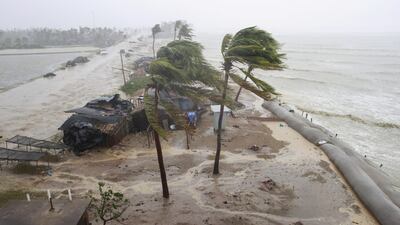
Cyclone Mocha makes landfall near Cox's Bazar, Bangladesh. A rise in extreme weather events around the world has been blamed on global warming caused by man-made greenhouse gases. EPA -
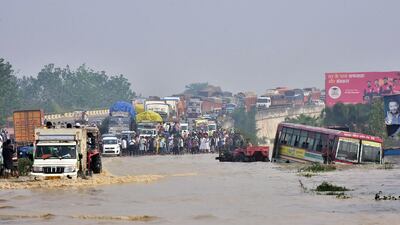
Commuters stand on a flyover, on a flooded motorway near Rampur, in India's Uttar Pradesh state, in 2021. AFP -

Monsoon floods and landslides killed about 100 people in Nepal and India earlier this year. AFP -
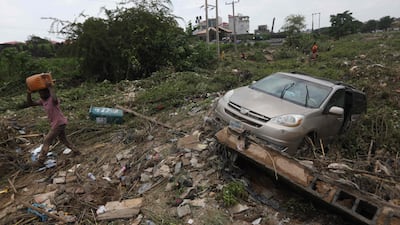
A man walks past a car swept by floodwaters in Abuja, Nigeria, in 2021. AFP -
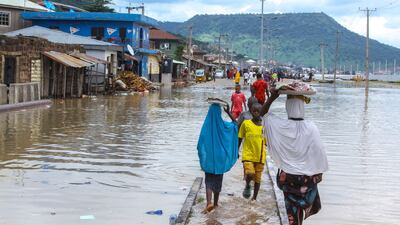
Flooding in Kogi, Nigeria, in October 2022. AP -
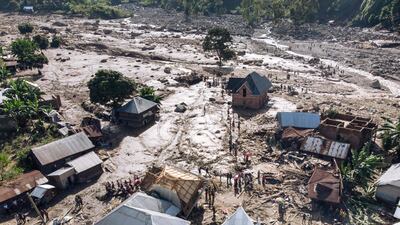
A landslide engulfs Nyamukubi village, eastern Democratic Republic of Congo. AFP -

A landslide in the Mont Ngafula district of Kinshasa, the capital of the Democratic Republic of Congo. AFP -

Aid workers crossing flooded areas in Bundibugyo, Uganda. Twitter/UgandaRedCross -

Villagers try to pull up a minibus in which 14 bodies were retrieved, in the river Nabuyonga in eastern Uganda, after flash floods. AFP


About two-thirds of cases brought last year were based in the US, but Mr Wetzer said that many of the most consequential cases have been in continental Europe, while Brazil is another key battleground for climate change law suits.
“It is increasingly a global phenomenon,” he said. “It’s definitely not a trend that we see just in a few global north jurisdictions. That’s no longer the case.”
The governments of the Netherlands, Germany and Belgium are among those that have been forced by courts to amend climate policies, with likely impacts on those countries’ emissions and regulatory environment, which impacts companies.
Firms have also been forced directly by courts to cut their carbon emissions. For example, Royal Dutch Shell was, in 2021, ordered by a court in The Hague to cut its carbon emissions by 45 per cent by the end of the decade relative to 2019 levels. Shell has appealed.
Shell has recently had better luck in UK courts, where this month [January] the Court of Appeal found against the campaigning organisation ClientEarth over a case it brought against Shell for “failing to move away from fossil fuels fast enough”.
ClientEarth described it as the first climate change case that attempted to hold directors personally liable over their company’s actions.
The impact of cases can extend beyond whatever verdict the court gives, given that they bring attention to the activities of companies.
“It not only has material implications for business operations, it can have huge reputational consequences to be taken to court because you’re being accused of not acting strongly or quickly enough on climate,” Mr Ward said.
The cost of going green

But cases are not just brought by those pushing for stronger action on climate change, they are also initiated in the opposite direction by companies unhappy at regulations around emissions.
Firms that face being left with “stranded assets”, such as high-emissions power plants that have had to be decommissioned because of regulations, have tried to secure compensation for their losses.
The German energy companies RWE and Uniper sued the Dutch government over the mandated closure of their coal-fired power stations in the Netherlands by 2030, although their claims were rejected.
One study has estimated that investors in the oil and gas sector are seeking as much as $340 billion because of the climate policies of governments.
Many cases are brought under arbitration and so are not in the public domain, Mr Wetzer said, which is one reason why it is unclear overall whether climate activists or industrial players are bringing more cases.
That aside, he sees climate court cases as playing an ever-increasing role in efforts to limit greenhouse gas emissions.
“Until we fix it, the damages as a result of climate change will go up and the evidence about the causal relationship between emissions, climate change and these damages will strengthen, so legal risk is really not going away,” he said.

