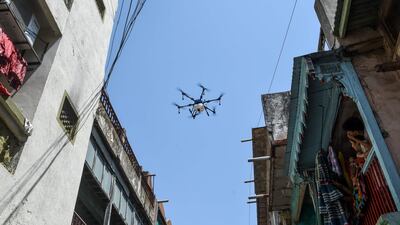
A drones spraying disinfectant flies over a residential area of Ahmedabad, India on May 9, 2020. The flying machines have proven useful in many ways during the pandemic, but their biggest test will arrive when a vaccine becomes available. AFP
A drones spraying disinfectant flies over a residential area of Ahmedabad, India on May 9, 2020. The flying machines have proven useful in many ways during the pandemic, but their biggest test will ar

Will drones be ready for last-mile Covid-19 vaccine delivery?


Kelsey Warner
  • English
  • Arabic

From conveying stay-at-home messages in Dubai to washing streets in Ahmedabad, India and providing contactless delivery in Wuhan, China, drones have played a critical role in maintaining public safety since the start of the pandemic.

As researchers race to develop a Covid-19 vaccine, questions remain over how it will be distributed and who will get it when the time comes. Industry experts say drones can provide a last-mile solution in rural areas to deliver life-saving treatment or preventative inoculation.

At DJI, the world's biggest drone maker based in Shenzhen, China, with about 70 per cent of global market share, Covid-19 has "further proved the potential of drones, especially in the domain of public safety", Raissa Mendes, the company's regional manager for Latin America, the Middle East and Africa, told The National. "In a crisis such as Covid-19, where time plays a critical role, drones are proving to be essential."

In the UAE, DJI’s partnerships with Dubai Municipality, Dubai Police and Sharjah Police have seen the company's drones deployed for inspections, supply delivery, disinfection and temperature checks on individuals, Ms Mendes said.

“This is not something new, especially not to the UAE – which continues to be receptive to, and embracing of, the latest technologies,” she added.

While drones have been useful to communities in states of lockdown or under social distancing protocols, their application can be extended when a vaccine becomes available. Some optimistic infectious disease experts believe that "hundreds of millions of doses of vaccine might be ready for roll-out by the end of 2020" but that "distribution, delivery and administration need to be worked out", according to a recent assessment of Covid-19 vaccines under development by medical journal The Lancet.

Pawanexh Kohli, an honorary professor at the University of Birmingham and a supply chain expert, wrote in a recent op-ed that “it is not simply a matter of adding capacity of vaccine refrigerators at existing vaccination centres, but possibly creating a different network”.

Any Covid-19 vaccine will need to be handled within specified temperature ranges that are likely to follow those for the influenza vaccine, which must be kept between 2°C and 8°C, while in transport and storage, according to Mr Kohli.

Zipline, a Silicon Valley-based drone company with operations in Ghana and Rwanda, is already working to meet those standards.

“As new treatments and vaccines become available in the next 18-24 months, they will continue to be in scarce supply amid growing global demand. Zipline’s medical drone delivery service could help make sure distribution is targeted in real-time, at national-scale, to the people and populations that need it most, helping to save lives and prevent further outbreaks,” the company said in a recent statement on its website.

In April, as coronavirus cases began surfacing in Ghana, Zipline started collecting test samples from patients at rural health facilities and delivering them to medical laboratories in the country’s two largest cities, Accra and Kumasi, in less than an hour. Usually, Zipline’s drones deliver packages like units of blood to rural hospitals located up to 85 kilometeres away. But this is the first time that autonomous UAVs have been used to make regular long-distance deliveries to densely-populated urban areas, according to the company.

For DJI, it is piloting its own community health projects in the Dominican Republic. Within 14 minutes, medical staff can receive life-saving antidotes, blood sample analyses and prescriptions, in comparison with over 45 minutes if delivered by car. This has been a crucial differentiating factor which has helped to reduce infant mortality rates, as well as helping to address other medical conditions more efficiently.

But the drone market will need to achieve a new level of scale and innovation if it is to go beyond limited use cases to become a viable solution as part of the Covid-19 vaccine distribution network – and there are signs the timing may be right.

Regulators from different countries in Europe and drone manufacturers are working together to set rules and regulations, a positive environment that is supporting the growth of the market in commercial aerospace. Meanwhile, the industry has seen a spike in investments with venture capitalists showing increased interest, which will fuel innovation. Data acquired by Finbold.com shows that by the end of 2019, total investment was at a record high of $1.2 billion (Dh4.4bn), a year-on-year increase of 67 per cent.

Coming out of Covid-19, there is likely to be a wave of mergers and acquisitions in the near future in mobility start-ups focused on autonomous technology, Kersten Heineke, who heads the McKinsey Centre for Future Mobility in Europe, told The National. Flight service providers, hardware start-ups, drone manufacturers and flight path management software companies are set to work more closely together in a tighter economy.

"Drones certainly have a role to play in our future healthcare logistics as they provide advantages to areas that are difficult to reach by car, or are low density and situated away from central logistics areas," John Gillespie, a principal transport planner at consultancy WSP in the Middle East, told The National.

“To reach these remote areas requires a significant amount of time and resources. Drones could help deliver healthcare resources to remote areas.”

The timing may be right for the drone market to find viable business models for scaling these services, he added.

Ms Mendes, of DJI, echoed this. “We can anticipate areas of application to continue to expand, and a fundamental part of this may well be the use of drones for delivery of medical supplies,” she said.

“We focus on applications which can be applied tomorrow, next month or in a year’s time. We believe that drone deliveries can offer substantial value for urgent or time-sensitive deliveries in rural areas. "In these scenarios, traditional vehicle delivery within a specific timeframe are notoriously expensive due to the distance. Drones provide a potential solution for point-to-point deliveries as the networks scale out.”

A vaccine for Covid-19 will demand an urgent scaling of delivery networks. Drones can – and should – be ready to take on the last mile.


Mercer, the investment consulting arm of US services company Marsh & McLennan, expects its wealth division to at least double its assets under management (AUM) in the Middle East as wealth in the region continues to grow despite economic headwinds, a company official said.

Mercer Wealth, which globally has $160 billion in AUM, plans to boost its AUM in the region to $2-$3bn in the next 2-3 years from the present $1bn, said Yasir AbuShaban, a Dubai-based principal with Mercer Wealth.

Within the next two to three years, we are looking at reaching $2 to $3 billion as a conservative estimate and we do see an opportunity to do so,” said Mr AbuShaban.

Mercer does not directly make investments, but allocates clients’ money they have discretion to, to professional asset managers. They also provide advice to clients.

“We have buying power. We can negotiate on their (client’s) behalf with asset managers to provide them lower fees than they otherwise would have to get on their own,” he added.

Mercer Wealth’s clients include sovereign wealth funds, family offices, and insurance companies among others.

From its office in Dubai, Mercer also looks after Africa, India and Turkey, where they also see opportunity for growth.

Wealth creation in Middle East and Africa (MEA) grew 8.5 per cent to $8.1 trillion last year from $7.5tn in 2015, higher than last year’s global average of 6 per cent and the second-highest growth in a region after Asia-Pacific which grew 9.9 per cent, according to consultancy Boston Consulting Group (BCG). In the region, where wealth grew just 1.9 per cent in 2015 compared with 2014, a pickup in oil prices has helped in wealth generation.

BCG is forecasting MEA wealth will rise to $12tn by 2021, growing at an annual average of 8 per cent.

Drivers of wealth generation in the region will be split evenly between new wealth creation and growth of performance of existing assets, according to BCG.

Another general trend in the region is clients’ looking for a comprehensive approach to investing, according to Mr AbuShaban.

“Institutional investors or some of the families are seeing a slowdown in the available capital they have to invest and in that sense they are looking at optimizing the way they manage their portfolios and making sure they are not investing haphazardly and different parts of their investment are working together,” said Mr AbuShaban.

Some clients also have a higher appetite for risk, given the low interest-rate environment that does not provide enough yield for some institutional investors. These clients are keen to invest in illiquid assets, such as private equity and infrastructure.

“What we have seen is a desire for higher returns in what has been a low-return environment specifically in various fixed income or bonds,” he said.

“In this environment, we have seen a de facto increase in the risk that clients are taking in things like illiquid investments, private equity investments, infrastructure and private debt, those kind of investments were higher illiquidity results in incrementally higher returns.”

The Abu Dhabi Investment Authority, one of the largest sovereign wealth funds, said in its 2016 report that has gradually increased its exposure in direct private equity and private credit transactions, mainly in Asian markets and especially in China and India. The authority’s private equity department focused on structured equities owing to “their defensive characteristics.”

Fixtures

Friday Leganes v Alaves, 10.15pm; Valencia v Las Palmas, 12.15am

Saturday Celta Vigo v Real Sociedad, 8.15pm; Girona v Atletico Madrid, 10.15pm; Sevilla v Espanyol, 12.15am

Sunday Athletic Bilbao v Getafe, 8.15am; Barcelona v Real Betis, 10.15pm; Deportivo v Real Madrid, 12.15am

Monday Levante v Villarreal, 10.15pm; Malaga v Eibar, midnight

Charlotte Gainsbourg

Rest

(Because Music)

JOKE'S%20ON%20YOU
%3Cp%3EGoogle%20wasn't%20new%20to%20busting%20out%20April%20Fool's%20jokes%3A%20before%20the%20Gmail%20%22prank%22%2C%20it%20tricked%20users%20with%20%3Ca%20href%3D%22https%3A%2F%2Farchive.google%2Fmentalplex%2F%22%20target%3D%22_blank%22%3Emind-reading%20MentalPlex%20responses%3C%2Fa%3E%20and%20said%3Ca%20href%3D%22https%3A%2F%2Farchive.google%2Fpigeonrank%2F%22%20target%3D%22_blank%22%3E%20well-fed%20pigeons%20were%20running%20its%20search%20engine%20operations%3C%2Fa%3E%20.%3C%2Fp%3E%0A%3Cp%3EIn%20subsequent%20years%2C%20they%20announced%20home%20internet%20services%20through%20your%20toilet%20with%20its%20%22%3Ca%20href%3D%22https%3A%2F%2Farchive.google%2Ftisp%2Finstall.html%22%20target%3D%22_blank%22%3Epatented%20GFlush%20system%3C%2Fa%3E%22%2C%20made%20us%20believe%20the%20Moon's%20surface%20was%20made%20of%20cheese%20and%20unveiled%20a%20dating%20service%20in%20which%20they%20called%20founders%20Sergey%20Brin%20and%20Larry%20Page%20%22%3Ca%20href%3D%22https%3A%2F%2Farchive.google%2Fromance%2Fpress.html%22%20target%3D%22_blank%22%3EStanford%20PhD%20wannabes%3C%2Fa%3E%20%22.%3C%2Fp%3E%0A%3Cp%3EBut%20Gmail%20was%20all%20too%20real%2C%20purportedly%20inspired%20by%20one%20%E2%80%93%20a%20single%20%E2%80%93%20Google%20user%20complaining%20about%20the%20%22poor%20quality%20of%20existing%20email%20services%22%20and%20born%20%22%3Ca%20href%3D%22https%3A%2F%2Fgooglepress.blogspot.com%2F2004%2F04%2Fgoogle-gets-message-launches-gmail.html%22%20target%3D%22_blank%22%3Emillions%20of%20M%26amp%3BMs%20later%3C%2Fa%3E%22.%3C%2Fp%3E%0A