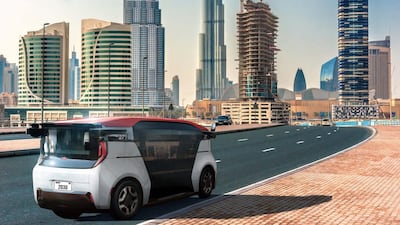
The robotaxi service in Dubai will use the Cruise Origin, an all-electric shuttle first unveiled in January last year. Cruise

Cruise to unveil its driverless robotaxis in Dubai in 2023


Alkesh Sharma
  • English
  • Arabic

Cruise, the self-driving vehicle company backed by General Motors and Honda, will launch its first international robotaxi service outside the US in Dubai in 2023, Sheikh Hamdan bin Mohammed, Crown Prince of Dubai, said on Twitter.

“Dubai will be the first outside America to operate self-driving Cruise vehicles, in fulfilment of His Highness Sheikh Mohammed bin Rashid’s vision that Dubai is always in first place and the best city to live and work,” said Sheikh Hamdan.

“Our goal is to convert 25 per cent of the total ... trips in Dubai to self-driving trips through various means of transport by 2030.”

Sheikh Hamdan discussed the future of mobility with Jeff Bleich, chief legal officer of General Motors-Cruise. He also attended the signing ceremony of a strategic partnership between Cruise and the Dubai Roads and Transport Authority.

The entities aim to have a limited number of Cruise’s self-driving vehicles running in Dubai from 2023, with 4,000 vehicles on the road by 2030.

Dubai aims to reduce transport costs by Dh900 million ($245.2m) through its adoption of self-driving technology, Sheikh Hamdan said. Using these vehicles could increase the transport efficiency, help the emirate to grow revenue by Dh18bn a year and generate Dh1.5 billion in savings through a reduction of environmental pollution by 12 per cent a year, he said.

The robotaxi service in Dubai will use the Cruise Origin, an all-electric shuttle first unveiled in January last year.

“The Cruise Origin will make transportation safer, a better experience, more affordable and better for the planet,” Dan Ammann, chief executive of Cruise, said.

“Dubai and the RTA are leading the way in making this a reality for their people, and for people everywhere.”

The vehicle has no steering wheel and seats will face each other.

The robotaxis, in Cruise’s orange and black colours, will “accommodate the needs of an individual, with personal USB ports”, the company’s chief technology officer and co-founder Kyle Vogt said at the time.

Improvements are also being made to allow it to travel at motorway speeds. The Cruise Origin is will be produced at General Motor’s Detroit-Hamtramck plant from next year.

A driverless Cruise vehicle displayed at 2019's Detroit Motor Show. AP

The car maker has spent about $2.2bn refurbishing the plant to switch from internal combustion motors to battery-powered electric engines.

“We engaged in a comprehensive, multi-year process to choose the best possible partner,” said Mattar Al Tayer, director general and chairman of the board of executive directors of the RTA.

“Cruise’s technology, resources, purpose-built vehicle, car maker partnerships, approach to safe testing and deployment and strategy give them the ability to launch safely and faster than any other company.”

Cruise, which has raised more than $7.4bn over the last three years, was valued at $30bn in January. Its investors include SoftBank, Honda, GM, T Rowe Price Group and Microsoft.

The company aims to unveil a robotic taxi service to compete against companies such as Uber and Lyft.

It began to test self-driving vehicles on the streets of San Francisco in December after it obtained permission from California’s state government in October.

The company, which was bought by GM in 2016, had previously set a goal of using driverless cars as part of a ride-hailing service by the end of 2019 but the plan has taken longer than expected to bring to fruition.

Other technology companies such as Amazon and Google owner Alphabet are also backing self-driving electric initiatives that are focused on mass transport.

Alphabet's Waymo is operating a commercial self-driving taxi service, whereas Amazon-backed Zoox is working on a self-driving ride-hailing fleet. Industry analysts said Amazon could also use self-driving cars to deliver goods to customers.

Many local companies are experimenting with self-driving technology in the UAE.

Cruise will establish a new Dubai-based company which will be fully responsible for the deployment, operation and maintenance of the fleet. Courtesy Cruise

In September, the Dubai-based Al Habtoor group joined forces with Israeli car technology company Mobileye in September to operate a fleet of self-driving vehicles and robotaxis in Dubai by 2023.

Transport chiefs in Abu Dhabi intend to allow driverless taxis in the emirate from this year.

The Department of Municipalities and Transport has linked up with Bayanat, part of the G42 group, on a trial for the use of self-driving vehicles.

The first phase of the project will feature three self-driving vehicles providing free transport services from hotels, restaurants, shopping malls and offices at Yas Mall.


In numbers: PKK’s money network in Europe

Germany: PKK collectors typically bring in $18 million in cash a year – amount has trebled since 2010

Revolutionary tax: Investigators say about $2 million a year raised from ‘tax collection’ around Marseille

Extortion: Gunman convicted in 2023 of demanding $10,000 from Kurdish businessman in Stockholm

Drug trade: PKK income claimed by Turkish anti-drugs force in 2024 to be as high as $500 million a year

Denmark: PKK one of two terrorist groups along with Iranian separatists ASMLA to raise “two-digit million amounts”

Contributions: Hundreds of euros expected from typical Kurdish families and thousands from business owners

TV channel: Kurdish Roj TV accounts frozen and went bankrupt after Denmark fined it more than $1 million over PKK links in 2013 

Teams

Punjabi Legends Owners: Inzamam-ul-Haq and Intizar-ul-Haq; Key player: Misbah-ul-Haq

Pakhtoons Owners: Habib Khan and Tajuddin Khan; Key player: Shahid Afridi

Maratha Arabians Owners: Sohail Khan, Ali Tumbi, Parvez Khan; Key player: Virender Sehwag

Bangla Tigers Owners: Shirajuddin Alam, Yasin Choudhary, Neelesh Bhatnager, Anis and Rizwan Sajan; Key player: TBC

Colombo Lions Owners: Sri Lanka Cricket; Key player: TBC

Kerala Kings Owners: Hussain Adam Ali and Shafi Ul Mulk; Key player: Eoin Morgan

Venue Sharjah Cricket Stadium

Format 10 overs per side, matches last for 90 minutes

Timeline October 25: Around 120 players to be entered into a draft, to be held in Dubai; December 21: Matches start; December 24: Finals

The specs
  • Engine: 3.9-litre twin-turbo V8
  • Power: 640hp
  • Torque: 760nm
  • On sale: 2026
  • Price: Not announced yet
How to help

Donate towards food and a flight by transferring money to this registered charity's account.

Account name: Dar Al Ber Society

Account Number: 11 530 734

IBAN: AE 9805 000 000 000 11 530 734

Bank Name: Abu Dhabi Islamic Bank

To ensure that your contribution reaches these people, please send the copy of deposit/transfer receipt to: juhi.khan@daralber.ae

Our family matters legal consultant

Name: Hassan Mohsen Elhais

Position: legal consultant with Al Rowaad Advocates and Legal Consultants.

Electric scooters: some rules to remember
  • Riders must be 14-years-old or over
  • Wear a protective helmet
  • Park the electric scooter in designated parking lots (if any)
  • Do not leave electric scooter in locations that obstruct traffic or pedestrians
  • Solo riders only, no passengers allowed
  • Do not drive outside designated lanes
EMILY%20IN%20PARIS%3A%20SEASON%203
%3Cp%3ECreated%20by%3A%20Darren%20Star%3C%2Fp%3E%0A%3Cp%3EStarring%3A%20Lily%20Collins%2C%20Philippine%20Leroy-Beaulieu%2C%20Ashley%20Park%3C%2Fp%3E%0A%3Cp%3ERating%3A%202.75%2F5%3C%2Fp%3E%0A

Mercer, the investment consulting arm of US services company Marsh & McLennan, expects its wealth division to at least double its assets under management (AUM) in the Middle East as wealth in the region continues to grow despite economic headwinds, a company official said.

Mercer Wealth, which globally has $160 billion in AUM, plans to boost its AUM in the region to $2-$3bn in the next 2-3 years from the present $1bn, said Yasir AbuShaban, a Dubai-based principal with Mercer Wealth.

Within the next two to three years, we are looking at reaching $2 to $3 billion as a conservative estimate and we do see an opportunity to do so,” said Mr AbuShaban.

Mercer does not directly make investments, but allocates clients’ money they have discretion to, to professional asset managers. They also provide advice to clients.

“We have buying power. We can negotiate on their (client’s) behalf with asset managers to provide them lower fees than they otherwise would have to get on their own,” he added.

Mercer Wealth’s clients include sovereign wealth funds, family offices, and insurance companies among others.

From its office in Dubai, Mercer also looks after Africa, India and Turkey, where they also see opportunity for growth.

Wealth creation in Middle East and Africa (MEA) grew 8.5 per cent to $8.1 trillion last year from $7.5tn in 2015, higher than last year’s global average of 6 per cent and the second-highest growth in a region after Asia-Pacific which grew 9.9 per cent, according to consultancy Boston Consulting Group (BCG). In the region, where wealth grew just 1.9 per cent in 2015 compared with 2014, a pickup in oil prices has helped in wealth generation.

BCG is forecasting MEA wealth will rise to $12tn by 2021, growing at an annual average of 8 per cent.

Drivers of wealth generation in the region will be split evenly between new wealth creation and growth of performance of existing assets, according to BCG.

Another general trend in the region is clients’ looking for a comprehensive approach to investing, according to Mr AbuShaban.

“Institutional investors or some of the families are seeing a slowdown in the available capital they have to invest and in that sense they are looking at optimizing the way they manage their portfolios and making sure they are not investing haphazardly and different parts of their investment are working together,” said Mr AbuShaban.

Some clients also have a higher appetite for risk, given the low interest-rate environment that does not provide enough yield for some institutional investors. These clients are keen to invest in illiquid assets, such as private equity and infrastructure.

“What we have seen is a desire for higher returns in what has been a low-return environment specifically in various fixed income or bonds,” he said.

“In this environment, we have seen a de facto increase in the risk that clients are taking in things like illiquid investments, private equity investments, infrastructure and private debt, those kind of investments were higher illiquidity results in incrementally higher returns.”

The Abu Dhabi Investment Authority, one of the largest sovereign wealth funds, said in its 2016 report that has gradually increased its exposure in direct private equity and private credit transactions, mainly in Asian markets and especially in China and India. The authority’s private equity department focused on structured equities owing to “their defensive characteristics.”

Smart words at Make Smart Cool

Make Smart Cool is not your usual festival. Dubbed “edutainment” by organisers Najahi Events, Make Smart Cool aims to inspire its youthful target audience through a mix of interactive presentation by social media influencers and a concert finale featuring Example with DJ Wire. Here are some of the speakers sharing their inspiration and experiences on the night.
Prince Ea
With his social media videos accumulating more half a billion views, the American motivational speaker is hot on the college circuit in the US, with talks that focus on the many ways to generate passion and motivation when it comes to learning.
Khalid Al Ameri
The Emirati columnist and presenter is much loved by local youth, with writings and presentations about education, entrepreneurship and family balance. His lectures on career and personal development are sought after by the education and business sector.
Ben Ouattara
Born to an Ivorian father and German mother, the Dubai-based fitness instructor and motivational speaker is all about conquering fears and insecurities. His talk focuses on the need to gain emotional and physical fitness when facing life’s challenges. As well managing his film production company, Ouattara is one of the official ambassadors of Dubai Expo2020.