
As of early autumn, it was clearer than ever that production problems meant Apple wouldn’t have enough iPhone Xs in time for the holidays. The challenge was how to make the sophisticated phone - with advanced features such as facial recognition - in large enough numbers.
As Wall Street analysts and fan blogs watched for signs that the company would stumble, Apple came up with a solution: It quietly told suppliers they could reduce the accuracy of the face-recognition technology to make it easier to manufacture, according to people familiar with the situation.
With the iPhone X set to debut on November 3, we're about to find out whether the move has paid off. Some analysts say there may still be too few iPhone Xs to meet initial demand.
Ming-Chi Kuo of KGI Securities predicts Apple will have two to three million handsets available on launch day and 25 million to 30 million units for the holiday quarter, down from his previous forecast of 40 million. For comparison, Apple sold 78 million phones during the same period last year, although that included all models.
Apple is famously demanding, leaning on suppliers and contract manufacturers to help it make technological leaps and retain a competitive edge. The company’s decision to downgrade the accuracy of its Face ID system - if only a little - shows how hard it’s becoming to create cutting-edge features that consumers are hungry to try.
And while Apple has endured delays and supply constraints in the past, those typically have been restricted to certain iPhone colours or less important offerings such as the Apple Watch.
This time the production hurdles affected a 10th-anniversary phone expected to generate much of the company’s revenue. Apple declined to comment.
-

Apple CEO Tim Cook, announces the new iPhone X at the Steve Jobs Theater on the new Apple campus. Marcio Jose Sanchez / AP Photo -

Senior Vice President of Worldwide Marketing at Apple Philip Schiller speaks about the iPhone 8 Plus. Josh Edelson / AFP Photo -

Apple Senior Vice President of Worldwide Marketing, Phil Schiller, shows Animoji. Stephen Lam / Reuters -
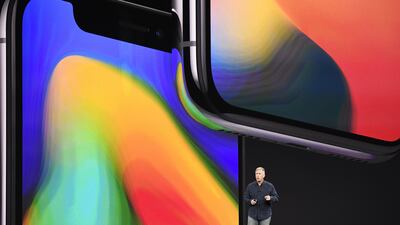
Phil Schiller, senior vice president of worldwide marketing at Apple Inc., speaks about the iPhone X. David Paul Morris / Bloomberg -
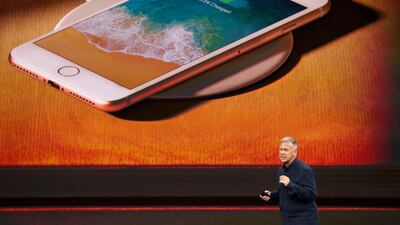
Apple Senior Vice President of Worldwide Marketing, Phil Schiller, introduces the iPhone 8 during a launch event in Cupertino, California. Stephen Lam / Reuters -
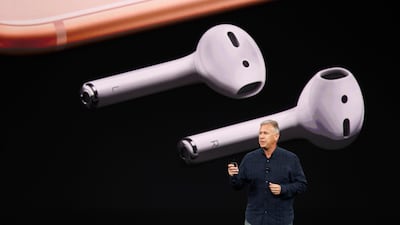
Apple Senior Vice President of Worldwide Marketing, Phil Schiller, introduces the iPhone 8 during a launch event in Cupertino, California. Stephen Lam / Reuters -
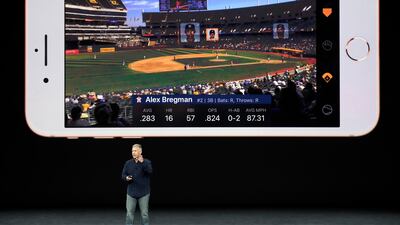
Phil Schiller, Apple's senior vice president of worldwide marketing, shows features of the new iPhone 8 at the Steve Jobs Theater on the new Apple campus in Cupertino, California. Marcio Jose Sanchez / AP Photo -
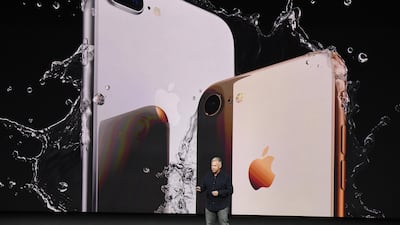
Phil Schiller, senior vice president of worldwide marketing at Apple Inc., pauses while speaking about the new iPhone 8 and 8 Plus during an event at the Steve Jobs Theater in Cupertino, California. David Paul Morris / Bloomberg -
Tim Cook, chief executive officer of Apple Inc., speaks about the iPhone during an event at the Steve Jobs Theater in Cupertino, California. David Paul Morris / Bloomberg -
Eddy Cue, Senior VP of Internet Software, introduces Apple TV. Stephen Lam / Reuters -
Tim Cook, chief executive officer of Apple Inc., speaks about the iPhone during an event at the Steve Jobs Theater in Cupertino, California. David Paul Morris / Bloomberg -

Apple's Chief Operating Officer Jeff Williams speaks during a media event at Apple's new headquarters. Josh Edelson / AFP Photo -

Apple's Chief Operating Officer Jeff Williams speaks about the Apple Watch during a media event at Apple's new headquarters in Cupertino, California. Josh Edelson / AFP Photo -
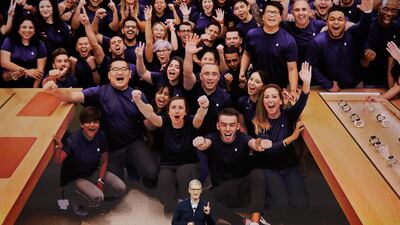
Apple CEO Tim Cook talks during a presentation on new products at the Steve Jobs Theater on the new Apple campus, in Cupertino, California. Marcio Jose Sanchez / AP Photo -
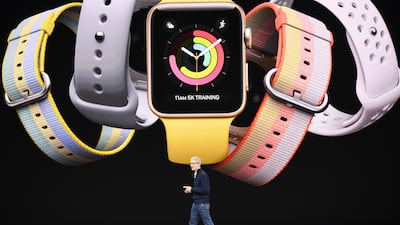
Tim Cook, chief executive officer of Apple Inc., speaks about Apple Watch during an event at the Steve Jobs Theater in Cupertino, California. David Paul Morris / Bloomberg -
Tim Cook, CEO of Apple, speaks as images are shown behind him during a product launch event in Cupertino, California. Stephen Lam / Reuters -

Angela Ahrendts, Apple's Senior Vice President of Retail, discusses updates at Apple Stores before a new product announcement at the Steve Jobs Theater on the new Apple campus in Cupertino, California. Marcio Jose Sanchez / AP Photo -

Tim Cook, chief executive officer of Apple Inc., speaks during an event at the Steve Jobs Theater in Cupertino, California. David Paul Morris / Bloomberg


About a month ago, Foxconn Technology Group pulled as many as 200 workers off an iPhone X production line. Apple was struggling to get sufficient components for the phone and needed fewer people to put it together. The main culprit, the people said, was the 3-D sensor that recognises faces and unlocks the handset. Foxconn declined to comment.
The sensor was always going to be a major technical challenge. Until the iPhone X, the most significant deployment of the technology was in Microsoft’s Kinect controller, which the Xbox console used to detect a gamer’s movements. But the Kinect was the size of a large book, and Microsoft sold just 24 million units of the controller over two years, a far easier production challenge than the one confronted by Apple, which sells more than 200 million iPhones a year.
“That technology is something we have been looking at for five years,” chief design officer Jony Ive said in an onstage discussion hosted by The New Yorker this month. “We had prototypes that were this big,” he added, holding his hands about a foot apart. By the time Apple had greenlighted the iPhone X, the company was looking for technology that could be squeezed into a space a few centimeters across and millimeters deep.
Despite demanding the near impossible, Apple didn’t add extra time to get it right - giving suppliers the typical two-year lead time. The tight schedule underestimated the complexity of making and assembling exceedingly fragile components, said one of the people familiar with the production process.
That left suppliers short on time to prepare their factories and explains why the iPhone X is being released a full six weeks later than the iPhone 8, said this person, who asked to remain anonymous to discuss an internal matter. “It’s an aggressive design,” the person said, “and it’s a very aggressive schedule”.
The 3-D sensor has three key elements: a dot projector, flood illuminator and infrared camera. The flood illuminator beams infrared light, which the camera uses to establish the presence of a face. The projector then flashes 30,000 dots onto the face which the phone uses to decide whether to unlock the home screen. The system uses a two-stage process because the dot projector makes big computational demands and would rapidly drain the battery if activated as frequently as the flood illuminator.
The dot projector is at the heart of Apple’s production problems. In September, the Wall Street Journal reported that Apple was having trouble producing the modules that combine to make the dot projector, causing shortages.
The dot projector uses something called a vertical cavity surface-emitting laser, or VCSEL. The laser beams light through a lens known as a wafer-level optic, which focuses it into the 30,000 points of infra-red light projected onto the user’s face.
The laser is made of gallium arsenide, a semiconductor material, and the lens is constructed of glass; both are fragile and easily broken. Precision is key. If the microscopic components are off by even several microns, a fraction of a hair’s breadth, the technology might not work properly, according to people with knowledge of the situation.
____________
Read more:
High iPhone prices can’t last forever
At what price will the UAE fall in love with the new iPhone X?
____________
To make matters worse, Apple lost one of its laser suppliers early on. Finisar Corp failed to meet Apple’s specifications in time for the start of production, and now the Sunnyvale, California-based company is racing to meet the standards by the end of October. That left Apple reliant on fewer laser suppliers: Lumentum Holdings and II-VI.
The fragility of the components created problems for LG Innotek and Sharp, both of which struggled to combine the laser and lens to make dot projectors. At one point only about 20 per cent of the dot projectors the two companies produced were usable, according to a person familiar with the manufacturing process.
LG Innotek and Sharp slowed the production process down in an effort to prevent breakages and ensure the components were assembled with the required level of precision.
LG Innotek confirmed in a conference call with analysts on Wednesday that there has been a problem with yield and that mass production is just beginning. The current modules are "significantly" more difficult to produce than previous cameras, said Kim Jong-ho, who oversees the South Korean supplier's optical solution division.
He said manufacturing has improved enough to meet the iPhone X launch date, though supply may be limited, and stressed Innotek has been able to achieve a "far stronger" yield than a rival supplier - a reference to Sharp. The Japanese company declined to comment.
_____________
Read more:
What is Apple Pay? Everything you need to know about the digital wallet's launch in the UAE
Study shows new iPhone system update can cut battery life by half
Apple iPhone X facial recognition: All you need to know
_____________
To boost the number of usable dot projectors and accelerate production, Apple relaxed some of the specifications for Face ID, according to a different person with knowledge of the process. As a result, it took less time to test completed modules, one of the major sticking points, the person said.
It’s not clear how much the new specs will reduce the technology’s efficacy. At the phone’s official unveiling in September, executives boasted that there was a one in a million chance that an interloper could defeat Face ID to unlock a phone. Even downgraded, it will probably still be far more accurate than TouchID, where the odds of someone other than the owner of a phone being able to unlock it are one in 50,000.
Besides struggling to produce enough 3-D sensors, Apple has suffered from a dearth of suppliers capable of making organic light-emitting diode displays, Bloomberg reported last year.
The OLED, which delivers sharper images, is the iPhone X's other main advance. But Apple is dependent on Samsung Electronics for its entire supply of the components.
-

The iPhone 8 on show at the Dubai Mall. Anna Nielsen For The National -

A small crowd of Apple fans queue at Dubai Mall on Saturday morning ahead of the iPhone 8 launch. Anna Nielsen For The National -

Ibrahim Al Shamsi from Al Ain was the first person to receive the iPhone after having pre ordered 12 online.Anna Nielsen For The National. -

People wait in line for the iPhone 8 at Dubai Mall. Anna Nielsen For The National -

People wait in line for the iPhone 8 at Dubai Mall. Anna Nielsen For The National -

Dozens of customers went to the Dubai Mall early for the iPhone 8 release. Anna Nielsen For The National -

Ibrahim Al Shamsi bought 12 iPhones. Anna Nielsen For The National -

Dozens of customers went to the Dubai Mall early for the iPhone 8 release. Anna Nielsen For The National -
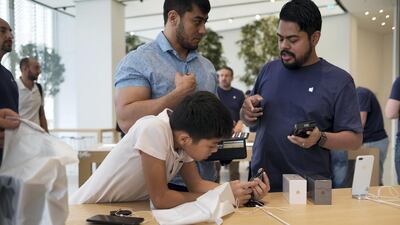
Dozens of customers went to the Dubai Mall early for the iPhone 8 release. Anna Nielsen For The National -

Dozens of customers went to the Dubai Mall early for the iPhone 8 release. Anna Nielsen For The National -

Dozens of customers went to the Dubai Mall early for the iPhone 8 release. Anna Nielsen For The National -

The iPhone 8 released turned out to be a low-key event at Dubai Mall. Anna Nielsen For The National -

Dozens of customers went to the Dubai Mall early for the iPhone 8 release. Anna Nielsen For The National -

People has waited in line for the doors to open. Anna Nielsen For The National -

Dozens of customers went to the Dubai Mall early for the iPhone 8 release. Anna Nielsen For The National -

Some of the people who were waiting for the opening of the shop were tourists. Anna Nielsen For The National. -

Dozens of customers went to the Dubai Mall early for the iPhone 8 release. Anna Nielsen For The National -

Dozens of customers went to the Dubai Mall early for the iPhone 8 release. Anna Nielsen For The National


For months, Apple investors have fretted that a shortage of iPhone Xs would send consumers into the arms of rival smartphone makers such as Samsung and Huawei Technologies.
Apple seems to have overcome the biggest production hurdles. Sharp is working to bring the production yield for dot projectors above 50 per cent, while LG Innotek has already surpassed that level, which both companies consider acceptable.
Meanwhile, Apple is working with Taiwan’s Himax Technologies to boost production of lenses to make up for lower-than-needed output from Heptagon, a Singaporean company that so far has been the only lens supplier.
The 3-D sensor shortage is expected to end in early 2018. Even so, signs of weakness in iPhone 8 sales means Apple could sell fewer handsets than last year - despite all the fanfare surrounding the iPhone X.

