


Alphabet-owned Google has launched Gemini, its most capable generative artificial intelligence tool yet.
With the launch, the California-based company is aiming to grab a huge chunk of the generative AI market that was first disrupted by Microsoft-backed OpenAI last year with the launch of ChatGPT.
Here, The National looks at various features of Gemini and other options available in the market.
What is Gemini?
Gemini is the first AI model to beat human experts on MMLU (Massive Multitask Language Understanding) that is one of the widely used methods to test the knowledge and problem-solving abilities of AI.
It can comprehend diverse tasks and generate code based on different inputs – an innovation poised to revolutionise problem-solving capabilities. It can independently navigate and merge diverse information types such as text, code, audio, images and video, thereby operating across varied data formats.
Its ability to extract insights from hundreds of thousands of documents through reading, filtering and understanding information will help deliver new breakthroughs at digital speeds in many fields from science to finance, Google said.
Who developed Gemini?
Started in 2010, Google DeepMind played a crucial role in developing Gemini.
So far, it has brought together new ideas in machine learning, neuroscience, engineering, maths, simulation and computing infrastructure, along with new ways of organising scientific endeavours.
Gemini is the result of DeepMind’s efforts to produce AI that “feels less like a smart piece of software and more like something useful and intuitive”, said Demis Hassabis, chief executive and co-founder of Google DeepMind.
Three variants
The first version, Gemini 1.0, is optimised for different sizes – nano, pro and ultra – to ensure it can run on everything from resource-intensive data centres to small mobile devices.
- Gemini pro: The pro version is merged with Google’s generative AI tool Bard, which was originally launched in February. It adds to Bard’s ability for advanced reasoning, planning, coding, summarising, understanding and detailed interpretations. It is available from Wednesday.
- Gemini nano: It is available on the company’s Pixel 8 Pro smartphones. It will help prevent sensitive data from leaving the phone, as well as offer the ability to use various features without a network connection.
- Gemini ultra: The largest and most capable model for highly complex tasks, ultra will be available early next year. Google said it will launch Bard Advanced version to let users gain access to the best models and capabilities offered by ultra.
Is Gemini Google’s most capable AI model yet?
Google said Gemini is the most capable and general AI model it has ever built.
Thus far, the standard approach to creating multimodal models involved training separate components for different modalities and then stitching them together. These models can sometimes be good at performing certain tasks, like describing images, but struggle with more conceptual and complex reasoning.
However, Gemini is pre-trained on different modalities.
“We [have] fine-tuned it with additional multimodal data to further refine its effectiveness. This helps Gemini seamlessly understand and reason about all kinds of inputs from the ground up, far better than existing multimodal models … its capabilities are state of the art in nearly every domain,” Mr Hassabis said.
How users can gain access to Gemini
Gemini’s pro and nano versions are currently accessible across Google's Bard chatbot and Pixel 8 smartphones, respectively.

In the coming months, Gemini will be available in more of Google’s products and services like Search, Ads, Chrome and Duet AI.
Google said it is already experimenting Gemini in Search, where it is making search faster for users with a 40 per cent reduction in latency in English in the US, alongside improvements in quality.
From December 13, developers and enterprise customers can gain access to Gemini pro to customise the technology and use it in their applications and inventions.
How Gemini differs from other AI chatbots
Google said before launching it to the public that it had run Gemini through a number of industry-standard benchmarks. In six out of eight benchmarks, Gemini Pro outperformed GPT-3.5.
It surpassed GPT-3.5 on MMLU and GSM8K, which measures grade school maths reasoning.
What other options are on the market
Microsoft-backed OpenAI launched ChatGPT in December last year and it was an instant success. It is a programme that comes up with humanlike responses to prompts in seconds, based on information publicly available on the internet. However, it has also raised concerns about what it is being used for and its accuracy.
In September, the Abu Dhabi government-supported research centre the Technology Innovation Institute launched Falcon 180B – an advanced version of its flagship language model – to boost generative AI in the region.
Last month, cloud company Amazon Web Services launched a generative AI tool specifically for businesses.
How big is the market?
Investors have put more than $4.2 billion into generative AI start-ups in 2021 and 2022 through 215 deals after interest surged in 2019, recent data from CB Insights showed.
Globally, AI investments are projected to hit $200 billion by 2025 and could possibly have a bigger impact on gross domestic product, Goldman Sachs Economic Research said in a report in August.
Meanwhile, in Saudi Arabia, the Arab world's biggest economy, the generative AI market is expected to surpass $1 trillion by 2030, growing at a compound annual rate of more than a quarter, from nearly $220 million in 2023, data from Statista shows.
-
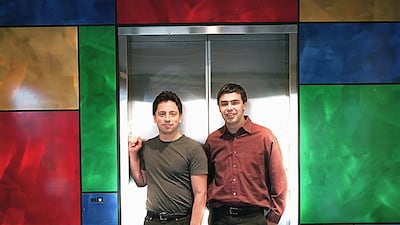
Google founders Sergey Brin, left, and Larry Page at the company's HQ in Mountain View, California, in 2003. Getty Images -
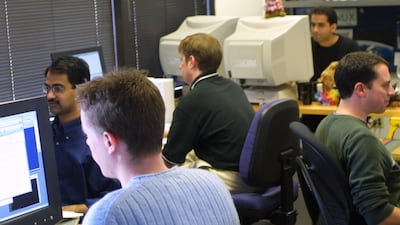
Employees working in the office, dubbed the 'Googleplex', in 2003. Getty Images -

Google's closing share price is displayed in Times Square, New York City, on the company's first day of public trading in August 2004. Getty Images -
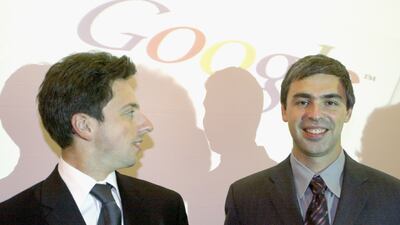
Sergey Brin and Larry Page at the opening of the Frankfurt book fair in 2004. Getty Images -
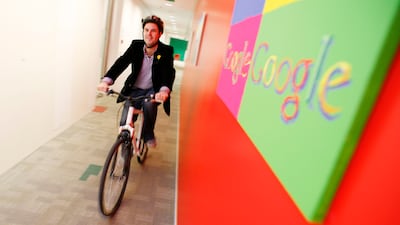
An employee rides his new Google-branded bike in 2007 in London. Google improved its green credentials by offering all staff a free bike to ride to work. Getty Images -

A Google Street View camera car makes its way through London in 2008, creating innovative mapping. Getty Images -
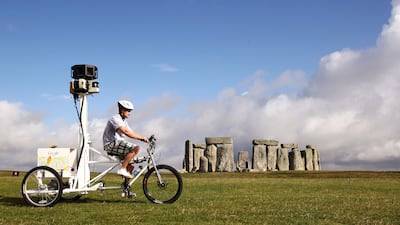
Google launches the Street View Trike at Stonehenge in Wiltshire in 2009. The British public voted for the top 6 tourist attractions they wished to be photographed by the tricycle. Getty Images -
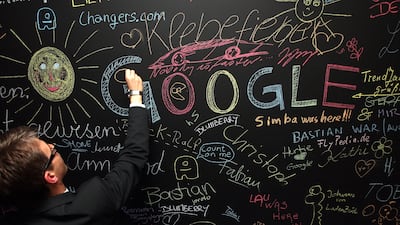
The official opening party of Berlin's Google offices in 2012. Getty Images -
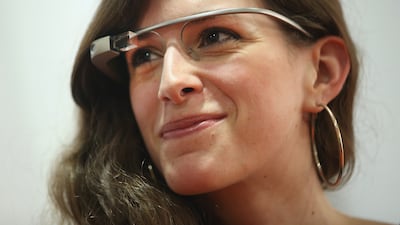
Trying out the wearable tech 'Google Glass' in Berlin, 2014. Getty Images -
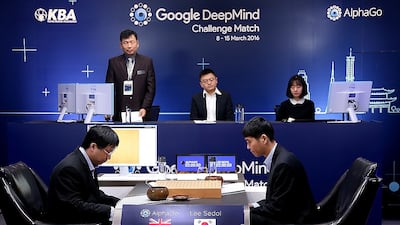
South Korean professional Go player Lee Se-dol, right, prepares for his match against Google's AI programme, AlphaGo, during the Google DeepMind challenge match in Seoul, 2016. Getty Images -

The new Google Home Hub displayed at a Google hardware launch event in London in 2018. Getty Images -
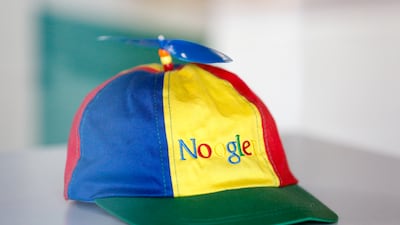
A Noogler hat, given to each new employee, displayed at the Google Search 20th Anniversary Event in San Francisco in 2018. AFP -
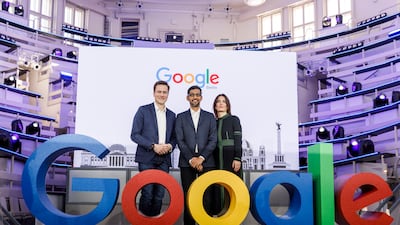
From left, bosses Philipp Justus, Sundar Pichai and Annette Kroeber-Riel at the opening of the Berlin representation of Google Germany in 2019. Getty Images -

Ivy Goodall, 11, meets with her teacher and her classmates in Google Classroom for the first lessons of term while in Covid-19 lockdown from her home in Auckland, New Zealand, in 2020. Getty Images -

A driver using Google Maps to navigate towards London in 2021. Getty Images -
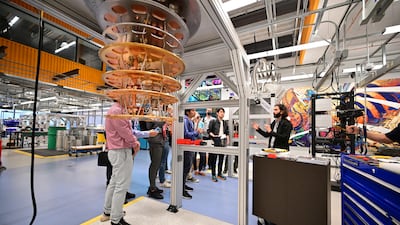
Dr Erik Lucero, lead engineer of Google Quantum AI, leads a media tour of campus in Goleta, California in 2022. AFP -

Workers leave Google’s Bay View campus in Mountain View in 2022. AFP -

A man carries a Google Street View Trekker backpack in Berlin in 2023. Getty Images -
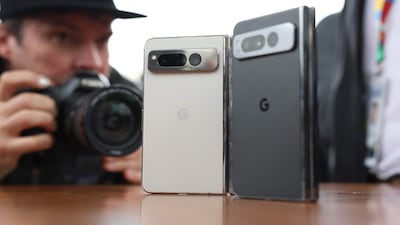
The new Google Pixel Fold phone on display at an I/O developers' conference in Mountain View, 2023. AFP



