


Artificial intelligence has become a key revenue generator for enterprises as the use of the technology continues to grow, and the Middle East is well positioned to benefit from this, Google Cloud's top executive for the region has said.
The need to adopt AI – especially its evolved, more advanced iterations – has increased, with companies putting in “massive investments” to cater to the “massive demands” of using data and capitalising on it, Abdulrahman Al Thehaiban, Google Cloud's managing director for the Middle East, Africa and Turkey, told The National.
Data collection, especially in today's technology-driven world, is the process of gathering data intended to be used for a variety of purposes such as marketing, decision making, research and strategic planning, as well as predicting consumer behaviour to cater to their preferences and several others.
“Before the pandemic, digital transformation was a key pillar of many of strategies, including government visions in Saudi Arabia, the UAE, Qatar and Kuwait,” Mr Al Thehaiban said in an interview at the Gitex Global technology conference in Dubai.
“During the pandemic, many learnt its importance of being a key enabler of driving businesses and serving citizens from a government perspective.”
“And now, it has become the key pillar of execution. There is a new era of focus on the digital transformation journey that enabled organisations to collect massive amounts of data … and that created the element of AI and the need to adopt it.”
AI plays an important role in data collection, especially when it comes to handling massive amounts of data, sorting it and using them for specific needs.
In tandem with machine learning algorithms, it is able to help organisations to arrive at strategies, based on the information that is gathered.
Among the sectors that benefit the most from collected data are e-commerce, travel, news, media and entertainment, health care, marketing, banking and finance, and social media.
The Middle East is a high-potential market for new technology, especially AI, because of its evolving economic dynamics and the willingness to invest by governments, Mr Al Thehaiban said.
The region is looking at a potentially huge economic impact from AI – $320 billion by 2030, according to data from PwC.
Saudi Arabia, the Arab world's biggest economy, is expected to benefit the most, with the contribution of AI set to hit $135.2 billion, or 12.4 per cent of gross domestic product, it said.
The UAE, the second largest Arab economy, is forecast to reap $96 billion, or 13.6 per cent of its economy.
AI's contribution to the rest of the GCC – Bahrain, Kuwait, Oman and Qatar – by that year, would be about $46 billion, or 8.2 per cent of GDP, while in Egypt, the Arab world's most populous country, it is expected to be $42.7 billion, or 7.7 per cent, the global consultancy said.
However, Mr Al Thehaiban cautioned that AI-driven data, especially with the arrival of generative AI, must be handled ethically.
“When you have data in your hands, you must deal with it in a responsible way – not in a corrupt or irresponsible way,” he said.
For data centres – another key pillar of Google's global investments and strategy – the company had said it was considering plans to build more data centres in the Middle East, Google Cloud chief executive Thomas Kurian told The National last year.
-

A robotic hand at the Etisalat stand at Gitex, which is being held at Dubai World Trade Centre. All photos: Leslie Pableo / The National -

Amina, a robot, interacting with a visitor to the show -
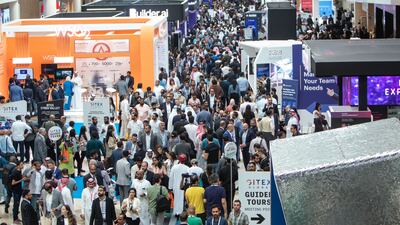
Crowds at Gitex on the second day of the exhibition -
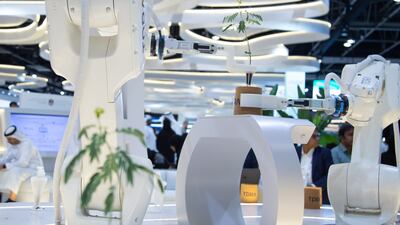
A robot designed to plant trees on the RTDA stand -
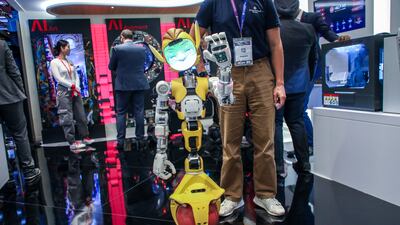
Miroki robot on the Etisalat stand -

A flying vehicle at the Etisalat stand -

A driverless vehicle -

A futuristic Mercedes Benz on the Etisalat stand -

A high-speed floating police car on display at the conference in Dubai -
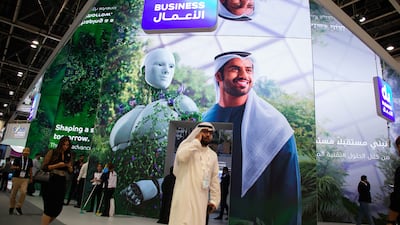
The Du stand at Gitex -
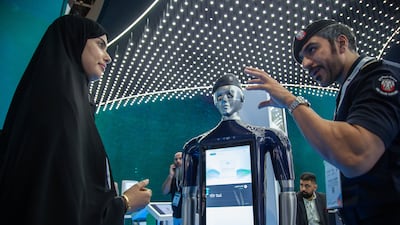
Abu Dhabi Customs shows off its robot technology at Gitex -

An Abu Dhabi government stand at Gitex -
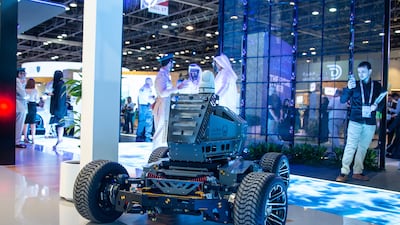
Another Dubai Police vehicle on display at the tech show -

Ramnas the robot at Gitex -

Abu Dhabi Customs during a virtual reality demonstration -
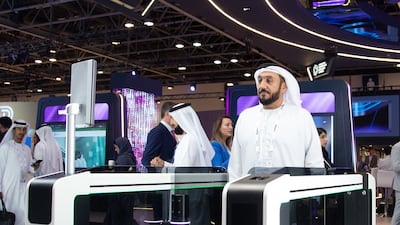
A face scanner at the Road and Transport Authority stand at Gitex -
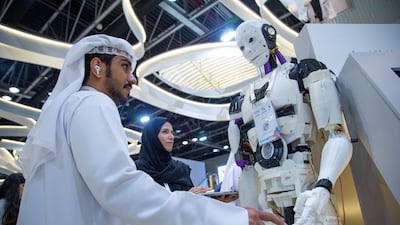
A man interacts with a robot at the Abu Dhabi Government stand -
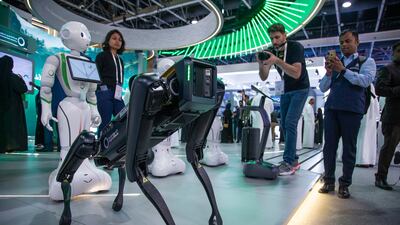
A robot dog was part of the tech show on Monday -
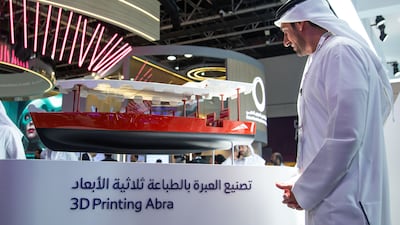
A 3D printing of an abra that will be launched next year by Dubai's RTA


Google currently has three data centres in the region – in Dammam, Doha and Tel Aviv. The company considers three factors – infrastructure, commercial viability and “very, very important” policies and regulations – when selecting a country to build a data centre, Mr Al Thehaiban said.
“We have a dedicated [a] team that helps customers and governments … [informing them of] the best business practices, and what it take to address policies and regulations, because that's a key fundamental,” he said.

