


Astrophysicists from Northwestern University in Illinois have discovered that the universe's youngest galaxies, captured by the James Webb Space Telescope (JWST), are not as vast as their brightness suggests.
This challenges previous perceptions about these galaxies, helping our understanding of the universe shortly after the Big Bang, the scientists say.
In their study, the researchers were initially surprised by their excessive brightness.
They said it appeared as if a toddler had matured into an adult within mere years, prompting concerns about our understanding of the cosmos.
Prof Claude-Andre Faucher-Giguere, Northwestern's senior researcher, said: “The discovery of these galaxies was a big surprise because they were substantially brighter than anticipated.”
The question of how these galaxies had matured so quickly after the Big Bang the arose.
The team employed new simulations to solve this cosmic riddle.
While a galaxy's luminosity usually reflects its mass, the team found that smaller galaxies can also shine intensely due to sporadic bursts of star formation,
Research lead Dr Guochao Sun noted: “If star formation happens in bursts, it will emit flashes of light. That is why we see several very bright galaxies.”
The era called the “cosmic dawn”, ranging from roughly 100 million to 1 billion years after the Big Bang, witnessed the birth of the universe's first stars and galaxies.
Our knowledge about this period was limited until the launch of the space telescope.
“The JWST brought us a lot of knowledge about cosmic dawn,” Dr Sun said.
The study team employed intricate computer simulations to recreate the conditions after the Big Bang.
These simulations spotlighted a phenomenon called “bursty star formation” – an alternating pattern of intense star birth followed by extended periods of star-formation dormancy.
“Bursty star formation is particularly prevalent in low-mass galaxies,” Prof Faucher-Giguere said, detailing the cyclic nature of stars forming, then exploding as supernovae, leading to new formations.
Significantly, the simulations aligned with the JWST's observations regarding the brightness of cosmic dawn galaxies.
This research not only provides the first evidence through detailed computer simulations that bursty star formation could account for the luminance of galaxies at cosmic dawn but also supports our standard model of the universe.
-
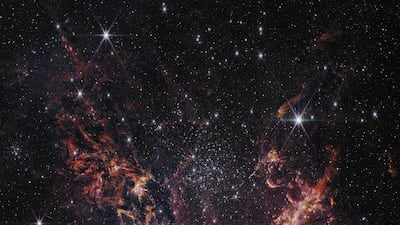
A cluster of stars in the Small Magellanic Cloud in an image taken by the James Webb Space Telescope. PA -
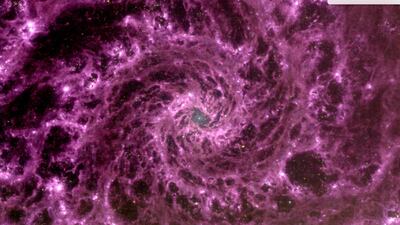
A colour composite image of the Messier 74 galaxy. Photo: Gabriel Brammer (Cosmic Dawn Center, Niels Bohr Institute, University of Copenhagen) / James Webb Space Telescope -
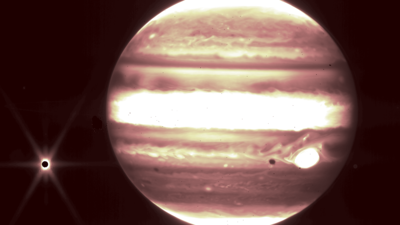
Jupiter and its moon Europa, left, are seen through the James Webb Space Telescope. Photo: Nasa -
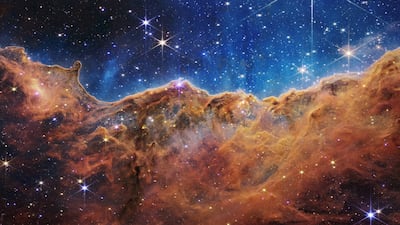
Captured in infrared light by Nasa's new James Webb Space Telescope, this image reveals areas of star birth in Carina Nebula. All photos: James Webb Space Telescope -
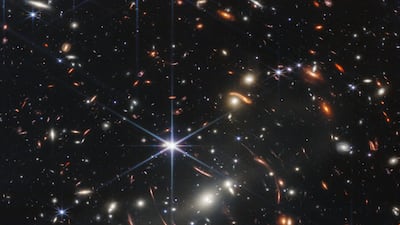
Known as Webb's First Deep Field, the picture showcases a galaxy cluster called SMACS 0723 as it appeared 4.6 billion years ago. The image was revealed by US President Joe Biden on July 11 during an event at the White House. -
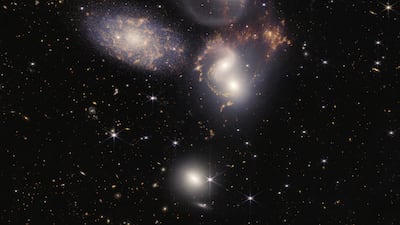
An image of Stephan's Quintet, an area in space with a group of five galaxies. -
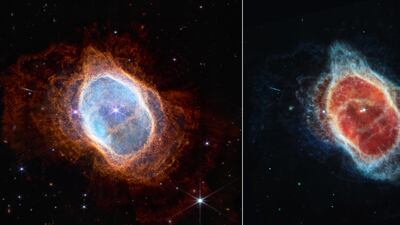
Side-by-side comparison shows observations of the Southern Ring Nebula in near-infrared light (left) and mid-infrared light. -
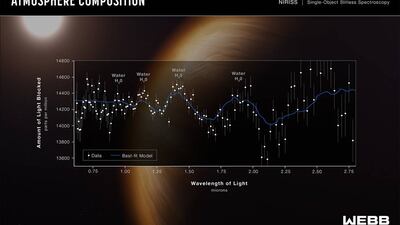
The telescope has captured the distinct signature of water, along with evidence for clouds and haze, in the atmosphere surrounding a hot, puffy gas giant planet orbiting a distant Sun-like star, called WASP-96 b. Photo: James Webb Space Telescope


Emphasising the importance of recent star formation in determining galaxy brightness, Prof Faucher-Giguere concluded, “Most of the light in a galaxy comes from the most massive stars.
"The brightness of a galaxy is more directly related to how many stars it has formed in the last few million years than the mass of the galaxy as a whole.”
The study called 'Bursty star formation naturally explains the abundance of bright galaxies at cosmic dawn' was supported by Nasa and the National Science Foundation, and published in the Astrophysical Journal Letters.

