

This year has been a challenging one for Phil Schneider, who hasn’t seen wildfire behaviour like this in his 47-year firefighting career.
Blazes raged through more than 2,000 acres of wildland in recent months in his county deep in the woods of Oregon, where a wet climate once made forest fires unthinkable.
That’s an increasingly common scene around the world – from Canada to Greece, global warming has helped fuel larger and more destructive blazes, pushing firefighting services to the brink. But Mr Schneider has a new recruit to help manage the growing risks: artificial intelligence.
“It’s a huge game changer for the fire service,” says Mr Schneider of the technology created by Pano AI, which acts as a second set of eyes looking out for fires.
While AI alone won’t completely ease the burden of wildfire management, it’s one of a growing number of tools firefighters have at their disposal to detect and combat blazes.
The high-tech fire lookout Mr Schneider has recently put to work leverages panoramic cameras that capture minute-by-minute snapshots of their surroundings. Those images are then analysed by an AI algorithm that has learnt how to look for signs of fires. It’s a job that’s traditionally been done by human eyes, whether it’s bystanders phoning in a fire or lookouts posted in towers.
It can take hours, if not days, to detect flames with conventional methods, says Mr Schneider, a fire chief in Clackamas County. The AI system, on the other hand, can pick up the threat right away.
“Fires are burning hotter and faster. That early detection is going to make a difference,” Mr Schneider says.
On one occasion, Pano’s AI fire watcher located a blaze that Mr Schneider’s crew failed to find after an hours-long search in forests. In another case, it spotted a blaze 30 minutes before anyone else.
San Francisco-based Pano AI, which has built about 100 AI-enabled fire lookouts in six US states and Australia, is one of a growing number of start-ups leveraging technology to aid in wildfire detection and prevention.
Virtually nonexistent five years ago, the club of wildfire tech companies now has at least 400 members, says Bill Clerico, founder and managing director of Convective Capital, a venture capital firm specifically focused on investing in the sector.
Thermal imaging
As the number of start-ups has grown, so too has the variety of offerings.
Engineers in Germany enlist satellites and thermal imaging sensors to hunt down wildfires from the sky.
In France, robots work side by side with human firefighters to combat blazes.
And at Mr Schneider’s fire department in Oregon, drones equipped with infrared cameras take off at night, helping firefighters map out burning sites in the dark.
“Technology could play a big role [in wildfire management],” Mr Clerico says.
“The demand is fuelled by the problem, and the problem unfortunately is at historically bad levels.”
-
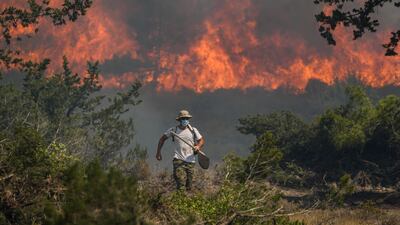
A forest fire burns near Vati village, on the island of Rhodes. AP -
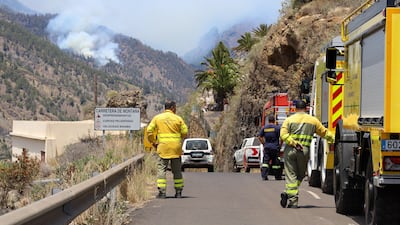
Firefighters watch as a forest fire reignites in Spain's Caldera de Taburiente national park. EPA -

A man lifts a tile from underneath the frame of a burnt bed after a forest fire raced through the Tunisian town of Melloula. AFP -
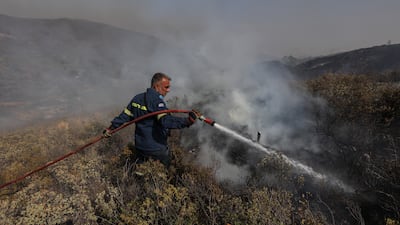
A firefighter tries to extinguish a blaze near the village of Asklipieio, on the Greek island of Rhodes. Reuters -
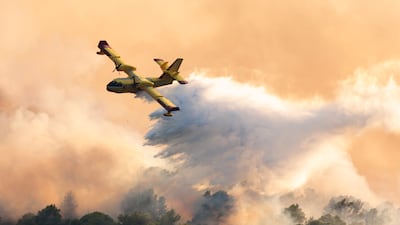
A plane dumps water over a wildfire on Ciovo island, Croatia. AP -
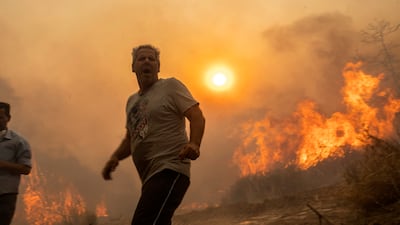
Residents of Gennadi village stand near a forest fire raging on the island of Rhodes. AP -

People are evacuated by boat as they flee a fire burning near the Greek town of Nea Anchialos. EPA -
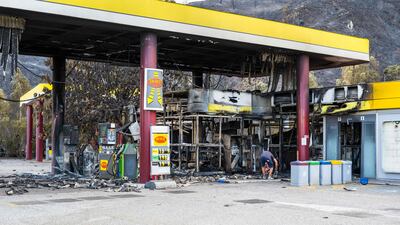
A petrol station destroyed by a forest fire in the Italian town of Oliveri. AFP -
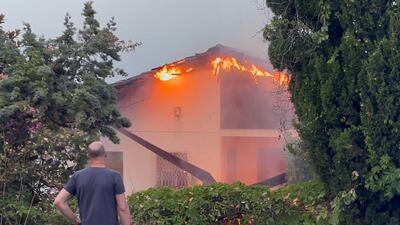
A man watches as a house burns in the Tono district of Messina, Sicily. AFP -
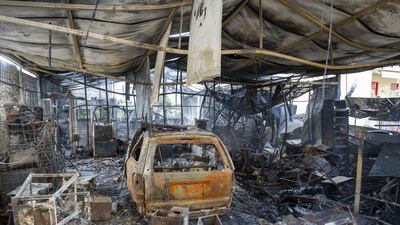
The fire destroyed homes and cars in Oliveri. AFP -
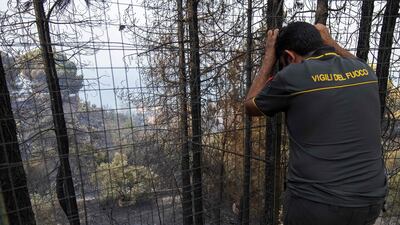
A firefighter is overwhelmed as he looks at the trail of destruction in Messina, Sicily. AFP -
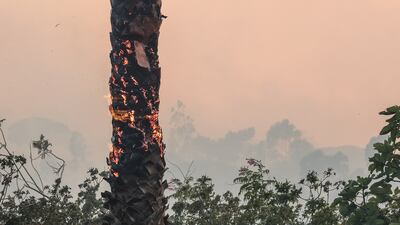
A fire burns a forested area of Alto do Alvide, Portugal. EPA -
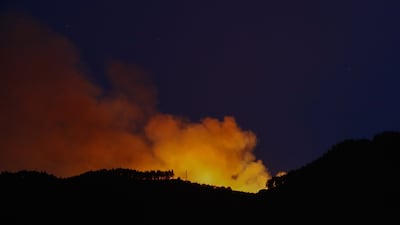
A forest fire burns in Valsequillo, Spain. EPA -
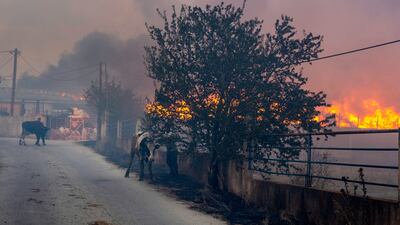
Calves try to escape the fire in Sesklo village, Greece. EPA -

Farmers try to save their animals as the fire approaches Sesklo village. EPA -

A firefighter tackles a blaze outside the village of Vati, Greece. Getty -
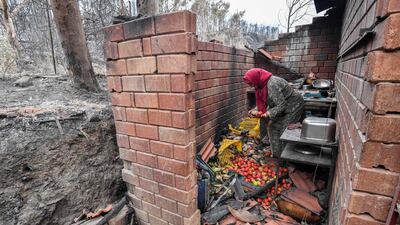
A woman salvages produce from a building gutted by a forest fire near the town of Melloula, Tunisia. AFP -
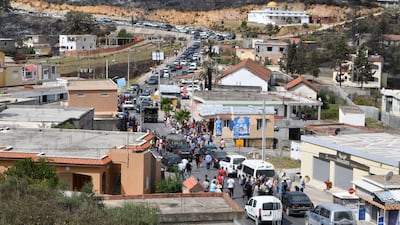
Residents block a street as they demand the restoration water supplies in Melloula, following recent heatwaves and a forest fire in the area. AFP -
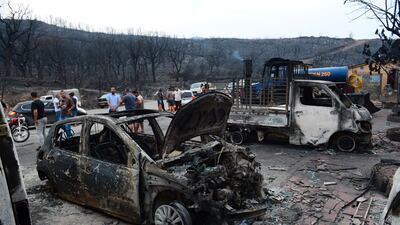
Algerians gather next to vehicles destroyed by wildfires in Bouira, 100km from the capital, Algiers. AP -

A fire engine moves along a road as a forest fire rages near the Tunisian town of Melloula, close to the border with Algeria. AFP -
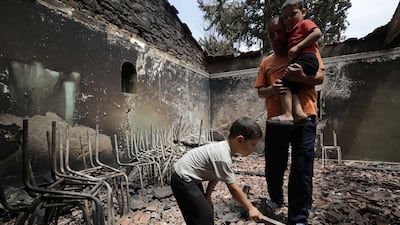
A man and his children inspect the damage to their house after a fire raced through the Algerian village of De Oeud Das. EPA -
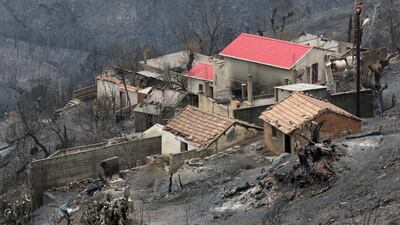
Houses damaged by the forest fires in De Oeud Das village. EPA -
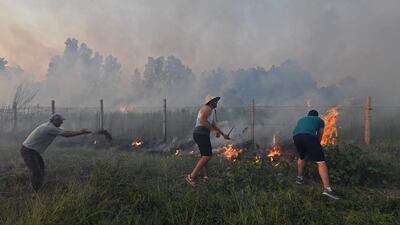
Residents try to extinguish a fire in Tunisia's coastal town of Tabarka amid a blistering heatwave. AFP -
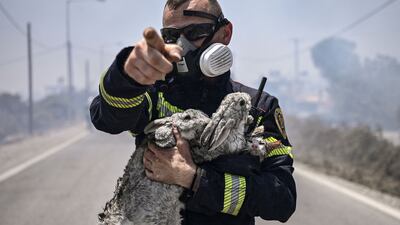
A fireman holds a cat and two rabbits after rescuing them from a fire on the Greek island of Rhodes. AFP -

German tourists and local residents try to extinguish a fire near the seaside resort of Lindos. AP -
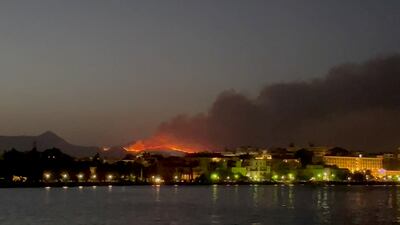
Smoke rises on Corfu following a wildfire. Reuters -
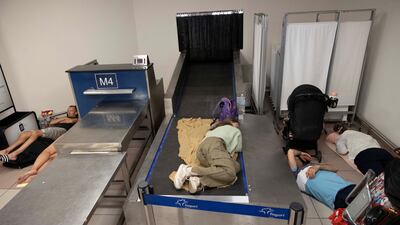
Tourists wait for departing planes at the airport on the island of Rhodes, after being evacuated. Reuters -
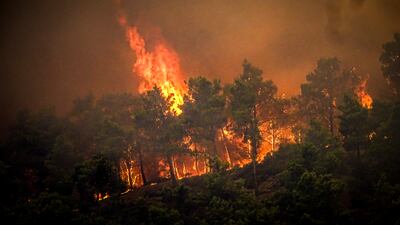
A large forest fire on the Greek island of Rhodes has forced authorities to order an evacuation of four locations. AP -
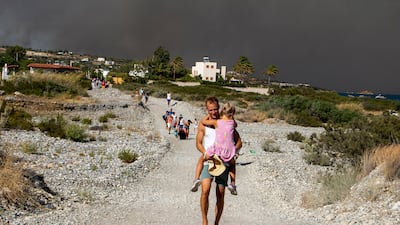
A man carries a child as they leave an area where a forest fire burns. AP -
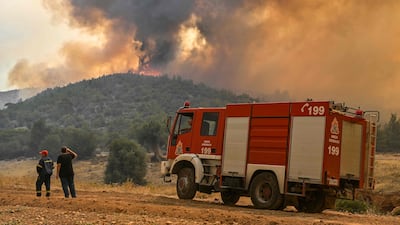
A fire engine is parked in front of a blaze raging in New Peramos, near Athens. AFP -
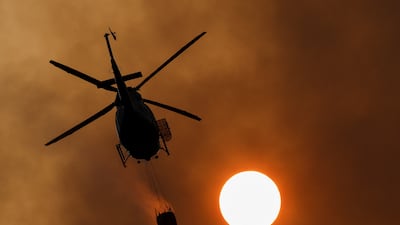
A helicopter works to extinguish a wildfire, in the area of Pico de las Nieves, on the Canary Island of Gran Canaria, Spain. Reuters -
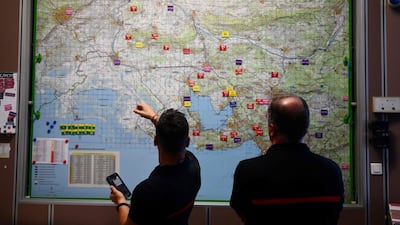
A firefighters' operations room in Marseille, France. AFP -
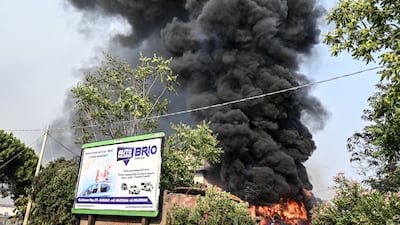
Smoke billows from a house on fire in the Aci Catena area, 20km from Catania. Getty


Indeed, wildfires have cost Europe an estimated €4.1 billion ($4.43 billion) so far this year, fuelled by extreme heat that has seared the Mediterranean from Greece to Spain.
In Maui, at least 115 died in a firestorm that engulfed the town of Lahaina last month.
And while the economic and human toll has been lower, Canada has seen a record swath of forest burn, releasing as much carbon dioxide as Mexico emits in a year.
The problem is expected to get worse as climate change causes temperatures to rise and drought to become more frequent. An analysis, co-authored by the United Nations in 2022, warned that the global risk of cataclysmic wildfires will increase as much as 57 per cent by the end of the century. In addition to climate change upping the risks, human infrastructure is as well, particularly power lines.
US states such as California and Oregon are requiring electric utility companies to brace for the looming threat. Portland General Electric, which powers about half of Oregon’s homes, has budgeted nearly $51 million for wildfire preparation this year. Part of that was spent on Pano’s fire detection intelligence.
For a fee, Pano allows companies like PGE to access information gathered by its fire lookout stations, not unlike how telecom network operators sell their service to mobile users.
Since Pano’s algorithm has yet to master distinguishing smoke from dust and fog, human fire watchers are assigned to verify every AI-generated alert before sending it out. The start-up says that approach boosts accuracy to “almost 100 per cent”.
That has spared PGE staff from having to exhaustively look out for blazes 24 hours a day in a service area equivalent to about 3,000 Central Parks, says Dan Nuñez, who manages the utility’s wildfire planning and analytics.
Pano’s digital firewatcher has also spotted smoke that a human spotter would struggle to see, Mr Nuñez says, adding, “The AI just does such a better job.”
Those words are music to the ears of Sonia Kastner, who has seen “surging” demand since she cofounded Pano. The start-up this year has sold its subscription-based fire detection service to more than two dozen customers, up from four clients in 2021 when Pano first introduced the service. The company’s monitoring network currently covers nearly 9 million acres of wildland – an area larger than Hawaii – but it’s a fraction of the wildfire-prone areas around the world.
Other companies such as Munich-based OroraTech are offering a bigger-picture way to spot fires: looking for them from space.
OroraTech uses infrared imaging sensors installed on more than 20 satellites to detect fires worldwide. As the satellites are orbiting the Earth, the sensors pick up signs of fire – as small as roughly half of a tennis court – and provide several updates an hour to users, says Axel Roenneke, chief commercial officer of the company.
Early detection
While satellites have been used to look for wildfires for decades – Nasa’s Landsat satellites have been collecting information about wildfires since the 1970s – Mr Roenneke says OroraTech’s infrared imaging solution enables firefighters to see through forest canopy or trace the progress of a fire even through thick smoke, providing intelligence that conventional visual sensors can’t offer.
Its satellite-based early detection, combined with AI-empowered analytical tools, has earned OroraTech more than $3 million in revenue this year from 30-plus customers, Mr Roennek says.
The start-up expects its sales to grow fivefold in 2024.
Early detection is just one component of wildfire management. Once a fire is identified, it generally has to be put out, particularly if it poses a threat to infrastructure or nearby communities. But combating fire is a risky profession. In 2021 alone, the US lost 10 firefighters to dangerous blazes in forests. Two firefighters in Canada were killed during this year’s unprecedented wildfire season.
-

The McDougall Creek wildfire burns on the mountainside above a lakefront home in West Kelowna, British Columbia. All photos: The Canadian Press / AP -
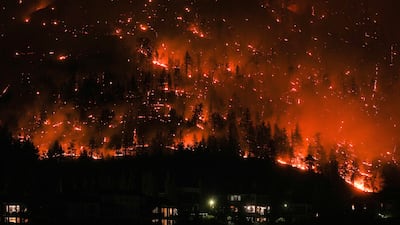
Thousands have been forced to flee in western Canada due to wildfires -
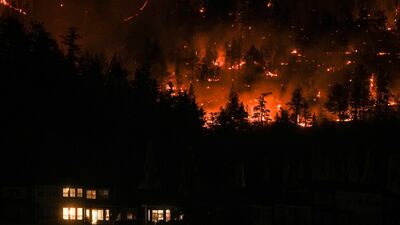
Those evacuating have driven hundreds of kilometers to safety or waited in long queues for emergency flights, as the worst fire season on record in Canada showed no signs of easing -

Two motorcyclists stop to view the McDougall Creek wildfire -

Hundreds of wildfires prompted emergency evacuations in western Canada -

Residents who are unable to drive to safety have been advised to register for flights taking off from nearby areas -
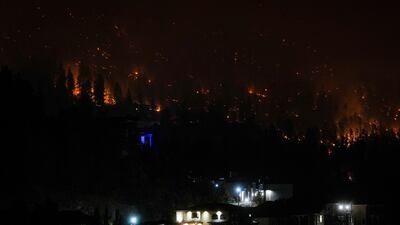
Ingraham Trail, in Dettah, Kam Lake, Grace Lake and Engle Business District face the greatest risk from the wildfires in the Northwest Territories -
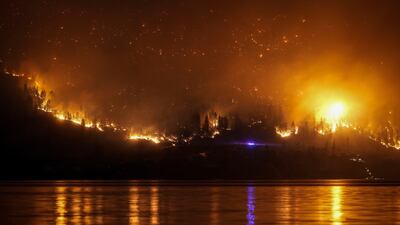
The McDougall Creek wildfire -
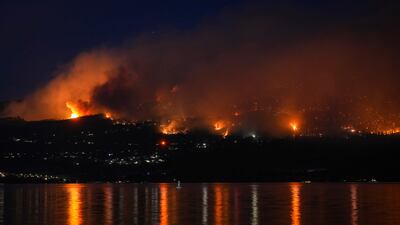
Hundreds of people have been evacuated by plane from remote areas -

The McDougall Creek wildfire burns on the mountainside -
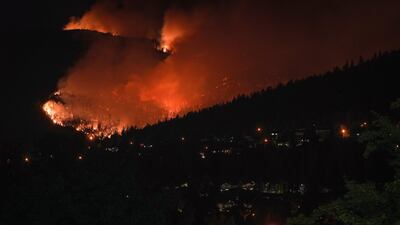
More than 200 fires have already burnt through parts of the Northwest Territories in Canada -
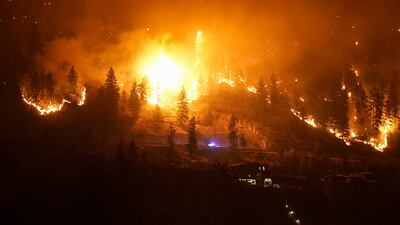
Fires tear through a mountainside in British Columbia -
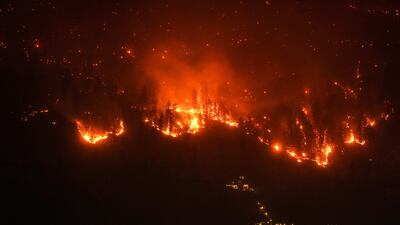
Canadian wildfires have burnt more than 10 million hectares in 2023 -

The McDougall Creek wildfire -

The National Weather Service has said smoke from Canada's fires will once again cross into the US


To reduce the risk to human firefighters, French start-up Shark Robotics builds robots that can be sent to the front lines.
Connected via radio signals, human firefighters can operate Shark’s robot from up to 1km away, watching the flames using the robot’s thermal camera and using water to battle the blaze, says Cyrille Kabbara, the start-up’s founder.
Since the debut of Shark’s first product in 2017, more than 300 robotic firefighters have been put in service in 15 markets including France, India and Switzerland, Mr Kabbara says.
One barrier to wider adoption of wildfire technologies is scepticism.
Solutions such as firefighting robots and AI detectors are useful only if firefighters use them, but convincing fire authorities isn’t an easy task.
“We can't scale this by just selling to progressive cities and counties,” Ms Kastner says.
Many wildfire solution start-ups also face technological limitations. Take early fire detection. While AI cameras can provide real-time feeds, their detection power weakens at night. Satellite-based thermal sensors can see through the darkness but their images often come with a delay.
“There is no one solution that is going to fix everything,” says Ankita Mohapatra, an associate professor at California State University at Fullerton, who is creating a smart sensor that can be mounted on trees to detect forest fires.
The future of battling blazes will rely on human firefighters utilising multiple high-tech solutions, Ms Mohapatra says.
But who will pay for those solutions remains a troublesome question. Pano says its customers typically pay $50,000 per year to gain access to one fire lookout station. Deep-pocketed companies like PGE can afford it, but local fire chiefs like Mr Schneider cannot.
If PGE didn’t sponsor its access to Pano’s AI cameras, it would be “very hard” to afford the service, Mr Schneider says.
In July, the Joe Biden administration provided $185 million in additional funding to help wildland firefighters prepare for and respond to wildfires, following an already allocated fire management budget of $278 million in fiscal year 2023.
While it is unclear if, or what portion of, the fresh funding will be spent on tech-based solutions, Mr Schneider says a high-tech aided future will eventually arrive for him and his fellow firefighters.
“Technologies will keep rolling in,” Mr Schneider says.
“Using extra tools to our advantage just helps us do our job.”

