

Abu Dhabi-based Bayanat, an artificial intelligence-powered geospatial data products and services provider, expects its recently announced space deal for satellites as well as its self-driving vehicles pilot programme to offer a significant boost to the emirate’s smart city ambition.
The company, which is majority owned by G42, is working on boosting its capabilities as part of efforts to work with the government to ensure that Abu Dhabi is “first in the world” when it comes to smart city infrastructure, Abdulla Al Shamsi, Bayanat’s chief operating officer, told The National.
Its initial public offering on the Abu Dhabi Securities Exchange in October is helping the company expand with a focus on building capability in-country, he said.
“Listing definitely allowed us to think we crossed the border that we had [and grab] the opportunities – space itself was the first investment that we decided to go with.”
In May, Bayanat teamed up with Abu Dhabi’s Al Yah Satellite Communications, better known as Yahsat, and Iceye to launch a space programme aimed at building national satellite remote sensing and earth observation capabilities within the UAE.
The first satellite as part of the programme remains on track to be launched in the first quarter of 2024, said Mr Al Shamsi.
“The first satellite will not be built locally … it will be launched and built with our partner. From there, we're building, we are also making ourselves ready from the facility perspective,” he said.
It aims to develop at least five SAR, or Synthetic Aperture Radar, low Earth orbit satellites to provide a consistent data stream.
SAR is an active sensing system that illuminates the Earth’s surface and measures the reflected signal to generate high-resolution images. Unlike traditional optical imaging satellites, SAR can capture images day and night, regardless of weather or sunlight.

The commercial opportunities from the programme are “massive”, according to Mr Al Shamsi.
“We are specialised in the geospatial space, but at the same time we are specialised in smart mobility, smart cities, so now, we will look into that angle also. Having that source of data – be it in an aerial sensing sensors or also remote sensing, definitely will allow us to develop more products,” he said.
SAR will help with the detection of incidents such as land deformation – which earlier would have needed the help of an inspector – or an oil spill at sea, helping authorities take immediate action and contain damage.
It will also have a major impact on urban planning.
“SAR will help us to understand, to plan in a more efficient way and [urban planners] will utilise the data in a more bigger and wider range,” he said.

Abu Dhabi this year retained its title as the smartest city in the Middle East and North Africa thanks to its digital-first initiatives, according to Switzerland's International Institute for Management Development's (IMD) Smart City Index for 2023.
The UAE capital came in 13th globally in the index, which was released in May.
Abu Dhabi's emergence as the regional leader comes following initiatives focused on technologies that include AI and the Internet of Things, and the development of smart city initiatives across society, services and the economy, Mohammed Al Shorafa, chairman of the emirate's Department of Municipalities and Transport (DMT), said at the time.
Bayanat, which is also currently testing driverless transport in Abu Dhabi along with the DMT and the Integrated Transport Centre, is aiming to soon move into the next phase of trials, Mr Al Shamsi said.
The company is working with partners including China’s WeRide, which last month received the UAE’s first preliminary licence to operate self-driving cars in the country.
"This is a new technology and the whole world [is still] trying to be careful with it. We are taking the extra measure [of a safety driver] at this stage just to ... build the trust and the confidence with our partners on the ability of those autonomous vehicles to run freely on our roads," Mr Al Shamsi said.
Thousands of people have taken part in the trials, which started last year, with the robotaxis and robo-buses currently operating in Yas Island and Saadiyat Island.
The tests have provided a lot of data to Bayanat and allowed it to make adjustments to the operating system as it seeks to understand future regulations ahead of massive fleet expansion.
"At this stage, we are working also on how we can increase the fleet and also how we can mobilise the first autonomous vehicle without the safety officer," he said.
"We will test that in a geofencing environment, just to make sure that we are containing it. We have done a test before and it was a success but it was kind of limited in the range of travel. We are planning to expand it in the near future."
-

WeRide's self-driving service has been operating at Yas Island for a year and a half. Khushnum Bhandari / The National -

A safety driver is required in the car as part of the government's regulations. Khushnum Bhandari / The National -
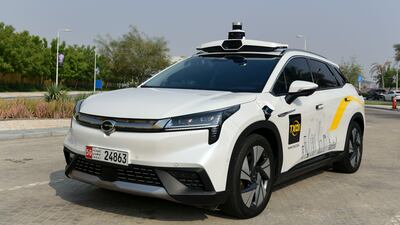
So far, more than 10,000 passengers have already tried the service known as 'Txai'. Khushnum Bhandari / The National -
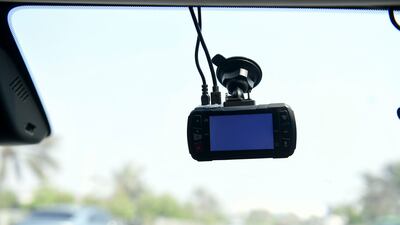
Each car has 10 cameras and 3 lidars - or laser radars. Khushnum Bhandari / The National -
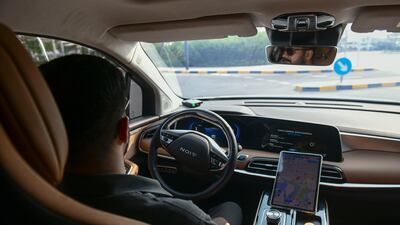
WeRide currently has 10 vehicles, including eight robotaxis and two robobuses operating in the UAE. Khushnum Bhandari / The National -

At present, three of its taxis in the UAE are of Nissan make while five are GAC cars. Khushnum Bhandari / The National -
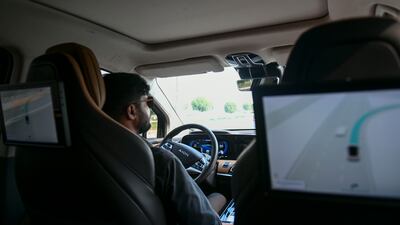
Monitors display the road map in the robotaxi. Khushnum Bhandari / The National -

WeRide currently operates its robobus in China. Photo: WeRide -
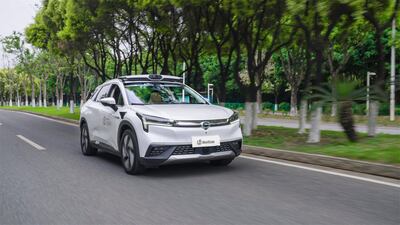
It has permits for testing its vehicles in China and the US. Photo: WeRide -

WeRide's robovans can be customised for commercial operations, including logistics services. Photo: WeRide


Also, from a cost-perspective, the technology at this stage remains on the "higher side".
"We are working with our partners trying to find solutions and how we can really make that commercially viable for the future," Mr Al Shamsi said.
"We are very excited on this."
While the company already has the capability to build an autonomous vehicle locally, it remains to be seen whether that will form part of Bayanat's future strategy.
By next year, Bayanat will be more confident about giving advice, helping to build regulations, building a vehicle and an operating system that will operate the car, Mr Al Shamsi said.
While Bayanat intends to expand across the region and globally with its smart mobility strategy, “we will go when we have the full consultancy service and also when we are providing the technology and implementing this on a wider range”, he said.
Looking ahead, the company will continue focusing on organic and inorganic growth within its key verticals of AI and geospatial to ensure its "sustainable growth and business", he added.

