

Global car makers have touted plans to re-use electric vehicle (EV) batteries when they lose power, but competition for battery packs and cell materials, and the appetite for affordable cars cast doubt on this part of the circular economy.
An array of start-ups offers second-life energy storage using old EV batteries.
But creating the viable industry envisioned by car makers such as Nissan would mean fighting off competition from recyclers, refurbishers and the needs of drivers squeezed by the cost-of-living crisis.
“The assumption that EV batteries are only going to last eight-to-10 years and then owners will swap them out is just not true,” Hans Eric Melin, founder of consultancy Circular Energy Storage, which tracks battery volumes and prices, said.
“It's going to be tricky to make second-life work.”
While a possible solution for buses, lorries and other commercial vehicles, it will take longer for batteries from passenger cars to be re-used at scale.
The second-life energy storage idea is in theory simple.
As EV batteries' capacity falls below 80 per cent to 85 per cent after eight-to-10 years of use, the theory goes, they will be repurposed to power buildings or even balance local and national energy grids.
Investors believing in the circular economy, where products and materials are repaired and re-used, have provided around $1 billion in funding to nearly 50 start-ups globally, according to Reuters calculations.
In addition, car makers from Mercedes to Nissan have set up their own second-life operations.
The problem is a lack of old EV batteries that shows no sign of easing.
-

The demand for electric cars in particular has intensified because of a shortage in the supply of new cars, coupled with escalating fuel prices. AP -
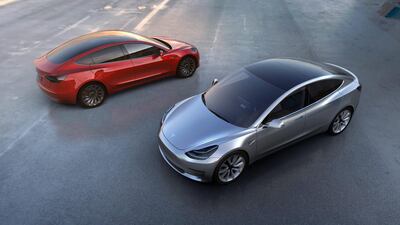
The Tesla Model 3 is one of the most popular used electric vehicles to buy in the UAE. Photo: EPA -

There are four Tesla charging stations located at Masdar Park in Abu Dhabi. Victor Besa / The National -
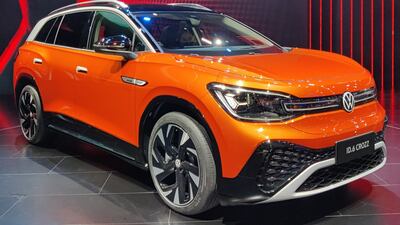
The Volkswagen ID6. Photo: Wikipedia -
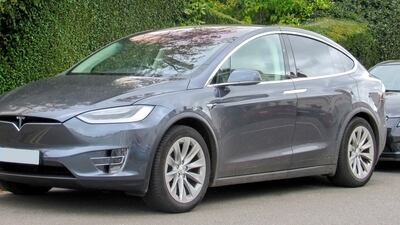
The Tesla Model X is one of the most sought after electric cars on Dubizzle. Photo: Wikimedia commons -
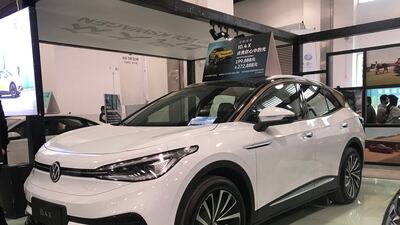
The Volkswagen ID4 is one of the most popular electric cars for people to search for on Dubizzle. Photo: Wikipedia


The rising average age of fossil-fuel cars on the road – now a record 12.5 years in the US according to S&P Global Mobility – suggests many EVs will stay on the road for years to come even if their batteries are depleted.
“The 80 per cent threshold is an arbitrary number that does not reflect the real-life usage of EVs,” CES' Mr Melin said.
As EVs built a decade ago remain in use, Elmar Zimmerling, business development manager for automotive at German second-life battery start-up Fenecon, said there was “as good as no market for second-life batteries” at present, although he predicts a “tsunami” of batteries within the next five years.
Twice the price of new
Competition from outfits using EV batteries to power anything from fossil-fuel classic cars to boats pushed prices to $235 per kilowatt hour in late 2022, according to CES – around double the price major car makers pay for new batteries.
The long-range Tesla Model 3 has a 75KWh battery pack. At that rate, it would cost $17,625 on the used market.
Car and battery-makers increasingly offer energy storage systems using new batteries – from Tesla to the UK's AMTE Power and even Croatian electric sports car maker Rimac.
Although more energy- and therefore, carbon-intensive, recycling also presents another form of competition to re-use as demand for cell materials makes it economically compelling.
“The big question is, if you have pretty valuable raw materials in a battery and you ask, 'how can I get the most out of it?' the answer is recycling might be better,” said Thomas Becker, head of sustainability at BMW, which has a second-life battery storage facility at its Leipzig plant.
Demand surge
Demand for used batteries for storage is likely to soar as intermittent renewable energy takes on a bigger role.
By 2030 global battery capacity for grid storage could grow to 680 gigawatt-hours, from 16GWh at the end of 2021, the Paris-based International Energy Agency estimates.
Britain alone pays around £1 billion ($1.27 billion) annually to switch off wind farms when the grid does not need the power – there is no way yet to store it because of the battery shortage. It also often has to buy electricity from Europe when it has a shortfall.
US start-up Smartville has found a solution in buying packs from EVs written off by insurers. Because they cannot assess the extent and cost of even minor damage to EVs batteries, entire cars, often with almost 100 per cent battery capacity, have been scrapped.
Chief executive Antoni Tong estimates more than 1 GWh of salvaged batteries will hit that US market annually by 2026.
He said the company was trying to negotiate directly with insurers because refurbishers and overseas buyers often outbid it at salvage auctions for Tesla batteries.
Disappearing into the wild
The biggest issue is people keeping their vehicles longer. Jonathan Rivera, a resident of Coeur d'Alene, Idaho, illustrates the challenge.
Last September, he became the third owner of a used 2011 Nissan Leaf he bought for $3,750.
After 12 years' use, the electric car's driving range had fallen to 40 miles (64km) from 120 miles.
That was no problem for Rivera, who used it to commute 18 miles to work, forgoing the heater in the winter because it drained the battery.
He has just sold the car for $3,000 to pay down credit card debt, but wants another used EV.
“That car handled 90 per cent of my driving needs,” Mr Rivera said. “If treated right, it should last another five, six years.”
Even when their owners part with them, many cars simply disappear – in the UK, for instance, the figure is around 20 per cent – and are often sold overseas.
“A Nissan Leaf that's been in the wild for 10 years – there's very limited visibility into where even is that battery?” said Asad Hussain, a partner at Mobility Impact Partners, a private equity firm focused on transportation. “How do you get it back?”
Commercial vehicles provide the best hope thus far for second-life batteries, industry officials said.
London-based start-up Zenobe, for instance, teams up with bus companies wanting to go electric. They buy the buses, but Zenobe buys and manages the battery, then takes it for second-life energy storage.
Since 2017, Zenobe has raised around $1.2 billion in debt and equity funding. It owns 435 megawatt-hours of batteries in around 1,000 electric buses in the UK, Australia and New Zealand, which should grow to 3,000 buses by 2025.
Founder director Steven Meersman said once Britain's 40,000 buses all go electric, they will have 16 gigawatt-hours of batteries on board – about one third of Britain's peak demand in 2022.
“That's a gigafactory on wheels waiting to happen,” he said.

