



Steve Jobs’ original Apple-1 computer prototype has sold at an auction for $677,196.
Regarded as an example of the computer that started it all, the prototype was hand-soldered by Apple co-founder Steve Wozniak in 1976.
It was auctioned by RR Auction of Boston along with a host of other Jobs-related memorabilia.
The prototype was used by Jobs to demonstrate the Apple-1 to Paul Terrell, owner of the Byte Shop in Mountain View, California, one of the first personal computer shops in the world.
The demonstration led to Apple's first big order and instead of a $40 do-it-yourself kit for hobbyists, they set about producing a fully assembled personal computer to be sold at $666.66.
The product description highlighted the apparent use of Mr Wozniak's 'three-handed' technique — wire in one hand, soldering iron in the other, and solder held in his mouth — with tight bubbles formed at the soldered connections.
“There is no Apple-1 without this board — it’s the holy grail of Steve Jobs and Apple memorabilia,” Bobby Livingston, executive vice president at RR Auction, told Bloomberg.
The buyer of the item was not immediately revealed.
RR Auction sold an Apple-1 computer in September 2018 for $375,000, while Dubai-based collector Jimmy Grewal sold an Apple-1 computer signed by Mr Wozniak for $340,100 at an auction.
Other Apple-related items to sell this week include a Steve Jobs business card for $9,518, a 1983 Macintosh introduction plan and logo leaflet for $9,635, a Steve Jobs signed 1971 high school yearbook for $22,728, and a 1976 Apple tax exemption card signed by Jobs for $26,095.
________________________
The rarest Apple product collection in the Middle East
-
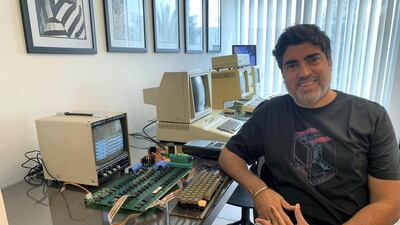
Jimmy Grewal sits in front of the incredibly rare Apple I, the first personal computer sold by Apple in 1976. Cody Combs / The National -
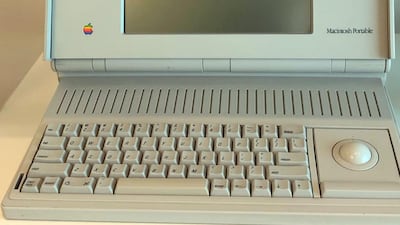
Apple's first attempt at a laptop, the Macintosh Portable, from 1989. It weighed 7 kilograms, but its battery lasted from 6 to 12 hours. Cody Combs / The National -
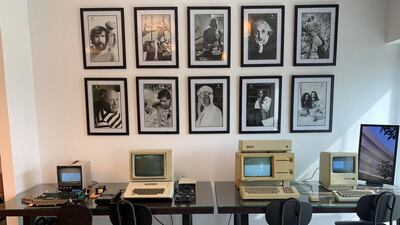
Left to right: Apple I, Apple II, Apple Lisa, Macintosh 512k. Cody Combs / The National -
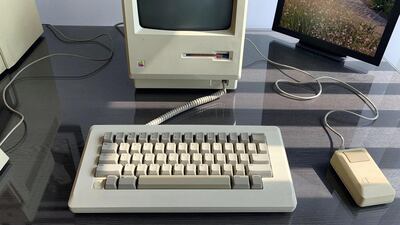
A closeup of one of the first Macintosh models. Cody Combs / The National -
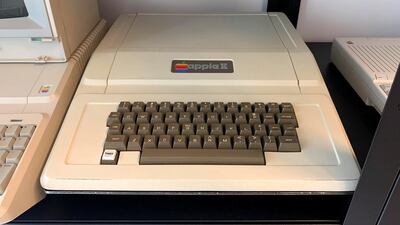
This Apple II (serial #92) has no vents on the casing, making it very rare, unlike the Apple II on the left. Grewal says only approximately a dozen of these ventless Apple IIs remain in existence. Cody Combs / The National -
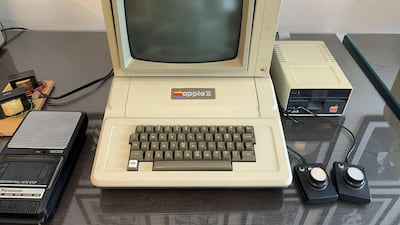
This Apple II was purchased by the American School of Dubai in 1978. Cody Combs / The National -
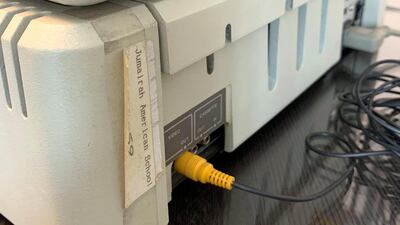
This sticker, complete with typo, shows just how old this Apple II is. Cody Combs / The National -
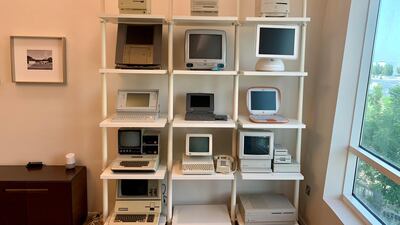
The original 128k Macintosh sits on the top left of this portion of Grewal's Apple Collection. Also pictured just below is the 20th Anniversary Macintosh. Cody Combs / The National -

Grewal's collection is still growing, prompting him to move computers to different locatins to make room. Cody Combs / The National -
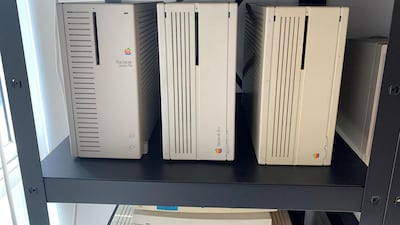
Some of Apple's first attempts at "tower" Macintosh computers, like the Macintohs Quadra, are also in Grewal's collection. Cody Combs / The National -
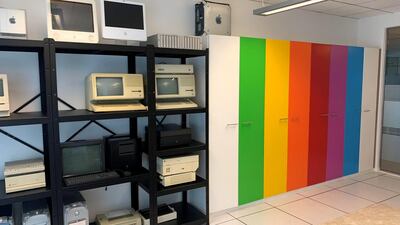
No detail was too small for Grewal in presenting his the Apple products. These cabinets were colour matched to correspond with the original rainbow Apple logo. Cody Combs / The National -
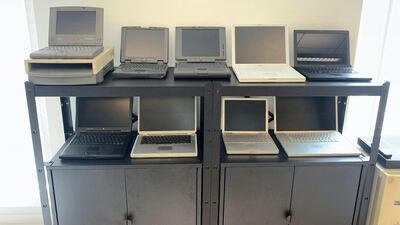
Grewal's collection of Apple laptops, ranging from the Apple Duo to the Apple PowerBooks continues to grow. Cody Combs / The National -
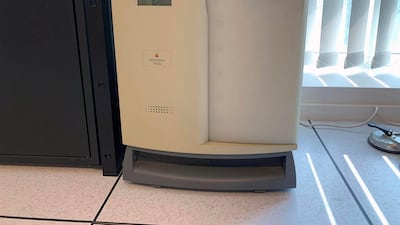
This unusually large Apple product is a rare Apple Network Server. These ran a Unix-based operating system. Cody Combs / The National -

The first Apple LaserWriter, manufactured in 1985, is one of several Apple printers in Grewal's collection. Cody Combs / The National -
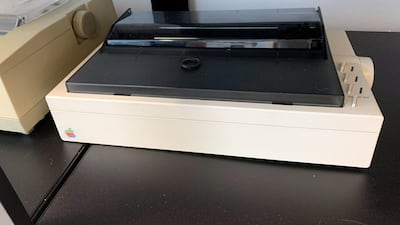
This Apple Scribe printer utilized special thermal paper. The quality was poor and the printing was slow, but the thermal paper was an innovative idea at the time. Cody Combs / The National -
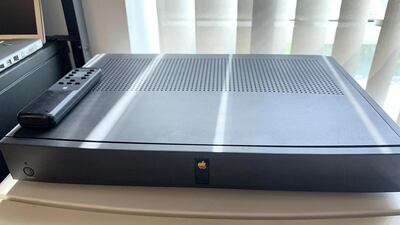
Also in Grewal's collection is an Apple Interactive Television Box from 1994. It was never released. Cody Combs / The National -
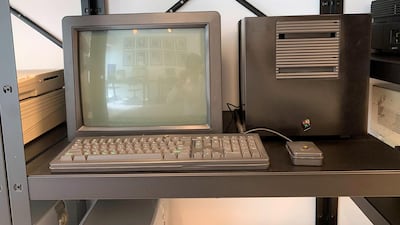
It's not technically an Apple product, but this NeXT Cube was the computer created by Steve Jobs' company, "Next", after he was fired from Apple in 1985. It's shaped almost perfectly like a cube, was very powerful, but sold poorly. Cody Combs / The National -
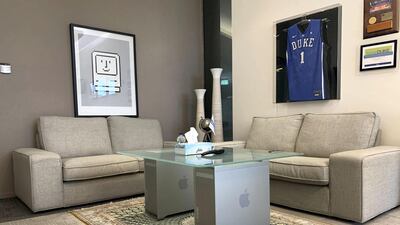
In Grewal's other office, Apple product cases are used to prop up a coffee table, and various Apple artefacts and photos are displayed on the wall. Cody Combs / The National -
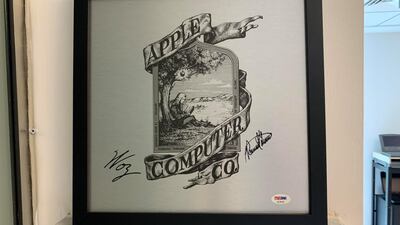
This is a rarely used early rendition of the Apple logo. It's signed by Apple co-founder Steve Wozniak, and the often forgotten co-founder Ron Wayne. Cody Combs / The National -

Inside this original Macintosh 128k, you can see the molded signatures from the original Macintosh team, including the signature of Steve Jobs. Cody Combs / The National -
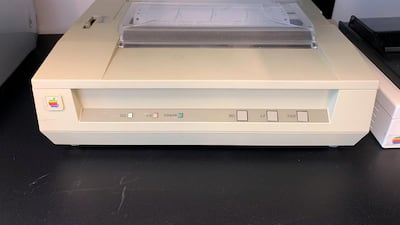
An Apple Dot Matrix Printer, first introduced in 1982. Cody Combs / The National -
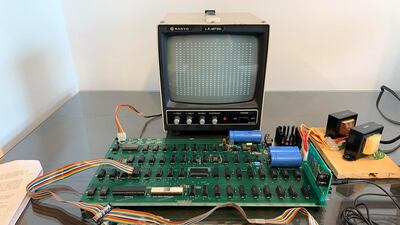
This rare Apple I was the first product shipped by Apple in 1976. This particular Apple I in Grewal's Dubai collection still works. Cody Combs / The National -
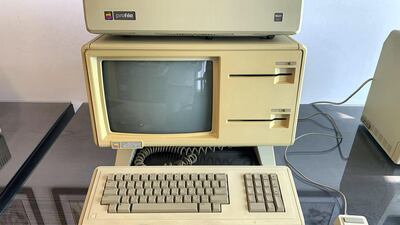
This is an original Apple Lisa in Grewal's Dubai collection. It was the first Apple computer to have a graphical user interface. Grewal says approximately 20 of the original Lisa computers remain in the world. Cody Combs / The National



