


Airbnb, the online marketplace for homestays, said it will allow its employees to work from anywhere permanently, in a bid to further improve flexibility.
The San Francisco-based company's move will enable employees to work from homes, offices or while travelling in different countries, chief executive Brian Chesky wrote in an email to staff.
He said the move was part of a wider transition to accommodate remote work.
“The world is becoming more flexible about where people can work. We see this in our own business,” Mr Chesky said.
“We wouldn't have recovered so quickly from the pandemic had it not been for millions of people working from Airbnbs.”
Working from home — or anywhere — is not new, but it exponentially grew during the Covid-19 pandemic when people were forced to stay indoors due to strict lockdowns.
Around 16 per cent of companies globally now have a fully-remote setup, while 44 per cent would not allow it, according to Owl Labs, which makes video conferencing devices.
The number of people who have been working from home has consistently surged in the past decade or so, by 44 per cent in the past five years, 91 per cent in the past decade and 159 per cent since 2009, Global Workplace Analytics data shows.
In the US alone, almost 60 per cent of the labour force are working from home as of 2022, it said.
Working from home has also brought its benefits into the mainstream. About three quarters say they are more productive when doing so due to fewer distractions, according to US companies CoSo Cloud, which provides software and services, and FlexJobs, a job site for remote working.
A better work-life balance is also the primary reason people opt to work remotely, Owl Labs said.
-
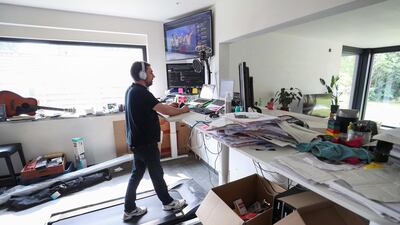
Exercise desks allow people to walk or cycle while they are working, so it creates a far healthier workspace. REUTERS/Yves Herman -
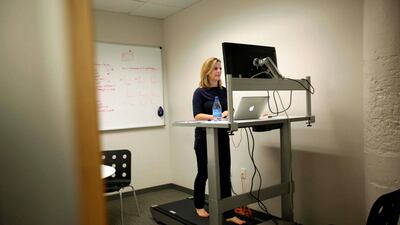
Google, Facebook, Twitter and Apple are some of the firms to implement exercise equipment fitted with desks. REUTERS / Robert Galbraith -
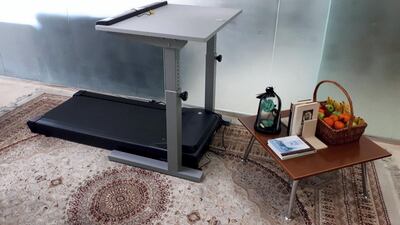
Demand for home office equipment has soared during the pandemic. A study by KPMG found 69 per cent of 500 CEOs from the world’s most influential firms planned to reduce their office space over three years. Courtesy: MoveToExcellence -
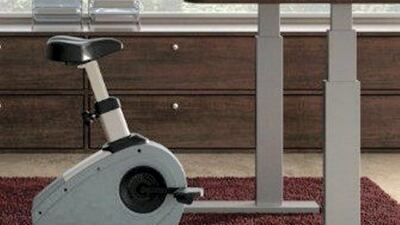
The machines are more expensive than regular exercise equipment, but are specifically designed for offices. Courtesy: MoveToExcellence -

Treadmills are designed to operate at low speeds for a long time. Courtesy: MoveToExcellence -
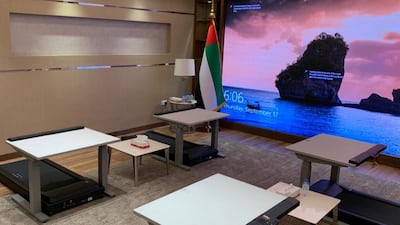
Exercise desks allow people to walk or cycle while they are working, so it creates a far healthier workspace. Courtesy: MoveToExcellence


The number of major companies adapting the work from home or hybrid working model is also growing. These include Apple, Facebook owner Meta Platforms and Microsoft.
But not all are switching to a permanent one. Google, for instance, asked its staff to be back in the office this month or risk getting suspended or have their contract terminated.
Mr Chesky's communique said employees who work in areas that have a lower cost of living will not have any changes in their compensation.
Despite the sweeping rule, Airbnb will be hosting regular in-person meet-ups and retreats in a move to keep face-to-face communication alive.
Mr Chesky, who in January said he would live and work out of Airbnb's properties for several months, said the decision was made due to the scheme's popularity, which continues to be the case even after the crisis has subsided and restrictions have been either relaxed or removed altogether.
Airbnb in February said it closed its fiscal 2021 year with its “strongest” fourth quarter, in which it booked 73.4 million nights — a 59 per cent surge over 2020. For the full year, bookings jumped 56 per cent annually to almost 301 million.
The company's gross booking value rose 91 per cent to $11.3 billion in the fourth quarter. For the entirety of 2021, GBV was about $47bn, a 96 per cent year-on-year improvement.
Revenue in the fourth quarter increased 78 per cent to $1.5bn, while for 2021 it grew 77 per cent to $6bn.
Nearly half of nights booked on the platform between July and December last year were part of stays that were one month or longer, the company said. In the past year, around 175,000 people used Airbnb to book stays for three months or longer.
Airbnb said it has added more than 150 updates, including verified Wi-Fi connections, to support remote-work trends.
In February, Airbnb signed an agreement with Abu Dhabi's Department of Culture and Tourism to promote the holiday home sector in the UAE capital.

