


The UAE plans to boost its cyber security expertise and “export” its knowledge in the industry, the government’s head of cyber security said.
The Emirates’ partnerships with global technology companies has helped spread this vision overseas and top cyber agencies will continue efforts to build a “cyber security coalition”, Mohammed Al Kuwaiti said at the Gulf Information Security Expo and Conference in Dubai on Monday.
“The plan is to definitely export the UAE’s cyber security model [globally]; our goal is to spread that cyber security culture. Their security is our security; the more secure they are, the more secure we are,” Mr Al Kuwaiti said.
“All of those [cyber] attacks do not know borders [or] geographical areas. This is the importance of actually working with them [international partners] and leveraging that relationship at private and government levels is an important thing for us.”
The UAE has invested heavily in building its cyber security infrastructure to protect the integrity of its government and economic systems even as the country pursues its digital economy ambitions.
Several initiatives and public-private partnerships have been signed to support these efforts. In January, Abu Dhabi Digital Authority teamed up with the UAE’s biggest telecom operator Etisalat Group — now known as e& — and security software company Trend Micro to launch a programme aimed at strengthening the cyber security capabilities of government entities in the emirate.
Last November, the Central Bank of the UAE established a new Networking and Cyber Security Operations Centre to help defend the financial system’s IT infrastructure against cyber attacks.
Cyber attacks can be costly for organisations: the average cost of an attack peaked in 2016, amounting to about $4 million, according to data from IBM’s security arm.
Corporate users were the prime target of financial malware attacks in the UAE during the first half of 2021, according to a study by Kaspersky. In the same period, ransomware attacks surged 151 per cent globally, the World Economic Forum said.
Mr Al Kuwaiti stressed that the world was facing a “cyber pandemic”, a term he previously used in November, saying that with remote work and online learning set to continue for a long time, there will always be threats, requiring organisations and individuals to remain vigilant.
-

The opening day of Gisec 2022 at the World Trade Centre in Dubai. All photos: Antonie Robertson / The National -

General image from the opening day of GISEC 2022 at the World Trade Center in Dubai. -

General image from the opening day of GISEC 2022 at the World Trade Center in Dubai. -

General image from the opening day of GISEC 2022 at the World Trade Center in Dubai. -
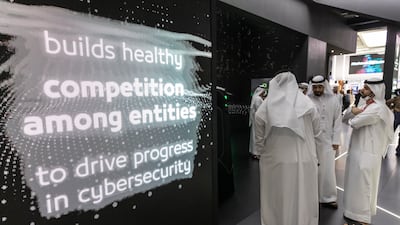
General image from the opening day of GISEC 2022 at the World Trade Center in Dubai. -
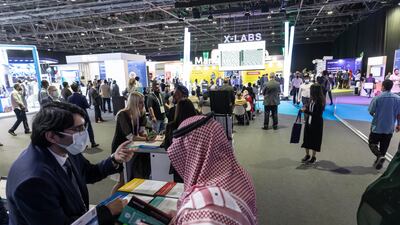
General image from the opening day of GISEC 2022 at the World Trade Center in Dubai. -

General image from the opening day of GISEC 2022 at the World Trade Center in Dubai. -
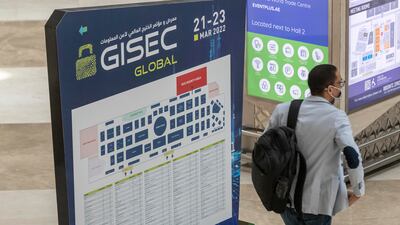
General image from the opening day of GISEC 2022 at the World Trade Center in Dubai. -

General image from the opening day of GISEC 2022 at the World Trade Center in Dubai. -

General image from the opening day of GISEC 2022 at the World Trade Center in Dubai. -
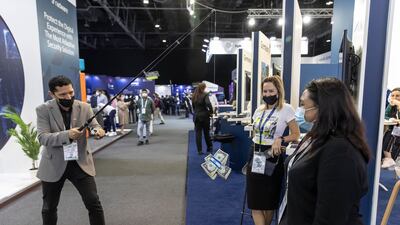
General image from the opening day of GISEC 2022 at the World Trade Center in Dubai. -

General image from the opening day of GISEC 2022 at the World Trade Center in Dubai. -

General image from the opening day of GISEC 2022 at the World Trade Center in Dubai. -
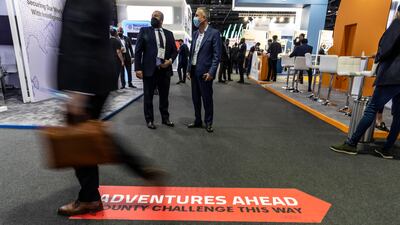
General image from the opening day of GISEC 2022 at the World Trade Center in Dubai. -
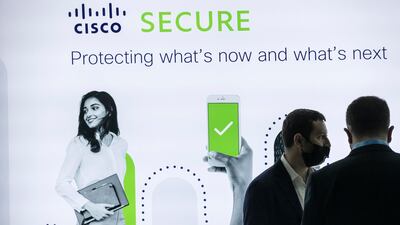
General image from the opening day of GISEC 2022 at the World Trade Center in Dubai. -

General image from the opening day of GISEC 2022 at the World Trade Center in Dubai.


He acknowledged that the onset of the Covid-19 pandemic caught security systems off-guard, paving the way for cyber criminals to perpetuate attacks. But lessons have been learnt and the world is better prepared to fend off bad actors in the cyber space, he said.
“We did not have that readiness for many infrastructure [systems at that time]. Fast forward to today, many technologies have evolved and with the zero-trust aspect ... we learnt that the cyber pandemic is here to stay,” Mr Al Kuwaiti said.
“This pandemic is not something bad; it is an opportunity that we actually need to leverage so we can innovate” to build resilience against future challenges, he said.
The UAE also has advanced cloud ecosystems that allow businesses of all sizes and government enterprises to operate safely, Mr Al Kuwaiti told The National during the Intersec event in January.
But the global challenge remains. Cyber attacks have been “breaking down boundaries” and are affecting the lives of more than 4.5 billion people around the world, Stephen Kavanagh, executive director of police services at Interpol, said at Gisec.
“It’s not a surprise that Covid-19 showed the ability of criminals to adapt quickly online,” he said. This needs to be countered in an equally paced way, “through models of cyber security co-operation in ways we haven’t seen,” he said.
“It is unrealistic to think law enforcement can recruit and retain the best brains, so that is where they turn to the private sector.”
UAE government head of cyber security
The massive number of devices connected to the internet today, and the many more in the future, also pose huge opportunities for cyber criminals, forcing businesses to reassess their priorities to prevent large attacks, said MK Palmore, former head of the FBI’s San Francisco cyber security investigative branch.
“By 2025, 42 billion devices will be connected to the internet. This is a huge expanded digital surface area to protect. It is no surprise then that, from an infrastructure and security standpoint, our reliance on digital services as we look to maintain society and business operations has become the number one issue for organisations,” he said.

