

Demand for sending satellites into space remains strong, but US rocket start-ups are taking drastic measures to survive a tight funding environment where fears have been exacerbated by the bankruptcy of Virgin Orbit.
The industry faces an interesting dichotomy. Demand has surged from launching a few satellites on small rockets to launching swarms of satellites at once using bigger rockets, even as investors shy away from the sector in search of safer bets.
Venture investment in space start-ups has dropped 50 per cent year-on-year in 2022 to $21.9 billion, according to venture capital firm Space Capital.
As the cost of capital rises with the Federal Reserve's interest rate hikes, investors are less incentivised to fund capital intensive projects that do not have a clear revenue stream or path to profitability, leaving many space start-ups scrambling for funds.
"I've never raised capital in a harder market than the one we're in right now," Firefly Aerospace chief executive Bill Weber said.
"The I word and the R word — recession and inflation — make the investment market conservative and a little more cautious."
The failure of billionaire Richard Branson's Virgin Orbit, which filed for bankruptcy this month, has only ratcheted up pressure on rivals trying to keep up with Elon Musk's SpaceX, Rocket Lab and the Boeing-Lockheed Martin joint venture, United Launch Alliance.

Texas-based Firefly is trying to mass-produce its medium-sized rocket, while developing a larger launcher under a new partnership with Northrop Grumman.
Fresh off celebrating its Alpha rocket's orbital debut last October, Firefly tried to raise $300 million by year-end to become cash-flow positive. By mid-February, it had only raised $30 million according to regulatory filings, although Mr Weber said since then the company had reached about 75 per cent of target.
Firefly expects to hold another funding round in mid-2024, Mr Weber said.
Last week, Relativity Space said it was ditching its centrepiece small rocket, Terran 1, for a larger planned rocket, Terran R, a decision roughly a year in the making as demand for small rockets faded, chief executive Tim Ellis said.
The California-based company to date has raised $1.3 billion, compared to Firefly's total $390 million which includes some funds from the continuing fund-raising effort.
"It was a lot better to just put those resources into Terran R because that's going to be a way-more-profitable way to allocate the team that we have," Mr Ellis said.
The bigger rocket's planned debut in 2026 will leave the company without any missions for roughly three years, but Mr Ellis said he is not worried about future funding and declined to say when the company would do another funding round.
Astra Space, which ditched its small Rocket 3.3 for a planned, larger Rocket 4 in the next few years, has struggled to bring its stock price above $1, facing delisting threats from Nasdaq. Astra declined to comment on its financial struggles.
Firefly and Astra have added other business lines to make up for lost revenue, while Relativity has said its 3D printers used in rocket construction will be eventually employed for other products.
Firefly, which was forced by US officials in 2021 to sever its Ukrainian ties through Noosphere Ventures over national security concerns, counts a lunar lander named Blue Ghost as a "very profitable" line of revenue, Mr Weber said.
Despite the start-ups' struggles, launch demand has soared after sanctions following the Russia-Ukraine conflict cut off access to Russian rockets. Recent failures with Europe's Arianespace's Vega-C rocket have added to demand in the US, outstripping the number of available rockets.
-
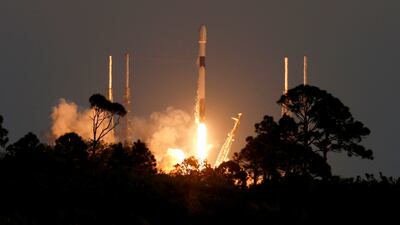
A SpaceX Falcon 9 rocket lifts off with a payload of 21 Starlink satellites from Cape Canaveral, Florida. Reuters -
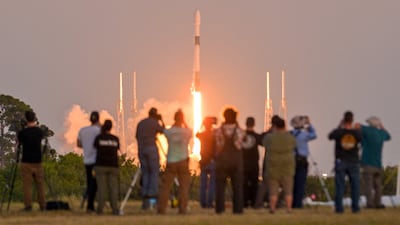
Spectators watch the SpaceX Falcon 9 rocket lift-off. Reuters -
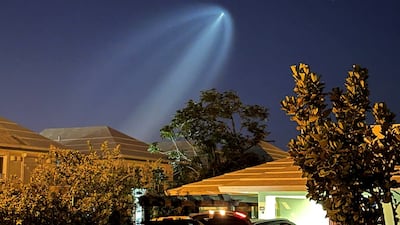
The SpaceX Falcon 9 rocket is seen from Punta Cana, Dominican Republic. Photo: Twitter @ahervas_ -

SpaceX conducted a record 61 orbital launches in 2022, including a significant number for the Starlink programme. Reuters -

The second generation of satellites offer four times the capacity, which means they 'provide more bandwidth with increased reliability', according to SpaceX. Photo: SpaceX -
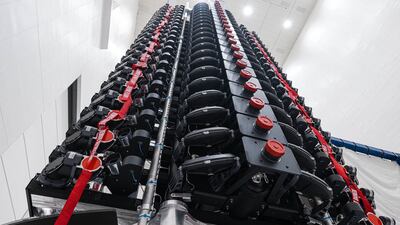
Starlink's network of low-orbit satellites are designed to deliver high-speed internet services to the world, particularly remote and rural locations. -

Residents in Ukraine's Donetsk enclave use a Starlink terminal. Reuters


Shared missions to space on SpaceX's Falcon 9 rockets, a cheaper, so-called ride-share option for satellite companies that helped kill the business case for small rockets, have taken some of that demand, but much of it remains.
Private plans to deploy mega-constellations, vast swarms of satellites in low-Earth orbit, have also given launch start-ups hope for future demand.
"The industry is now behaving as a more rational, capitalistic industry," Erich Fischer, a senior partner at Bain and Co who advises space companies, said. "It's never behaved that way before, ever."

