The Shams+ stand at the Electric Vehicle Innovation Summit. Photo: Al Masaood

Abu Dhabi's Al Masaood Group launches first UAE-built charging solution for EVs


Alvin R Cabral
  • English
  • Arabic

Abu Dhabi's Al Masaood Group launched the first UAE-made charging solution for electric vehicles on Monday, in line with the growth of green mobility in the country.

The Shams+ solution, released by Al Masaood Power Division, is a fully fledged battery-charging system powered by solar energy that can top up vehicles in 25 minutes and has an extensive network of stations, the company announced at the inaugural Electric Vehicle Innovation Summit on Monday.

Shams+, which is expected to be rolled out in the third quarter of 2022, will also be compatible with hybrid marine vehicles, Al Masaood said.

“We aim to deliver better access to connectivity-enabled and seamless plug-and-charge experience," said Rasso Bartenschlager, general manager of Al Masaood Power Division.

"It will precipitate wider adoption of EVs and marine vessels in the country and the rest of the Gulf region, thereby reducing carbon emissions and helping fast-track the goals of the UAE Net Zero 2050 strategic initiative.”

EVs are growing in popularity as more users see their benefits compared to traditional petrol vehicles, but one of the key requirements to increasing adoption is to grow the network of charging stations.

The UAE has focused on increasing charging stations in recent years. The Dubai Electricity and Water Authority recently said its charging network has risen to 325 stations, as the number of registered EVs in the emirate rose to 5,107 as of January 31 this year from 71 on December 31, 2015.

That has provided more than 8,800 megawatt hours, enabling motorists to travel more than 58 million kilometres since 2015 while cutting refuelling costs by about three quarters, Dewa said.

The UAE aims to have 42,000 electric vehicles on the roads by the end of the next decade, as part of its net zero target.

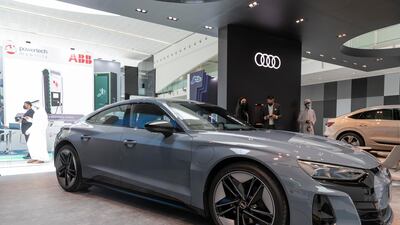
  • An Audi e-tron at the Electric Vehicle Innovation Summit (EVIS) being held at the Abu Dhabi National Exhibition Centre. All photos by Antonie Robertson / The National
    An Audi e-tron at the Electric Vehicle Innovation Summit (EVIS) being held at the Abu Dhabi National Exhibition Centre. All photos by Antonie Robertson / The National
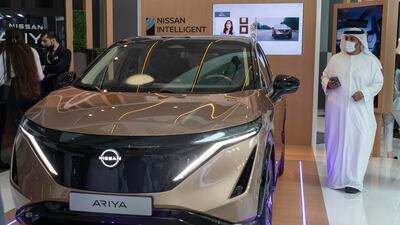
  • A Nissan Ariya electric model at EVIS.
    A Nissan Ariya electric model at EVIS.
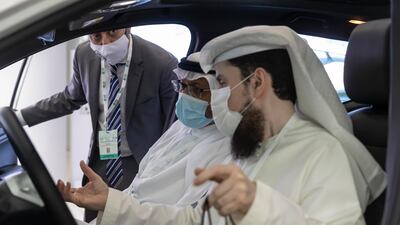
  • Visitors check out an electric vehicle at the show.
    Visitors check out an electric vehicle at the show.
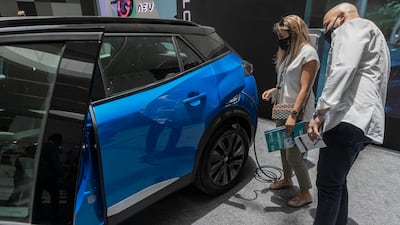
  • An electric Peugeot model at EVIS.
    An electric Peugeot model at EVIS.
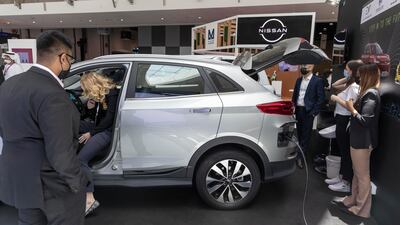
  • Visitors watch as an electric car is charged at EVIS.
    Visitors watch as an electric car is charged at EVIS.
  • Visitors check out the UAE's first locally produced electric car, Al Damani. The vehicle is manufactured by the M Glory Group.
    Visitors check out the UAE's first locally produced electric car, Al Damani. The vehicle is manufactured by the M Glory Group.
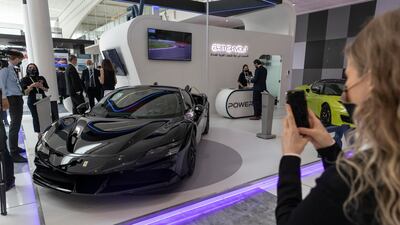
  • The Ferrari stand at the electric vehicle car show.
    The Ferrari stand at the electric vehicle car show.
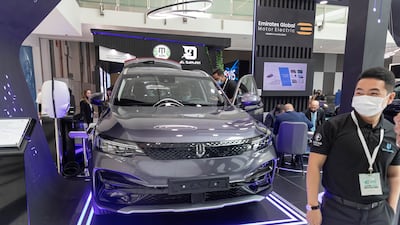
  • The Emirates Global Motor Electric stand. The UAE is seeking to position itself as a leader in the next generation of transport.
    The Emirates Global Motor Electric stand. The UAE is seeking to position itself as a leader in the next generation of transport.
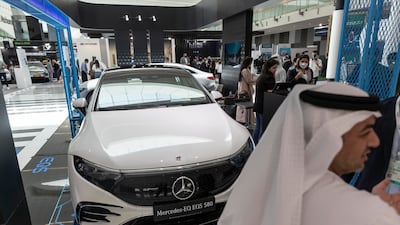
  • A Mercedes Benz electric car on display at the show.
    A Mercedes Benz electric car on display at the show.
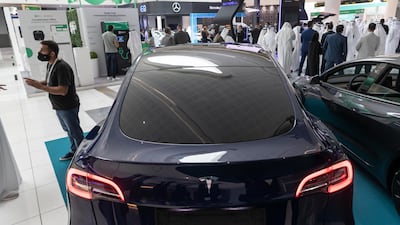
  • Tesla is also exhibiting its cars at the show, the Mena region's first exhibition focused on electric vehicles.
    Tesla is also exhibiting its cars at the show, the Mena region's first exhibition focused on electric vehicles.
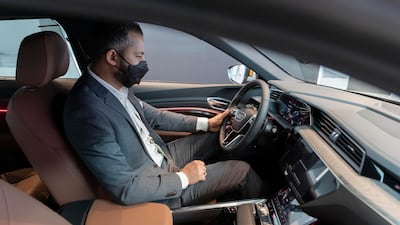
  • The interior of an Audi e-tron.
    The interior of an Audi e-tron.

Al Masaood Power Division said its charging stations will be built with rest areas for added convenience.

“We also want to highlight that such a value-added solution is an addition to our growing large-scale energy solution projects that are completely made in the country," Mr Bartenschlager said.


UK’s AI plan
  • AI ambassadors such as MIT economist Simon Johnson, Monzo cofounder Tom Blomfield and Google DeepMind’s Raia Hadsell
  • £10bn AI growth zone in South Wales to create 5,000 jobs
  • £100m of government support for startups building AI hardware products
  • £250m to train new AI models
COMPANY%20PROFILE
%3Cp%3E%3Cstrong%3EName%3A%20%3C%2Fstrong%3EKinetic%207%3Cbr%3E%3Cstrong%3EStarted%3A%3C%2Fstrong%3E%202018%3Cbr%3E%3Cstrong%3EFounder%3A%3C%2Fstrong%3E%20Rick%20Parish%3Cbr%3E%3Cstrong%3EBased%3A%3C%2Fstrong%3E%20Abu%20Dhabi%2C%20UAE%3Cbr%3E%3Cstrong%3EIndustry%3A%3C%2Fstrong%3E%20Clean%20cooking%3Cbr%3E%3Cstrong%3EFunding%3A%3C%2Fstrong%3E%20%2410%20million%3Cbr%3E%3Cstrong%3EInvestors%3A%3C%2Fstrong%3E%20Self-funded%3C%2Fp%3E%0A
The specs

Engine: 4.0-litre V8 twin-turbocharged and three electric motors

Power: Combined output 920hp

Torque: 730Nm at 4,000-7,000rpm

Transmission: 8-speed dual-clutch automatic

Fuel consumption: 11.2L/100km

On sale: Now, deliveries expected later in 2025

Price: expected to start at Dh1,432,000

Mercer, the investment consulting arm of US services company Marsh & McLennan, expects its wealth division to at least double its assets under management (AUM) in the Middle East as wealth in the region continues to grow despite economic headwinds, a company official said.

Mercer Wealth, which globally has $160 billion in AUM, plans to boost its AUM in the region to $2-$3bn in the next 2-3 years from the present $1bn, said Yasir AbuShaban, a Dubai-based principal with Mercer Wealth.

Within the next two to three years, we are looking at reaching $2 to $3 billion as a conservative estimate and we do see an opportunity to do so,” said Mr AbuShaban.

Mercer does not directly make investments, but allocates clients’ money they have discretion to, to professional asset managers. They also provide advice to clients.

“We have buying power. We can negotiate on their (client’s) behalf with asset managers to provide them lower fees than they otherwise would have to get on their own,” he added.

Mercer Wealth’s clients include sovereign wealth funds, family offices, and insurance companies among others.

From its office in Dubai, Mercer also looks after Africa, India and Turkey, where they also see opportunity for growth.

Wealth creation in Middle East and Africa (MEA) grew 8.5 per cent to $8.1 trillion last year from $7.5tn in 2015, higher than last year’s global average of 6 per cent and the second-highest growth in a region after Asia-Pacific which grew 9.9 per cent, according to consultancy Boston Consulting Group (BCG). In the region, where wealth grew just 1.9 per cent in 2015 compared with 2014, a pickup in oil prices has helped in wealth generation.

BCG is forecasting MEA wealth will rise to $12tn by 2021, growing at an annual average of 8 per cent.

Drivers of wealth generation in the region will be split evenly between new wealth creation and growth of performance of existing assets, according to BCG.

Another general trend in the region is clients’ looking for a comprehensive approach to investing, according to Mr AbuShaban.

“Institutional investors or some of the families are seeing a slowdown in the available capital they have to invest and in that sense they are looking at optimizing the way they manage their portfolios and making sure they are not investing haphazardly and different parts of their investment are working together,” said Mr AbuShaban.

Some clients also have a higher appetite for risk, given the low interest-rate environment that does not provide enough yield for some institutional investors. These clients are keen to invest in illiquid assets, such as private equity and infrastructure.

“What we have seen is a desire for higher returns in what has been a low-return environment specifically in various fixed income or bonds,” he said.

“In this environment, we have seen a de facto increase in the risk that clients are taking in things like illiquid investments, private equity investments, infrastructure and private debt, those kind of investments were higher illiquidity results in incrementally higher returns.”

The Abu Dhabi Investment Authority, one of the largest sovereign wealth funds, said in its 2016 report that has gradually increased its exposure in direct private equity and private credit transactions, mainly in Asian markets and especially in China and India. The authority’s private equity department focused on structured equities owing to “their defensive characteristics.”

T20 SQUADS

Australia: Aaron Finch (c), Mitchell Marsh, Alex Carey, Ashton Agar, Nathan Coulter-Nile, Chris Lynn, Nathan Lyon, Glenn Maxwell, Ben McDermott, D’Arcy Short, Billy Stanlake, Mitchell Starc, Andrew Tye, Adam Zampa.

Pakistan: Sarfraz Ahmed (c), Fakhar Zaman, Mohammad Hafeez, Sahibzada Farhan, Babar Azam, Shoaib Malik, Asif Ali, Hussain Talat, Shadab Khan, Shaheen Shah Afridi, Usman Khan Shinwari, Hassan Ali, Imad Wasim, Waqas Maqsood, Faheem Ashraf.

The years Ramadan fell in May

1987

1954

1921

1888

Four tips to secure IoT networks

Mohammed Abukhater, vice president at FireEye in the Middle East, said:

- Keep device software up-to-date. Most come with basic operating system, so users should ensure that they always have the latest version

- Besides a strong password, use two-step authentication. There should be a second log-in step like adding a code sent to your mobile number

- Usually smart devices come with many unnecessary features. Users should lock those features that are not required or used frequently

- Always create a different guest network for visitors

Updated: May 24, 2022, 6:16 PM