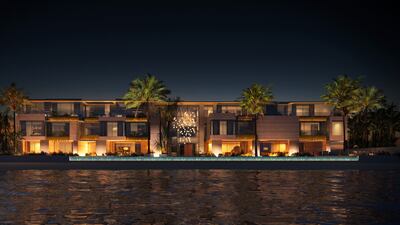
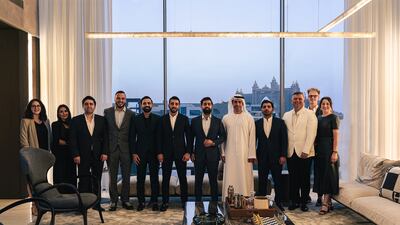
The total number of $10 million home sales in Dubai for the first nine months of the year has reached a record high of 277, driven by rising demand for luxury homes in the emirate, as reported in a new study by the global consultancy Knight Frank.
The emirate registered a 40.7 per cent annual jump in the volume of residential sales valued at more than $10 million in the third quarter of 2023.
The volume of homes priced over $10 million in Dubai - the commercial and tourism centre of the Middle East - totalled more than $1.59 billion in the July-September period, the report said.
“Demand for luxury homes in Dubai remains resilient and supply continues to stubbornly lag demand,” Faisal Durrani, partner – head of research for Middle East and Africa at Knight Frank, said.
In the first half of the year, Dubai emerged as one of the world's busiest markets for sales over $10 million, recording 189 transactions. It surpassed other global cities, including New York (125), Hong Kong (109), London (99), Los Angeles (77), and Singapore (67).
The average transacted price for homes that were sold for more than $10 million stood at Dh6,557 ($1,785.2) per square feet at the end of September quarter, Knight Frank’s analysis stated.
Dubai’s luxury home demand continues to strengthen, attracting both local and international purchasers, it added.
The city's prime residential areas are witnessing consistent interest, with the Palm Jumeirah remaining the key focal point for luxury home sales, accounting for nearly 52.3 per cent of total sales in the over $10 million price bracket.
The total value of over $10 million sales in the last quarter stood at more than $825.2 million in Palm Jumeirah. It was followed by Emirates Hills ($189.6 million), Umm Suqeim 3 ($141.8 million), MBR City ($125.6 million) and Jumeirah Bay Island ($117.9 million).
“The extraordinary run of price rises in this third market cycle has seen prices escalating for nine-consecutive quarters … Dubai’s prime neighbourhoods of the Palm Jumeirah, Emirates Hills, and Jumeirah Bay Island, have been and continue to be the real stars of this cycle,” Mr Durrani said.
Demand for luxury homes continued to rise in Dubai, driven by higher demand from wealthy individuals.
Global high-net-worth individuals plan to spend $2.5 billion on Dubai property this year, Knight Frank said in a report in May.
About 22 per cent of the HNWIs are prepared to commit $5 million to $10 million on real estate in the emirate, while 8 per cent are ready to spend more than $80 million, it said.
Last year, the emirate recorded the sale of 219 homes priced above $10 million, with the total value of the transactions reaching $3.8 billion.
That ranked Dubai behind New York (244 sales), Los Angeles (225 sales) and London (223 sales).

Abandon
Sangeeta Bandyopadhyay
Translated by Arunava Sinha
Tilted Axis Press
THE BIO
Born: Mukalla, Yemen, 1979
Education: UAE University, Al Ain
Family: Married with two daughters: Asayel, 7, and Sara, 6
Favourite piece of music: Horse Dance by Naseer Shamma
Favourite book: Science and geology
Favourite place to travel to: Washington DC
Best advice you’ve ever been given: If you have a dream, you have to believe it, then you will see it.
Results
5pm: Maiden (PA) Dh80,000 (Turf) 1,600m; Winner: Rawat Al Reef, Adrie de Vries (jockey), Abdallah Al Hammadi (trainer)
5.30pm: Wathba Stallions Cup Handicap (PA) Dh70,000 (T) 1,400m; Winner: Noof KB, Richard Mullen, Ernst Oertel
6pm: Handicap (PA) Dh80,000 (T) 1,200m; Winner: AF Seven Skies, Bernardo Pinheiro, Qaiss Aboud
6.30pm: Handicap (PA) Dh80,000 (T) 2,200m; Winner: Jabalini, Szczepan Mazur, Ibrahim Al Hadhrami
7pm: UAE Arabian Derby – Prestige (PA) Dh150,000 (T) 2,200m; Winner: Dergham Athbah, Richard Mullen, Mohamed Daggash
7.30pm: Emirates Championship – Group 1 (PA) Dh1,000,000 (T) 2,200m; Winner: Somoud, Richard Mullen, Jean de Roualle
8pm: Abu Dhabi Championship – Group 3 (TB) Dh380,000 (T) 2,200m; Winner: Irish Freedom, Antonio Fresu, Satish Seemar
Defending champions
World Series: South Africa
Women’s World Series: Australia
Gulf Men’s League: Dubai Exiles
Gulf Men’s Social: Mediclinic Barrelhouse Warriors
Gulf Vets: Jebel Ali Dragons Veterans
Gulf Women: Dubai Sports City Eagles
Gulf Under 19: British School Al Khubairat
Gulf Under 19 Girls: Dubai Exiles
UAE National Schools: Al Safa School
International Invitational: Speranza 22
International Vets: Joining Jack
Honeymoonish
%3Cp%3E%3Cstrong%3EDirector%3A%3C%2Fstrong%3E%20Elie%20El%20Samaan%3C%2Fp%3E%0A%3Cp%3E%3Cstrong%3EStarring%3A%20%3C%2Fstrong%3ENour%20Al%20Ghandour%2C%20Mahmoud%20Boushahri%3C%2Fp%3E%0A%3Cp%3E%3Cstrong%3ERating%3A%3C%2Fstrong%3E%203%2F5%3C%2Fp%3E%0A
Desert Warrior
Starring: Anthony Mackie, Aiysha Hart, Ben Kingsley
Director: Rupert Wyatt
Rating: 3/5
Mercer, the investment consulting arm of US services company Marsh & McLennan, expects its wealth division to at least double its assets under management (AUM) in the Middle East as wealth in the region continues to grow despite economic headwinds, a company official said.
Mercer Wealth, which globally has $160 billion in AUM, plans to boost its AUM in the region to $2-$3bn in the next 2-3 years from the present $1bn, said Yasir AbuShaban, a Dubai-based principal with Mercer Wealth.
“Within the next two to three years, we are looking at reaching $2 to $3 billion as a conservative estimate and we do see an opportunity to do so,” said Mr AbuShaban.
Mercer does not directly make investments, but allocates clients’ money they have discretion to, to professional asset managers. They also provide advice to clients.
“We have buying power. We can negotiate on their (client’s) behalf with asset managers to provide them lower fees than they otherwise would have to get on their own,” he added.
Mercer Wealth’s clients include sovereign wealth funds, family offices, and insurance companies among others.
From its office in Dubai, Mercer also looks after Africa, India and Turkey, where they also see opportunity for growth.
Wealth creation in Middle East and Africa (MEA) grew 8.5 per cent to $8.1 trillion last year from $7.5tn in 2015, higher than last year’s global average of 6 per cent and the second-highest growth in a region after Asia-Pacific which grew 9.9 per cent, according to consultancy Boston Consulting Group (BCG). In the region, where wealth grew just 1.9 per cent in 2015 compared with 2014, a pickup in oil prices has helped in wealth generation.
BCG is forecasting MEA wealth will rise to $12tn by 2021, growing at an annual average of 8 per cent.
Drivers of wealth generation in the region will be split evenly between new wealth creation and growth of performance of existing assets, according to BCG.
Another general trend in the region is clients’ looking for a comprehensive approach to investing, according to Mr AbuShaban.
“Institutional investors or some of the families are seeing a slowdown in the available capital they have to invest and in that sense they are looking at optimizing the way they manage their portfolios and making sure they are not investing haphazardly and different parts of their investment are working together,” said Mr AbuShaban.
Some clients also have a higher appetite for risk, given the low interest-rate environment that does not provide enough yield for some institutional investors. These clients are keen to invest in illiquid assets, such as private equity and infrastructure.
“What we have seen is a desire for higher returns in what has been a low-return environment specifically in various fixed income or bonds,” he said.
“In this environment, we have seen a de facto increase in the risk that clients are taking in things like illiquid investments, private equity investments, infrastructure and private debt, those kind of investments were higher illiquidity results in incrementally higher returns.”
The Abu Dhabi Investment Authority, one of the largest sovereign wealth funds, said in its 2016 report that has gradually increased its exposure in direct private equity and private credit transactions, mainly in Asian markets and especially in China and India. The authority’s private equity department focused on structured equities owing to “their defensive characteristics.”