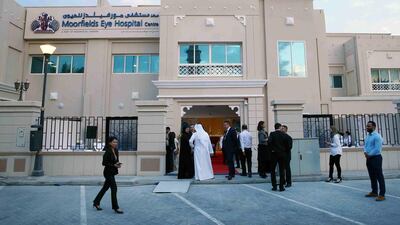
Moorfields Eye Hospital Abu Dhabi is one of 21 hospitals and health centres run by UEMedical. Courtesy Moorfields Hospital

Olive Rock Partners takes stake in UEMedical in debut deal


Michael Fahy
  • English
  • Arabic

Olive Rock Partners, an independent private equity firm based in Abu Dhabi, completed its debut deal with an investment in healthcare company UEMedical.

Olive Rock, in which Abu Dhabi Catalyst Partners became an anchor investor in March, said it is investing in the business alongside an affiliate of New York-based alternative asset firm Cerberus Capital Management. It did not reveal the value of the investment in UEMedical, but founding partner Muhannad Qubbaj told The National that it had secured an "influential minority" stake.

“We are excited to partner with the UEMedical team and shareholders to further enhance the growth of this exceptional platform within Abu Dhabi and its neighbouring Emirates as well as abroad, focusing initially on Saudi Arabia,” Mr Qubbaj said.

“This is a landmark deal within a growing and attractive sector globally and we are very pleased to be working with Cerberus to support it.”

The number of hospitals in the UAE grew by 6.2 per cent per year to 158 in 2020, with the bulk (70 per cent) of these operated by private sector companies, according to the UAE Health Sector Pulse report published by Alvarez & Marsal last month.

Abu Dhabi has 66 hospitals containing about 5,500 beds, according to the report. Occupancy rates stand at 55 per cent and the market remains relatively fragmented, with "few dominant players", the report said.

UEMedical was founded in 2008 and has 21 hospitals and health centres. The company operates Danat Al Emarat Hospital, a specialist women's and children's hospital in the UAE capital, as well as the HealthPlus fertility and family health centres and the Moorfields Eye Hospital Centre Abu Dhabi – a joint venture with the London-based specialist Moorfields Eye Hospital NHS Foundation Trust.

The company employs more than 2,300 healthcare professionals and has treated about 700,000 patients. It will use the new funding from Olive Rock and Cerberus to add complementary services and extend its geographical reach.

“With an expanding focus on healthcare in the region, the company [UEMedical] is well-positioned to broaden its reach,” Gabriel Schulze, senior managing director of Cerberus, said. “We look forward to partnering with Olive Rock as we support UEMedical on its mission to deliver exceptional, patient-centric care.”

Olive Rock was founded last year by Mr Qubbaj and Abdullah Shahin, both of whom are former partners at Gulf Capital. The company is currently in the process of raising its debut fund.

Cerberus Capital Management manages $53 billion of private equity, private credit and real estate assets.

Olive Rock and Cerberus were advised on their investment by law firm Freshfields Bruckhaus Deringer.


Wicked: For Good

Director: Jon M Chu

Starring: Ariana Grande, Cynthia Erivo, Jonathan Bailey, Jeff Goldblum, Michelle Yeoh, Ethan Slater

Rating: 4/5

Mercer, the investment consulting arm of US services company Marsh & McLennan, expects its wealth division to at least double its assets under management (AUM) in the Middle East as wealth in the region continues to grow despite economic headwinds, a company official said.

Mercer Wealth, which globally has $160 billion in AUM, plans to boost its AUM in the region to $2-$3bn in the next 2-3 years from the present $1bn, said Yasir AbuShaban, a Dubai-based principal with Mercer Wealth.

Within the next two to three years, we are looking at reaching $2 to $3 billion as a conservative estimate and we do see an opportunity to do so,” said Mr AbuShaban.

Mercer does not directly make investments, but allocates clients’ money they have discretion to, to professional asset managers. They also provide advice to clients.

“We have buying power. We can negotiate on their (client’s) behalf with asset managers to provide them lower fees than they otherwise would have to get on their own,” he added.

Mercer Wealth’s clients include sovereign wealth funds, family offices, and insurance companies among others.

From its office in Dubai, Mercer also looks after Africa, India and Turkey, where they also see opportunity for growth.

Wealth creation in Middle East and Africa (MEA) grew 8.5 per cent to $8.1 trillion last year from $7.5tn in 2015, higher than last year’s global average of 6 per cent and the second-highest growth in a region after Asia-Pacific which grew 9.9 per cent, according to consultancy Boston Consulting Group (BCG). In the region, where wealth grew just 1.9 per cent in 2015 compared with 2014, a pickup in oil prices has helped in wealth generation.

BCG is forecasting MEA wealth will rise to $12tn by 2021, growing at an annual average of 8 per cent.

Drivers of wealth generation in the region will be split evenly between new wealth creation and growth of performance of existing assets, according to BCG.

Another general trend in the region is clients’ looking for a comprehensive approach to investing, according to Mr AbuShaban.

“Institutional investors or some of the families are seeing a slowdown in the available capital they have to invest and in that sense they are looking at optimizing the way they manage their portfolios and making sure they are not investing haphazardly and different parts of their investment are working together,” said Mr AbuShaban.

Some clients also have a higher appetite for risk, given the low interest-rate environment that does not provide enough yield for some institutional investors. These clients are keen to invest in illiquid assets, such as private equity and infrastructure.

“What we have seen is a desire for higher returns in what has been a low-return environment specifically in various fixed income or bonds,” he said.

“In this environment, we have seen a de facto increase in the risk that clients are taking in things like illiquid investments, private equity investments, infrastructure and private debt, those kind of investments were higher illiquidity results in incrementally higher returns.”

The Abu Dhabi Investment Authority, one of the largest sovereign wealth funds, said in its 2016 report that has gradually increased its exposure in direct private equity and private credit transactions, mainly in Asian markets and especially in China and India. The authority’s private equity department focused on structured equities owing to “their defensive characteristics.”

RACE CARD

4pm Al Bastakiya – Listed (TB) $150,000 (Dirt) 1,900m

4.35pm Dubai City Of Gold – Group 2 (TB) $228,000 (Turf) 2,410m

5.10pm Mahab Al Shimaal – Group 3 (TB) $228,000 (D) 1,200m

5.45pm Burj Nahaar – Group 3 (TB) $228,000 (D) 1,600m

6.20pm Jebel Hatta – Group 1 (TB) $260,000 (T) 1,800m

6.55pm Al Maktoum Challenge Round-1 – Group 1 (TB) $390,000 (D) 2,000m

7.30pm Nad Al Sheba – Group 3 (TB) $228,000 (T) 1,200m

What can victims do?

Always use only regulated platforms

Stop all transactions and communication on suspicion

Save all evidence (screenshots, chat logs, transaction IDs)

Report to local authorities

Warn others to prevent further harm

Courtesy: Crystal Intelligence