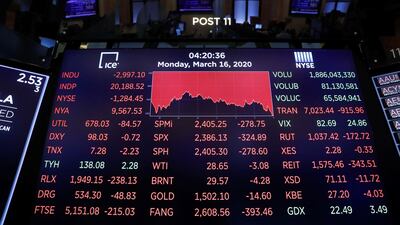
The New York Stock Exchange said the move was taken after “consultation with relevant regulatory authorities”. Reuters

NYSE backtracks on plan to delist Chinese telecom companies


  • English
  • Arabic

The New York Stock Exchange said it will no longer delist China’s three biggest state-owned telecommunications companies, backtracking on a plan that had threatened to escalate tensions between the world’s largest economies.

NYSE’s U-turn came just four days after the exchange said it would remove shares of China Mobile, China Telecom Corporation and China Unicom Hong Kong to comply with a US executive order. NYSE cited “consultation with relevant regulatory authorities” in a brief statement late on Monday announcing the reversal.

Shares of China Mobile, China Telecom and Unicom rallied on the latest development, rising more than 6 per cent in Hong Kong trading. Calls and emails to the companies weren’t immediately returned on Tuesday.

On New Year’s Eve, NYSE said it would delist the companies to comply with a November order by US President Donald Trump barring American investments in Chinese firms owned or controlled by the military. It was the first time an American exchange had announced plans to remove a Chinese company as a direct result of rising geopolitical tensions between the two superpowers.

The move to delist the shares had heightened concerns about tit-for-tat sanctions on Chinese and American companies. The former have turned to the US stock market for capital and international prestige for more than two decades, raising at least $144 billion from some of the world’s largest investors. Wall Street banks are particularly keen to see a ratcheting down of tensions after gaining unprecedented scope to operate in China last year.


Jetour T1 specs

Engine: 2-litre turbocharged

Power: 254hp

Torque: 390Nm

Price: From Dh126,000

Available: Now

BMW M5 specs

Engine: 4.4-litre twin-turbo V-8 petrol enging with additional electric motor

Power: 727hp

Torque: 1,000Nm

Transmission: 8-speed auto

Fuel consumption: 10.6L/100km

On sale: Now

Price: From Dh650,000

RESULTS

5pm: Handicap (PA) Dh70,000 1,400m
Winner: AF Tathoor, Tadhg O’Shea (jockey), Ernst Oertel (trainer)
5.30pm: Handicap (TB) Dh70,000 1,000m
Winner: Dahawi, Antonio Fresu, Musabah Al Muhairi
6pm: Maiden (PA) Dh70,000 2,000m
Winner: Aiz Alawda, Fernando Jara, Ahmed Al Mehairbi
6.30pm: Handicap (PA) Dh70,000 2,000m
Winner: ES Nahawand, Fernando Jara, Mohammed Daggash
7pm: Maiden (PA) Dh70,000 1,600m
Winner: Winked, Connor Beasley, Abdallah Al Hammadi
7.30pm: Al Ain Mile Group 3 (PA) Dh350,000 1,600m
Winner: Somoud, Connor Beasley, Ahmed Al Mehairbi
8pm: Handicap (PA) Dh70,000 1,600m
Winner: Al Jazi, Fabrice Veron, Eric Lemartinel

What is the FNC?

The Federal National Council is one of five federal authorities established by the UAE constitution. It held its first session on December 2, 1972, a year to the day after Federation.
It has 40 members, eight of whom are women. The members represent the UAE population through each of the emirates. Abu Dhabi and Dubai have eight members each, Sharjah and Ras al Khaimah six, and Ajman, Fujairah and Umm Al Quwain have four.
They bring Emirati issues to the council for debate and put those concerns to ministers summoned for questioning. 
The FNC’s main functions include passing, amending or rejecting federal draft laws, discussing international treaties and agreements, and offering recommendations on general subjects raised during sessions.
Federal draft laws must first pass through the FNC for recommendations when members can amend the laws to suit the needs of citizens. The draft laws are then forwarded to the Cabinet for consideration and approval. 
Since 2006, half of the members have been elected by UAE citizens to serve four-year terms and the other half are appointed by the Ruler’s Courts of the seven emirates.
In the 2015 elections, 78 of the 252 candidates were women. Women also represented 48 per cent of all voters and 67 per cent of the voters were under the age of 40.
 

Ten tax points to be aware of in 2026

1. Domestic VAT refund amendments: request your refund within five years

If a business does not apply for the refund on time, they lose their credit.

2. E-invoicing in the UAE

Businesses should continue preparing for the implementation of e-invoicing in the UAE, with 2026 a preparation and transition period ahead of phased mandatory adoption. 

3. More tax audits

Tax authorities are increasingly using data already available across multiple filings to identify audit risks. 

4. More beneficial VAT and excise tax penalty regime

Tax disputes are expected to become more frequent and more structured, with clearer administrative objection and appeal processes. The UAE has adopted a new penalty regime for VAT and excise disputes, which now mirrors the penalty regime for corporate tax.

5. Greater emphasis on statutory audit

There is a greater need for the accuracy of financial statements. The International Financial Reporting Standards standards need to be strictly adhered to and, as a result, the quality of the audits will need to increase.

6. Further transfer pricing enforcement

Transfer pricing enforcement, which refers to the practice of establishing prices for internal transactions between related entities, is expected to broaden in scope. The UAE will shortly open the possibility to negotiate advance pricing agreements, or essentially rulings for transfer pricing purposes. 

7. Limited time periods for audits

Recent amendments also introduce a default five-year limitation period for tax audits and assessments, subject to specific statutory exceptions. While the standard audit and assessment period is five years, this may be extended to up to 15 years in cases involving fraud or tax evasion. 

8. Pillar 2 implementation 

Many multinational groups will begin to feel the practical effect of the Domestic Minimum Top-Up Tax (DMTT), the UAE's implementation of the OECD’s global minimum tax under Pillar 2. While the rules apply for financial years starting on or after January 1, 2025, it is 2026 that marks the transition to an operational phase.

9. Reduced compliance obligations for imported goods and services

Businesses that apply the reverse-charge mechanism for VAT purposes in the UAE may benefit from reduced compliance obligations. 

10. Substance and CbC reporting focus

Tax authorities are expected to continue strengthening the enforcement of economic substance and Country-by-Country (CbC) reporting frameworks. In the UAE, these regimes are increasingly being used as risk-assessment tools, providing tax authorities with a comprehensive view of multinational groups’ global footprints and enabling them to assess whether profits are aligned with real economic activity. 

Contributed by Thomas Vanhee and Hend Rashwan, Aurifer

Company%20Profile
%3Cp%3E%3Cstrong%3EName%3A%3C%2Fstrong%3E%20HyveGeo%3Cbr%3E%3Cstrong%3EStarted%3A%3C%2Fstrong%3E%202023%3Cbr%3E%3Cstrong%3EFounders%3A%3C%2Fstrong%3E%20Abdulaziz%20bin%20Redha%2C%20Dr%20Samsurin%20Welch%2C%20Eva%20Morales%20and%20Dr%20Harjit%20Singh%3Cbr%3E%3Cstrong%3EBased%3A%20%3C%2Fstrong%3ECambridge%20and%20Dubai%3Cbr%3E%3Cstrong%3ENumber%20of%20employees%3A%3C%2Fstrong%3E%208%3Cbr%3E%3Cstrong%3EIndustry%3A%20%3C%2Fstrong%3ESustainability%20%26amp%3B%20Environment%3Cbr%3E%3Cstrong%3EFunding%3A%20%3C%2Fstrong%3E%24200%2C000%20plus%20undisclosed%20grant%3Cbr%3E%3Cstrong%3EInvestors%3A%20%3C%2Fstrong%3EVenture%20capital%20and%20government%3C%2Fp%3E%0A
The President's Cake

Director: Hasan Hadi

Starring: Baneen Ahmad Nayyef, Waheed Thabet Khreibat, Sajad Mohamad Qasem 

Rating: 4/5