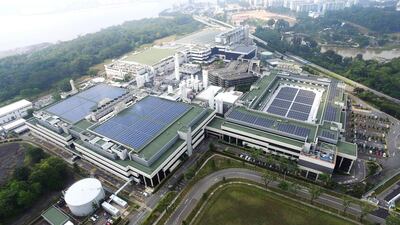
Globalfoundries, one of the top semiconductor manufacturers, is co-investing $4 billion in a new plant in Singapore to address an ongoing shortage of chips that is affecting the automotive and electronics industries worldwide.
The US company, a unit of Abu Dhabi's Mubadala Investment Company, will finance the expansion using its own investments and those of government and long-term customers, said chief executive Thomas Caulfield during an online ground-breaking ceremony on Tuesday.
“We are expanding our global manufacturing footprint, starting with a new fab [foundry] in Singapore,” he said.
“This is a true symbol of what can be achieved by combining government and customers’ partnerships and GF investments.”
The US company will spend $1bn each to expand manufacturing capacity in the US and Germany over the next two years, he told a separate media briefing on Tuesday.
In March, Globalfoundries said it plans to invest $1.4bn in 2021 to expand its manufacturing capacity across Singapore, Europe and the US.
“Globalfoundries is currently the only global semiconductor manufacturer of scale with a global footprint and we are stepping up and meeting the challenges of the global semiconductor shortage by accelerating our investment – not only in Singapore but around the world,” said Mr Caulfield.
“Working in close collaboration with our customers and the government of Singapore is a recipe of success that we are pioneering here and looking forward to replicating in the future – in Europe and [the] US.”
Automotive manufacturers and electronics companies, including some of the world’s biggest computer and smartphone makers, face a chip shortage that has been exacerbated by the Covid-19 pandemic, which disrupted global supply chains.
Car manufacturers such as Germany's Volkswagen and Ford and General Motors in the US had to trim production due to a chip shortage, prompting the semiconductor industry to boost investments to plug the supply gap.
In March, Intel said it will invest $20bn to expand its manufacturing facilities as it expects chip shortages to spill over into next year.
In the same month, Taiwan's TSMC unveiled plans to invest $100bn over the next three years to increase its production capacity.
Semiconductor manufacturers also intend to capitalise on future demand growth sparked by growing digitisation after the onset of the pandemic.
The global market is set to expand by 19.7 per cent this year and hit $573bn next year as growth slows to 8.8 per cent, according to World Semiconductor Trade Statistics, a global trade body representing chip makers. The growth will be mainly driven by demand for memory chips.
GF is currently the only global semiconductor manufacturer of scale with a global footprint and we are stepping up and meeting the challenges of global semiconductor shortage by accelerating our investment not only in Singapore but around the world
“It took 50 years for the industry to grow to $500bn today and now it is estimated that the industry will grow to $1 trillion in roughly eight years,” said Mr Caulfield. “It is hard to overstate the amount of investment and focus [needed] in order to meet this challenge.”
The new 23,000 square metre plant will be adjacent to the company's existing campus. It will boost production of 300-millimetre-wafers by 450,000 a year, taking the total capacity of its Singapore centre to 1.5 million 300mm wafers annually. The new foundry will create 1,000 high-skilled jobs.
“We have several long-term customer agreements in place,” said Mr Caulfield.
The company has more than 250 global customers and currently operates nine manufacturing centres in the US, Germany and Singapore.
Mubadala group chief executive Khaldoon Al Mubarak said the investment in the new Singapore plant was timely, given the growing importance of chips in every aspect of life.
The pandemic has also accelerated technology trends across the healthcare, FinTech, satellite communications, education, automation, mobility and enterprise sectors and “semiconductors are vital to all these sectors, which are in themselves long-term investment priorities at Mubadala”, he said.
Since the onset of Covid-19, “the need for the companies to be digital first has accelerated at an outstanding rate and it has required almost every company, every government worldwide to adapt and think like a tech company”, he said.

Mercer, the investment consulting arm of US services company Marsh & McLennan, expects its wealth division to at least double its assets under management (AUM) in the Middle East as wealth in the region continues to grow despite economic headwinds, a company official said.
Mercer Wealth, which globally has $160 billion in AUM, plans to boost its AUM in the region to $2-$3bn in the next 2-3 years from the present $1bn, said Yasir AbuShaban, a Dubai-based principal with Mercer Wealth.
“Within the next two to three years, we are looking at reaching $2 to $3 billion as a conservative estimate and we do see an opportunity to do so,” said Mr AbuShaban.
Mercer does not directly make investments, but allocates clients’ money they have discretion to, to professional asset managers. They also provide advice to clients.
“We have buying power. We can negotiate on their (client’s) behalf with asset managers to provide them lower fees than they otherwise would have to get on their own,” he added.
Mercer Wealth’s clients include sovereign wealth funds, family offices, and insurance companies among others.
From its office in Dubai, Mercer also looks after Africa, India and Turkey, where they also see opportunity for growth.
Wealth creation in Middle East and Africa (MEA) grew 8.5 per cent to $8.1 trillion last year from $7.5tn in 2015, higher than last year’s global average of 6 per cent and the second-highest growth in a region after Asia-Pacific which grew 9.9 per cent, according to consultancy Boston Consulting Group (BCG). In the region, where wealth grew just 1.9 per cent in 2015 compared with 2014, a pickup in oil prices has helped in wealth generation.
BCG is forecasting MEA wealth will rise to $12tn by 2021, growing at an annual average of 8 per cent.
Drivers of wealth generation in the region will be split evenly between new wealth creation and growth of performance of existing assets, according to BCG.
Another general trend in the region is clients’ looking for a comprehensive approach to investing, according to Mr AbuShaban.
“Institutional investors or some of the families are seeing a slowdown in the available capital they have to invest and in that sense they are looking at optimizing the way they manage their portfolios and making sure they are not investing haphazardly and different parts of their investment are working together,” said Mr AbuShaban.
Some clients also have a higher appetite for risk, given the low interest-rate environment that does not provide enough yield for some institutional investors. These clients are keen to invest in illiquid assets, such as private equity and infrastructure.
“What we have seen is a desire for higher returns in what has been a low-return environment specifically in various fixed income or bonds,” he said.
“In this environment, we have seen a de facto increase in the risk that clients are taking in things like illiquid investments, private equity investments, infrastructure and private debt, those kind of investments were higher illiquidity results in incrementally higher returns.”
The Abu Dhabi Investment Authority, one of the largest sovereign wealth funds, said in its 2016 report that has gradually increased its exposure in direct private equity and private credit transactions, mainly in Asian markets and especially in China and India. The authority’s private equity department focused on structured equities owing to “their defensive characteristics.”
Living in...
This article is part of a guide on where to live in the UAE. Our reporters will profile some of the country’s most desirable districts, provide an estimate of rental prices and introduce you to some of the residents who call each area home.
World Cricket League Division 2
In Windhoek, Namibia - Top two teams qualify for the World Cup Qualifier in Zimbabwe, which starts on March 4.
UAE fixtures
Thursday, February 8 v Kenya; Friday, February 9 v Canada; Sunday, February 11 v Nepal; Monday, February 12 v Oman; Wednesday, February 14 v Namibia; Thursday, February 15 final
The Dictionary of Animal Languages
Heidi Sopinka
Scribe
Tips to keep your car cool
- Place a sun reflector in your windshield when not driving
- Park in shaded or covered areas
- Add tint to windows
- Wrap your car to change the exterior colour
- Pick light interiors - choose colours such as beige and cream for seats and dashboard furniture
- Avoid leather interiors as these absorb more heat
MATCH INFO
Uefa Champions League semi-final, first leg
Bayern Munich v Real Madrid
When: April 25, 10.45pm kick-off (UAE)
Where: Allianz Arena, Munich
Live: BeIN Sports HD
Second leg: May 1, Santiago Bernabeu, Madrid
How tumultuous protests grew
- A fuel tax protest by French drivers appealed to wider anti-government sentiment
- Unlike previous French demonstrations there was no trade union or organised movement involved
- Demonstrators responded to online petitions and flooded squares to block traffic
- At its height there were almost 300,000 on the streets in support
- Named after the high visibility jackets that drivers must keep in cars
- Clashes soon turned violent as thousands fought with police at cordons
- An estimated two dozen people lost eyes and many others were admitted to hospital
Tales of Yusuf Tadros
Adel Esmat (translated by Mandy McClure)
Hoopoe
Naga
%3Cp%3E%3Cstrong%3EDirector%3A%C2%A0%3C%2Fstrong%3EMeshal%20Al%20Jaser%3C%2Fp%3E%0A%3Cp%3E%3Cstrong%3EStarring%3A%C2%A0%3C%2Fstrong%3EAdwa%20Bader%2C%20Yazeed%20Almajyul%2C%20Khalid%20Bin%20Shaddad%3C%2Fp%3E%0A%3Cp%3E%3Cstrong%3ERating%3A%20%3C%2Fstrong%3E4%2F5%3C%2Fp%3E%0A
More from Neighbourhood Watch:
From Zero
Artist: Linkin Park
Label: Warner Records
Number of tracks: 11
Rating: 4/5
Our family matters legal consultant
Name: Dr Hassan Mohsen Elhais
Position: legal consultant with Al Rowaad Advocates and Legal Consultants.
Russia's Muslim Heartlands
Dominic Rubin, Oxford
