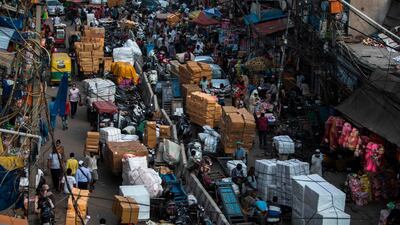
If education, healthcare and similar "soft" infrastructure are not put in place within the next decade, then countries such as India, Indonesia and Brazil may never become rich. AFP

Poor countries are running out of time to get rich


  • English
  • Arabic

The United Nations expects that by 2027, India will overtake China as the world’s most populous country. Estimates suggest India and Nigeria will together add 470 million people in the next three decades – almost a quarter of the world’s population increase to 2050.

According to a new study from the University of Washington (UW), however, several developing nations may find their so-called demographic dividend much less of a boon than anticipated.

Published in the Lancet, the UW study has improved on the UN's outlook by modelling fertility differently and making its decline more sensitive to the availability of contraception and the spread of education. In many parts of India, for instance, the total fertility rate – the expected average number of children born to each woman – is already well below the replacement rate of 2.1 and dropping faster than expected.

The study, which also tries to account for the feedback loops between education, mortality and migration, concludes that populations around the world are going to start shrinking sooner and faster than projected.

South Asia, for example, would have 600 million fewer people in 2100 than previously predicted thanks to lower-than-expected levels of fertility. Instead of growing throughout, India’s population would peak in 2050 and then decline to 70 per cent of that number by the end of the century. By that point, China’s population would be about half its current size. On the other hand, sub-Saharan Africa would continue to grow, with Nigeria entering the 22nd century as the world’s second-largest country, behind India and just ahead of China and Pakistan.

For policymakers in India and several other developing nations, this isn’t good news. As the authors of the UW study point out, a shrinking global population has “positive implications for the environment, climate change, and food production”. But it also means time is running out – indeed, may already have run out – on those nations’ development clocks.

China has been truly fortunate in its demographics; it peaked at the right time. Working-age Chinese people, both in total numbers and as a share of the population, crested just when world trade was most open. This made the possibilities for manufacturing-led growth easier to seize than they had been for centuries.

Right now, India's boosters tout the fact that its working-age population swells by a million people a month, propelling economic growth.

Those countries that come next – India and Pakistan in particular – will confront a more closed world. And, worse, they now know that it is people currently in the workforce, or children in school, who over their lifetimes will have to lift the country to prosperity. For countries whose populations will begin to decline in the 2040s, this generation of workers and the next is all there is: they must, like their Chinese counterparts in the past two decades, push their countries from farm to factory and beyond.

Right now, India’s boosters tout the fact that its working-age population swells by a million people a month, propelling economic growth. If that demographic push runs out sooner than expected, growth will depend on individual productivity, not sheer numbers. That means education and healthcare and similar “soft” infrastructure no longer look like rich-country luxuries. Unless they are put into place within the next decade, indeed within the next few years, countries such as India, Indonesia and Brazil may never become rich.

There are other dangers, some of which the Lancet article gestures at in passing. It is the spread of women's education and women's reproductive rights that are causing these declines in fertility. Unless women gain political clout to match, they might well end up being "blamed" for the loss in national power caused by a greying population. Those hard-won rights might begin to be curtailed. In places with particularly patriarchal societies, like much of South and West Asia, this is even more of a danger than elsewhere.

Even the most fortunate countries will need to be careful. By 2050, as expected, China will be the world’s largest economy. But the study authors predict that, as the Chinese population declines, immigration should in theory continue to bolster America’s workforce. The US could again become the world’s largest economy in 2098 – if the country lives up to its ideals and continues to welcome the world’s migrants. There’s no better way to ensure America becomes great again.

Mihir Sharma is the author of Restart: The Last Chance for the Indian Economy

• Bloomberg

MATCH INFO

Who: UAE v USA
What: first T20 international
When: Friday, 2pm
Where: ICC Academy in Dubai

Bharatanatyam

A ancient classical dance from the southern Indian state of Tamil Nadu. Intricate footwork and expressions are used to denote spiritual stories and ideas.

Five%20calorie-packed%20Ramadan%20drinks
%3Cp%3E%3Cstrong%3ERooh%20Afza%3C%2Fstrong%3E%0D%3Cbr%3E100ml%20contains%20414%20calories%0D%3Cbr%3E%3Cstrong%3ETang%20orange%20drink%3C%2Fstrong%3E%0D%3Cbr%3E100ml%20serving%20contains%20300%20calories%0D%3Cbr%3E%3Cstrong%3ECarob%20beverage%20mix%3C%2Fstrong%3E%0D%3Cbr%3E100ml%20serving%20contains%20about%20300%20calories%0D%3Cbr%3E%3Cstrong%3EQamar%20Al%20Din%20apricot%20drink%3C%2Fstrong%3E%0D%3Cbr%3E100ml%20saving%20contains%2061%20calories%0D%3Cbr%3E%3Cstrong%3EVimto%20fruit%20squash%3C%2Fstrong%3E%0D%3Cbr%3E100ml%20serving%20contains%2030%20calories%3C%2Fp%3E%0A
How much do leading UAE’s UK curriculum schools charge for Year 6?
  1. Nord Anglia International School (Dubai) – Dh85,032
  2. Kings School Al Barsha (Dubai) – Dh71,905
  3. Brighton College Abu Dhabi - Dh68,560
  4. Jumeirah English Speaking School (Dubai) – Dh59,728
  5. Gems Wellington International School – Dubai Branch – Dh58,488
  6. The British School Al Khubairat (Abu Dhabi) - Dh54,170
  7. Dubai English Speaking School – Dh51,269

*Annual tuition fees covering the 2024/2025 academic year

Mercer, the investment consulting arm of US services company Marsh & McLennan, expects its wealth division to at least double its assets under management (AUM) in the Middle East as wealth in the region continues to grow despite economic headwinds, a company official said.

Mercer Wealth, which globally has $160 billion in AUM, plans to boost its AUM in the region to $2-$3bn in the next 2-3 years from the present $1bn, said Yasir AbuShaban, a Dubai-based principal with Mercer Wealth.

Within the next two to three years, we are looking at reaching $2 to $3 billion as a conservative estimate and we do see an opportunity to do so,” said Mr AbuShaban.

Mercer does not directly make investments, but allocates clients’ money they have discretion to, to professional asset managers. They also provide advice to clients.

“We have buying power. We can negotiate on their (client’s) behalf with asset managers to provide them lower fees than they otherwise would have to get on their own,” he added.

Mercer Wealth’s clients include sovereign wealth funds, family offices, and insurance companies among others.

From its office in Dubai, Mercer also looks after Africa, India and Turkey, where they also see opportunity for growth.

Wealth creation in Middle East and Africa (MEA) grew 8.5 per cent to $8.1 trillion last year from $7.5tn in 2015, higher than last year’s global average of 6 per cent and the second-highest growth in a region after Asia-Pacific which grew 9.9 per cent, according to consultancy Boston Consulting Group (BCG). In the region, where wealth grew just 1.9 per cent in 2015 compared with 2014, a pickup in oil prices has helped in wealth generation.

BCG is forecasting MEA wealth will rise to $12tn by 2021, growing at an annual average of 8 per cent.

Drivers of wealth generation in the region will be split evenly between new wealth creation and growth of performance of existing assets, according to BCG.

Another general trend in the region is clients’ looking for a comprehensive approach to investing, according to Mr AbuShaban.

“Institutional investors or some of the families are seeing a slowdown in the available capital they have to invest and in that sense they are looking at optimizing the way they manage their portfolios and making sure they are not investing haphazardly and different parts of their investment are working together,” said Mr AbuShaban.

Some clients also have a higher appetite for risk, given the low interest-rate environment that does not provide enough yield for some institutional investors. These clients are keen to invest in illiquid assets, such as private equity and infrastructure.

“What we have seen is a desire for higher returns in what has been a low-return environment specifically in various fixed income or bonds,” he said.

“In this environment, we have seen a de facto increase in the risk that clients are taking in things like illiquid investments, private equity investments, infrastructure and private debt, those kind of investments were higher illiquidity results in incrementally higher returns.”

The Abu Dhabi Investment Authority, one of the largest sovereign wealth funds, said in its 2016 report that has gradually increased its exposure in direct private equity and private credit transactions, mainly in Asian markets and especially in China and India. The authority’s private equity department focused on structured equities owing to “their defensive characteristics.”

The%20specs
%3Cp%3E%3Cstrong%3EEngine%3A%3C%2Fstrong%3E%204.0-litre%20twin-turbo%20V8%3Cbr%3E%3Cstrong%3EPower%3A%20%3C%2Fstrong%3E680hp%20at%206%2C000rpm%3Cbr%3E%3Cstrong%3ETorque%3A%20%3C%2Fstrong%3E800Nm%20at%202%2C750-6%2C000rpm%3Cbr%3E%3Cstrong%3ETransmission%3A%20%3C%2Fstrong%3ERear-mounted%20eight-speed%20auto%3Cbr%3E%3Cstrong%3EFuel%20consumption%3A%20%3C%2Fstrong%3E13.6L%2F100km%3Cbr%3E%3Cstrong%3EOn%20sale%3A%3C%2Fstrong%3E%20Orderbook%20open%3B%20deliveries%20start%20end%20of%20year%3Cbr%3E%3Cstrong%3EPrice%3A%20%3C%2Fstrong%3EFrom%20Dh970%2C000%3C%2Fp%3E%0A
Dengue%20fever%20symptoms
%3Cp%3EHigh%20fever%20(40%C2%B0C%2F104%C2%B0F)%3Cbr%3ESevere%20headache%3Cbr%3EPain%20behind%20the%20eyes%3Cbr%3EMuscle%20and%20joint%20pains%3Cbr%3ENausea%3Cbr%3EVomiting%3Cbr%3ESwollen%20glands%3Cbr%3ERash%26nbsp%3B%3C%2Fp%3E%0A
